Loading the model
This device cannot show the 3D model. You can read the guide steps below as text.
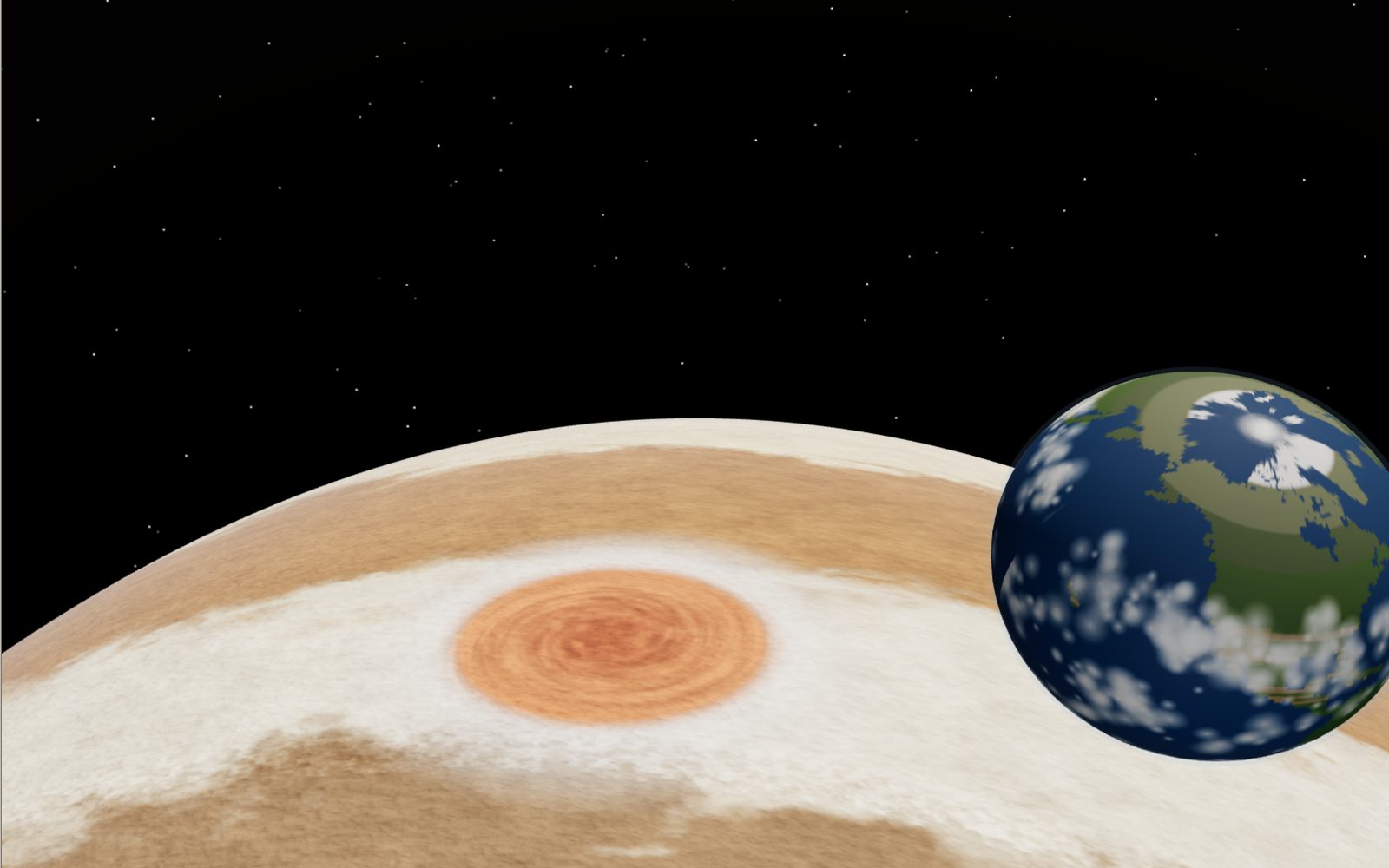
1 / 16 Earth beside the Great Red Spot You are 30,000 km above Jupiter. The red oval is the Great Red Spot, and the blue ball beside it is Earth at the same scale. In Hubble images from 2023 and 2024 the storm is about 13,600 km long, a little more than one Earth.
Drag to turn. Scroll or pinch to zoom.
Guide Parts Controls
01 Earth beside the Great Red Spot You are 30,000 km above Jupiter. The red oval is the Great Red Spot, and the blue ball beside it is Earth at the same scale. In Hubble images from 2023 and 2024 the storm is about 13,600 km long, a little more than one Earth.
02 At the edge of the storm Now you float 180 km above the northern edge of the Great Red Spot. The person on the platform is 1.7 m tall; the scale bar at the bottom shows how many people would fit along the clouds in view. Winds in the storm's outer ring exceed 640 km/h.
03 The spot in the late 1800s The year slider is at the late 1800s, when the storm was estimated at about 41,000 km: more than three Earths side by side. Drag it forward to watch the storm shrink.
04 The spot today Back to 2024. Voyager measured 23,300 km in 1979 and Hubble 16,500 km in 2014. Nobody knows yet why it is shrinking, or how small it will get.
05 Over the jet at 24° N You are 60 km above the fastest wind on the cloud tops. The clouds under you move east at 144 to 160 m/s. Turn on Ride the wind to drift with them.
06 Belts and zones From 9,000 km up the bands are clear: light zones and dark belts, with jets running east and west between them. The wind lines show which way each band moves and how fast.
07 A stormy belt at dusk Dusk at 47° N. The tall towers are model storms, and their flashes light the clouds from inside. Juno found most of Jupiter's lightning at high latitudes like this, not near the equator.
08 Shallow lightning Night, down among the storm tops. Small flashes here come from droplets of water and ammonia in air colder than −88 °C, a kind of cloud Earth does not have.
09 Into the clouds This is the spot where the Galileo probe entered on 7 December 1995, at 6.5° N. Below you is the ammonia ice cloud. Press Down to sink through it.
10 The middle cloud layer 14 km below the 1-bar level, among the ammonium hydrosulfide clouds. The pressure and temperature on the readout are the probe's own measurements.
11 Water clouds 60 km down: about 6 bar and above freezing. In the standard model, this is where the water clouds and the thunderstorms are. The probe found almost no water here, because it had fallen into a dry hot spot.
12 Where the probe went silent 132 km below the 1-bar level, 22 bar and 155 °C. The Galileo probe stopped sending data here, 58 minutes after its parachute opened. There is no ground below, only hotter and denser gas.
13 Cyclones at the north pole In infrared, as Juno's JIRAM camera sees it: one cyclone at the pole and eight around it, each 4,000 to 4,600 km across. Before Juno nobody knew the poles looked like this.
14 Aurora Night over the north. The aurora shines mostly in ultraviolet and infrared, so the stage shows it in false colour. Look for Io's footprint, a bright spot outside the main oval.
15 Moons in the evening sky Sunset at the equator. Io is 0.60° wide from here, a little more than our Moon from Earth. Europa and Ganymede are each about 0.30°, and the faint ring runs through the zenith.
16 Io's shadow At noon from 60,000 km up: Io is passing in front of the Sun and its shadow falls on the clouds as a black spot. Anyone inside it would see a total eclipse.
Great Red Spot The largest storm on the planet, 22° south of the equator: an anticyclone turning counterclockwise, about 13,600 km long in 2023 and 2024. Earth for scale Earth, 12,742 km across, floating beside the Great Red Spot at the same scale. Turn it off with Earth for scale. The spot in the 1800s The year slider redraws the storm at the size measured that year: about 41,000 km in the late 1800s, 23,300 km in 1979, 16,500 km in 2014. Oval BA Three white ovals that merged between 1998 and 2000 and turned red by 2006: "Red Spot Jr.", about half as wide as the Great Red Spot. String of Pearls White storms in a row at 40° S. Juno photographed eight of them in 2017. Clyde's Spot A plume first seen by amateur astronomer Clyde Foster on 31 May 2020 and photographed by Juno two days later. Comet scars, 1994 Set the year to 1994 to see the dark marks left by comet Shoemaker-Levy 9 in the southern hemisphere. Jet at 24° N The fastest wind at the cloud tops, 144 to 160 m/s in Hubble measurements from 2008 to 2016. Belts and zones Light zones and dark belts circle the planet, separated by jets blowing east and west. Wind lines show the direction and speed. White Spot Z A long-lived white storm just north of the North Equatorial Belt. Plume outbreak Bright plumes that burst out beside the 24° N jet every few years and slow it down. Juno NASA's spacecraft in orbit since July 2016, passing about 4,200 km above the clouds at its closest. Here it crosses the jet area every two minutes. Lightning storm Model storm towers at 47° N. Juno found most of Jupiter's lightning at high latitudes, not near the equator. Shallow lightning Small flashes high in the clouds, colder than −88 °C, in droplets of water and ammonia. Sprite A brief flash about 260 km above the 1-bar level, set off by lightning far below. Mushballs Hailstones of water and ammonia slush with an icy shell, thought to carry ammonia deep down. Ammonia ice cloud The top cloud layer, near 0.5 to 0.7 bar in the standard cloud model. Its white tops are what we see from Earth. Ammonium hydrosulfide cloud The middle layer, near 1.5 to 2.2 bar in the model, tan and brown. Water cloud The deepest cloud in the model, near 5 to 7 bar, where thunderstorms start. Galileo probe The 1995 descent module under its parachute. It sent 58 minutes of data, down to 22 bar and 155 °C. Hot spot A clear, dry patch that glows at 5 microns. The Galileo probe fell into one. North polar cyclones One cyclone at the north pole, eight around it, each 4,000 to 4,600 km across (Juno). South polar cyclones A central cyclone with five around it, 5,600 to 7,000 km each. A sixth joined in late 2019. Aurora Curtains of light around the magnetic poles, mostly in ultraviolet. Shown in false colour. Io's footprint A bright spot in the aurora where the current linking Io and Jupiter reaches the atmosphere. Io 0.60° wide from the cloud tops, a little bigger than our Moon from Earth. Europa 0.30° wide from here, 671,100 km from Jupiter's centre. Ganymede The largest moon, 5,262 km across, but only 0.30° from here because it is far away. Callisto The outermost big moon, 0.15° wide from here. Amalthea A small reddish moon about 250 km long, close to the planet. Ring The faint main ring, 123,000 to 128,940 km from the centre. Seen from the equator it crosses overhead. Earth in the sky A dot never more than 11° from the Sun, visible only in twilight. Io's shadow A black spot on the clouds when Io passes in front of the Sun. Under it the Sun is in total eclipse. Person for scale A plain figure 1.7 m tall on an imaginary platform under a small balloon, there only to show your own size.