Loading the model
This device cannot show the 3D model. You can read the guide steps below as text.
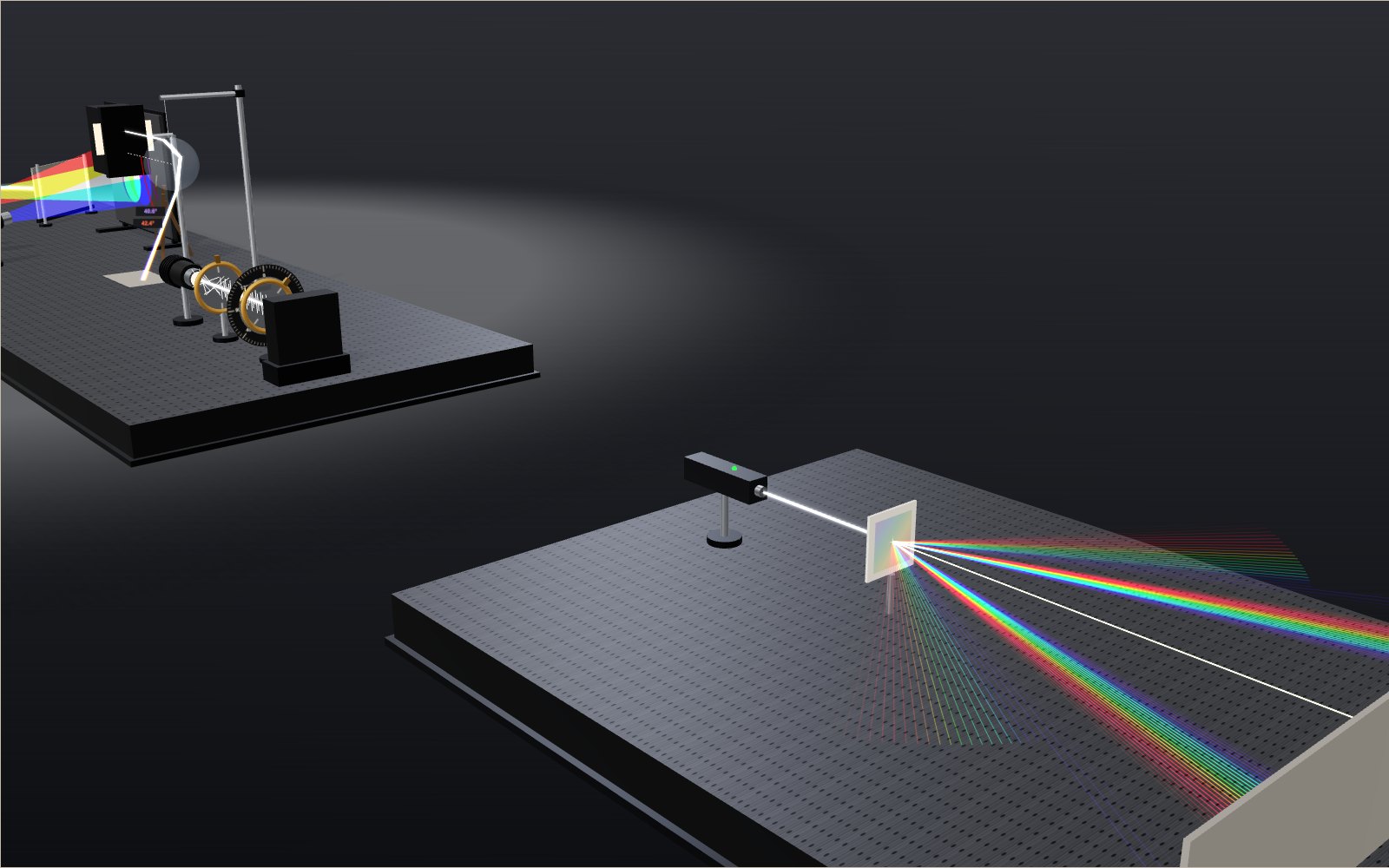
1 / 18 14 experiments on two tables The optical bench holds a prism, three coloured lamps beside an ink card, a hanging water drop and a pair of polarising filters. Ten more stations wait on the second table to the right. The bar under the picture jumps to each one.
Drag to turn. Scroll or pinch to zoom.
Guide Parts Controls
01 14 experiments on two tables The optical bench holds a prism, three coloured lamps beside an ink card, a hanging water drop and a pair of polarising filters. Ten more stations wait on the second table to the right. The bar under the picture jumps to each one.
02 White light comes apart in glass Glass slows violet light a little more than red, so violet bends more at each face. At this angle the prism bends 400 nm light by 39.9° and 700 nm light by 38.3°. On the screen the colours spread over about 18 mm.
03 Turning the prism Drag the prism angle in Controls. The total bend is smallest near 49.4°, which is where the spectrum moves least. Near 31° the fan widens to about 5°, and below 30° the violet end can no longer leave the second face.
04 Three lamps make white Red and green overlap as yellow, green and blue as cyan, red and blue as magenta. Where all three meet the board looks white. Switch a lamp off and its colour drops out of every overlap.
05 Inks work the other way An ink does not add light. It absorbs part of what falls on it, so two inks remove more than one. Cyan and yellow leave green, and all three together leave very little, close to black.
06 A single ray inside a raindrop The ray bends on the way in, reflects off the back of the drop and bends again on the way out. Red and violet take slightly different paths. Try other ray heights; the angle back toward the sun changes with each one.
07 Why the bow sits at 42° Send many rays at once. The exit angle climbs, stops near 42.4° for red and 40.6° for violet, then falls back. Rays pile up at that turning point, and that bright edge is the rainbow.
08 Two filters and Malus's law The first filter passes about half the lamp's light. The second passes cos² of the angle between them: 50% at 45°, none at 90°. Turn on the third filter to see crossed filters let light through again.
09 Filters take light away Each filter passes about two thirds of the spectrum: cyan stops red, magenta stops green and yellow stops blue. Where all three overlap, almost nothing gets through.
10 A grating sends each colour to its own angle The lines are 1.67 µm apart. Green light at 532 nm leaves the first order at 18.6° and the second at 39.7°. Longer wavelengths bend further.
11 Soap film colour comes from its thickness Light reflected from the back of the film travels 2nd further, 1197 nm here at the centre. The colours that come back strongly depend on how that path compares with each wavelength.
12 Small particles scatter blue In the tank, 450 nm light is scattered 5.9 times as strongly as 700 nm light. The side of the tank glows blue, and the light that reaches the far end turns yellow and orange.
13 Ultraviolet makes some things glow The lamp gives 365 nm ultraviolet. Each sample takes it in and gives out visible light of a longer wavelength, from about 425 nm in fluorite to 615 nm in calcite.
14 Hotter lamps look bluer At 2700 K a filament gives most of its light at 1.07 µm in the infrared and looks orange-white. Near 6500 K the light is close to daylight.
15 Every gas has its own lines Sodium puts nearly all its visible light into two lines at 589.0 and 589.6 nm. Hydrogen, helium, neon and mercury each give a different pattern, and sunlight shows dark lines instead.
16 Three kinds of cone At 580 nm the L cones answer fully, the M cones at 76% and the S cones hardly at all. The brain reads that mix as yellow.
17 Seeing with two cone types In deutan vision the M cones are missing. The orange and olive dots of the plate then look alike, so the 5 is hard to find.
18 Colour from layers Six pairs of chitin and air layers reflect 99% of 458 nm light head on. Turn the viewing angle and the peak moves to shorter wavelengths.
Optical table Steel top with threaded holes every 25 mm. The stands are bolted down so the beams stay where they are aimed. White light lamp Sends a narrow beam through a slit. The beam carries every visible wavelength at once. Glass prism A 60° prism of BK7 glass. Its index falls from 1.5308 at 400 nm to 1.5131 at 700 nm. Turntable Graduated disc under the prism. Turning it changes the angle at which the beam meets the first face. Screen Matte board 66 cm from the prism. Each wavelength lands on it as a separate vertical line. Red, green and blue lamps Three lamps aimed at one dark board. Where their circles overlap, the light adds up. Mixing board A dark board shows only the light that falls on it. Red and green together look yellow here. Ink card Cyan, magenta and yellow inks on paper. Each ink removes part of the light, so the overlaps get darker. Water drop A model raindrop. Light goes in, reflects once off the back and comes out turned by about 138°. First polarising filter Passes light vibrating along its marked axis. About half of the lamp's light gets through. Second polarising filter Turns on a graduated dial. The light it passes follows cos² of the angle between the two axes. Light meter screen Shows how much light is left after the filters. The exact figure is in the readout. Filter light box A white light box with cyan, magenta and yellow filter sheets in front. Where filters overlap, each takes away its own part of the spectrum. Laser A beam of one wavelength between 380 and 780 nm, or white light when White light is on. Diffraction grating A slide ruled with fine parallel lines, 100 to 1500 per mm. Each order leaves at the angle where d sin θ = mλ. Soap film A film of soapy water (n = 1.33) in a wire loop. Water drains down, so the film is thinner at the top than at the bottom. Tank of milky water A 56 cm glass tank with a little milk in the water. The tiny particles scatter blue light out of the beam. UV lamp A black-light tube that gives ultraviolet at 365 nm, which the eye barely sees. Glowing samples From left: highlighter, tonic water, fluorite, willemite, calcite, white paper and a glow-in-the-dark star. Black-body lamp A lamp whose filament can be set from 1000 to 10 000 K. The card beside it shows six painted patches in its light. Discharge tube A glass tube of low-pressure gas lit by a high voltage. Each gas gives its own set of lines. Spectroscope Spreads the tube's light into a spectrum. The panel beside it shows what you would see in the eyepiece. Cone response board The L, M and S cone curves with a line at the chosen wavelength, and three bars for how strongly each type answers. Colour vision board A dot plate with a hidden 5, two patches A and B and a row of hues, all redrawn as the chosen vision sees them. Morpho wing A model Morpho butterfly. Its blue comes from stacks of chitin and air layers, so the colour changes with the viewing angle.