Loading the model
This device cannot show the 3D model. You can read the guide steps below as text.
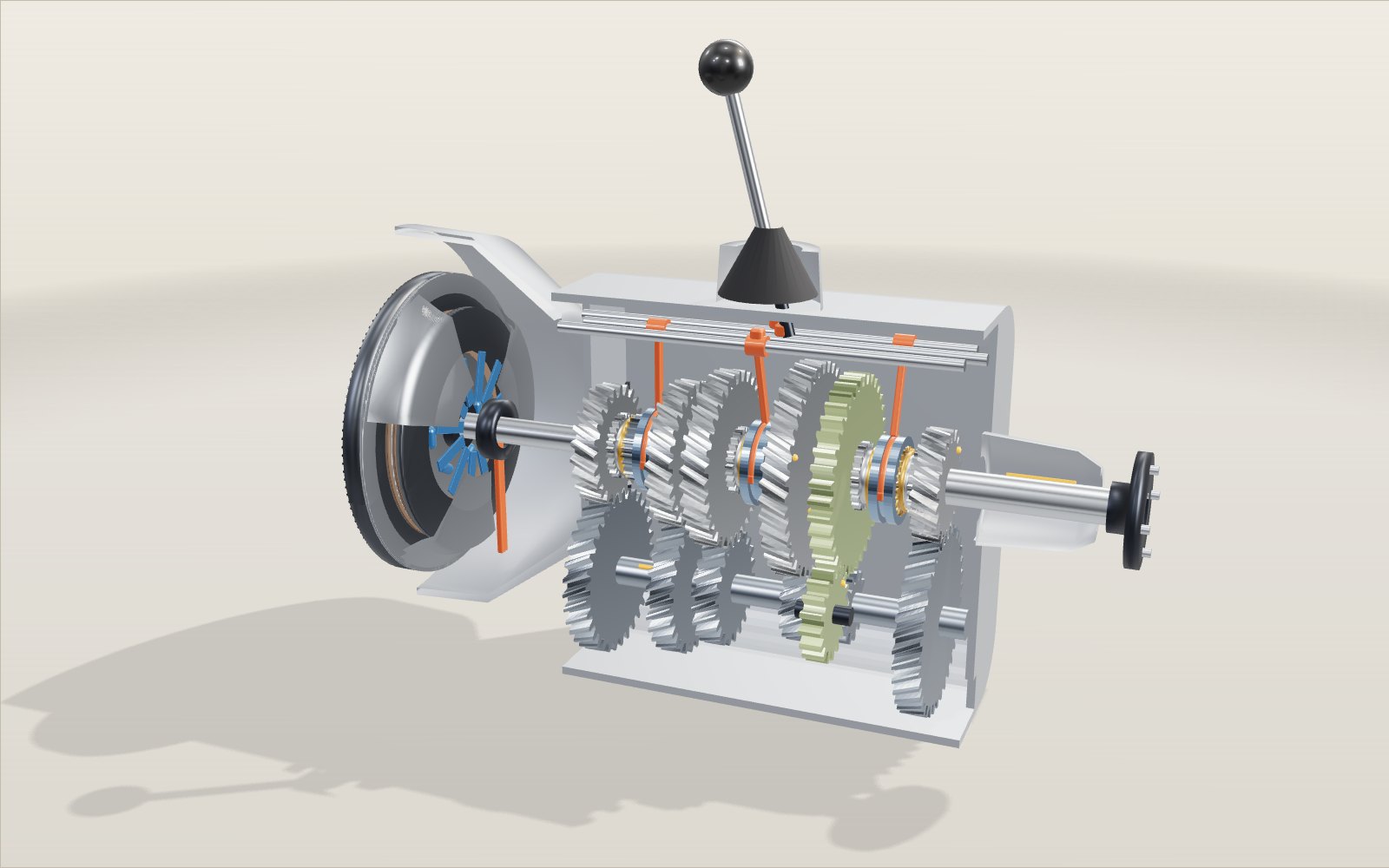
1 / 10 A five-speed gearbox, cut open The clutch is on the left, where the engine would be, and the output shaft leaves on the right. Three shafts carry eleven gears. Drag to look around, or use the gear lever in the corner.
Drag to turn. Scroll or pinch to zoom.
Guide Parts Controls
01 A five-speed gearbox, cut open The clutch is on the left, where the engine would be, and the output shaft leaves on the right. Three shafts carry eleven gears. Drag to look around, or use the gear lever in the corner.
02 The clutch With the pedal down the pressure plate backs off and the disc is free. The engine drops to 900 rpm, while the disc and the input shaft keep turning with the car. Watch the orange marks drift apart.
03 Three shafts The input shaft turns the layshaft below it through a 23 and 33 tooth pair, so the layshaft runs at 2,091 rpm when the engine runs at 3,000. The output shaft sits in line with the input shaft.
04 Every pair is always in mesh The layshaft gears turn all the gears on the output shaft all the time, each at its own speed. The teeth are cut at an angle (helical), which makes them quieter but pushes the shafts sideways.
05 A sleeve picks the gear The gears on the output shaft spin freely. A sleeve slides over the dog teeth on one of them and locks it to the shaft. Here the 1-2 sleeve has moved to 2nd.
06 The synchro matches the speeds Shifting from 2nd to 3rd, the input side must slow from about 3,000 to 1,941 rpm. The sleeve presses the brass ring onto the gear's cone, and friction does it. Only then does the ring let the sleeve through.
07 Reverse The car is stopped first. An idler between the layshaft and the reverse gear flips the direction, so the output shaft turns backwards. These gears have straight teeth and no ring of their own here; the 5-R synchro does the job.
08 Shifting without the clutch The engine is still connected, so the input side stays at 3,000 rpm while the output shaft turns at 2,091. The small ring cannot slow a running engine. The dog teeth clash and the sleeve is pushed back out.
09 Up close: ring and dog teeth This is the 3-4 synchro from close by, changing down from 4th to 3rd. Under Controls the Synchro panel unrolls the same teeth: the ring blocks the sleeve until the speeds match, then turns aside.
10 Taken apart, and what next The parts are pulled apart. Under Controls you can chart speed and rpm for 31 real gearboxes, try rev matching and double clutching, and pull away without stalling.
Clutch Flywheel, clutch disc and pressure plate. The diaphragm spring squeezes the disc between the other two; pressing the pedal pulls the pressure plate back so the gearbox is cut off from the engine. Input shaft Turns with the clutch disc. Its 23-tooth gear drives the layshaft, and in 4th the sleeve locks this gear straight to the output shaft. Layshaft One piece of steel with six gears cut on it (33, 28, 22, 15, 13 and 36 teeth). At 3,000 rpm on the input it turns at 2,091 rpm the other way. Output shaft Runs in line with the input shaft and goes back to the propeller shaft. The three synchro hubs are splined to it, so they always turn at its speed. Forward gear pairs Helical gears for 1st, 2nd, 3rd and 5th, always in mesh. The gears on the output shaft spin freely on bearings until a sleeve locks one of them. Reverse idler A 17-tooth idler between the layshaft's 13-tooth gear and the 38-tooth reverse gear. The extra gear makes the output turn backwards. Reverse is cut straight, so it whines. Synchro rings Brass rings with a tapered inside. The sleeve pushes one onto the cone of the gear, and friction brings the gear to the shaft's speed before the teeth can meet. Sleeves and dog teeth Three sliding sleeves with teeth inside. A sleeve slides over the dog teeth on the side of a gear and locks that gear to the output shaft. Shift forks and rails Each fork sits in the groove of one sleeve and is fixed to a rail. The lever picks a rail and slides it forward or back. Gear lever Pivots on a ball. Moving it across picks one of three rails; moving it forward or back slides that rail's sleeve. Gearbox case Cast aluminium, with the bell housing round the clutch at the front. Half has been cut away here. A real case is part filled with gear oil.