FIG. 50How It Works
How a manual gearbox works
At 3,000 rpm the same engine moves the car at 23 km/h in first and 115 km/h in fifth, and a brass ring the size of a biscuit decides when the next gear can go in.
This device cannot show the 3D model. You can read the guide steps below as text.
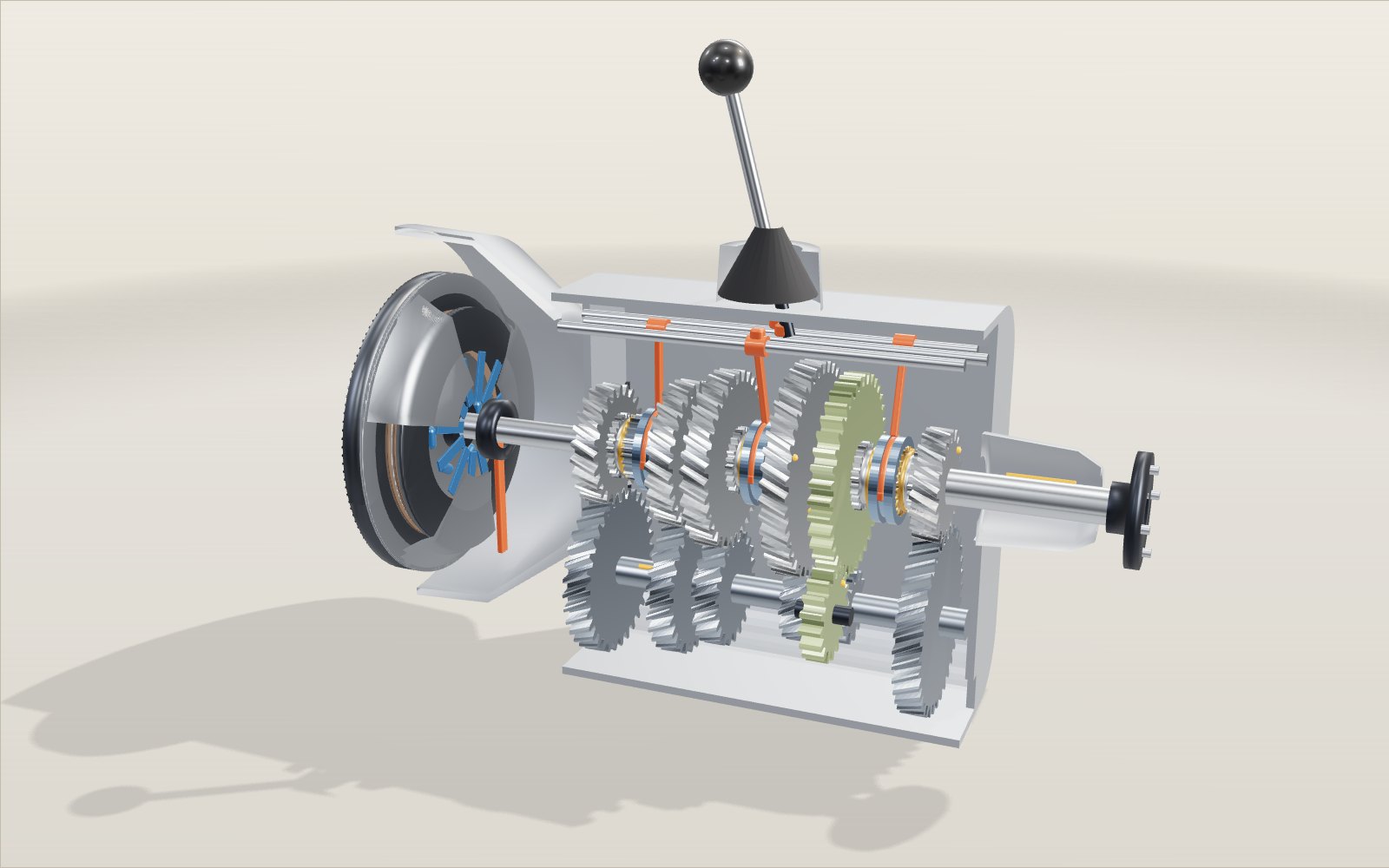
1 / 10 A five-speed gearbox, cut openThe clutch is on the left, where the engine would be, and the output shaft leaves on the right. Three shafts carry eleven gears. Drag to look around, or use the gear lever in the corner.
Drag to turn. Scroll or pinch to zoom.
What the model shows
Drive a car with a manual gearbox through town and you may change gear a few hundred times in an hour. The engine never changes its mind about how fast it likes to turn, yet the car can creep through a car park or cruise on a motorway. The box between the clutch and the propeller shaft is what makes that possible, and this exhibit cuts it open.
The model is a five-speed gearbox for a car with the engine at the front and drive to the rear wheels. Half of the case has been cut away. The clutch is on the left, where the engine would bolt on, and the output shaft leaves on the right. Use the gear lever in the corner of the 3D view to change gear. The sequence is played slowly so you can see the clutch open, the sleeve slide, the brass synchro ring do its work and the teeth lock. The panel shows the speed of every shaft and the road speed that goes with it. "Shift without the clutch" lets you try the one thing every driving instructor tells you not to do.
Why an engine needs more than one ratio
A petrol engine makes useful power over a band of perhaps 1,500 to 6,000 rpm. Below that it stalls or labours, above that it runs out of breath. A car, on the other hand, has to go from walking pace to well over 100 km/h. If the engine were connected to the wheels through one fixed ratio, you could choose a ratio that starts the car briskly or one that cruises quietly, but not both.
So the gearbox offers a choice of ratios. In first, the engine turns many times for each turn of the wheels, which multiplies the torque and lets the car pull away up a hill. In fifth, the engine turns fewer times than the propeller shaft, and the car covers ground at a relaxed engine speed. The driver picks the ratio that keeps the engine in its comfortable band for the speed of the moment.
How the power travels through three shafts
Follow the drive from the engine to the propeller shaft.
- Clutch. The flywheel is bolted to the engine's crankshaft. The clutch disc is squeezed between the flywheel and the pressure plate by a diaphragm spring, and the disc is splined to the input shaft.
- Input shaft. It carries one gear with 23 teeth, which is always in mesh with a 33-tooth gear on the layshaft.
- Layshaft. A single steel shaft with six gears cut on it. It turns the opposite way to the input shaft, at 23 ÷ 33 of its speed.
- Gears on the output shaft. Each layshaft gear is in mesh with a partner on the output shaft. These partners are not fixed to the output shaft. They spin on needle bearings, each at its own speed.
- Sleeves. Three sliding sleeves sit on hubs that are splined to the output shaft. When a sleeve slides sideways over the dog teeth on the side of a gear, that gear is locked to the shaft and the drive goes through it.
- Output shaft. It lines up with the input shaft and carries the drive back to the propeller shaft and the rear axle.
Fourth gear is a special case. The 3-4 sleeve can lock the input gear itself to the output shaft, so the two shafts turn together and the layshaft is bypassed. That is called direct drive, and the ratio is exactly 1.
Ratios and road speed at 3,000 rpm
The numbers in the model are model values chosen to look like a typical five-speed box, not copied from one car. Every forward pair has 56 teeth in total, so all of them fit the same distance between the shafts. The ratio for each gear is the constant-mesh ratio times the ratio of its own pair:
ratio = (33 ÷ 23) × (output-shaft gear ÷ layshaft gear)
| Gear | Pair (layshaft : output) | Gearbox ratio | With 3.909 final drive | Wheel rpm at 3,000 | Road speed |
|---|---|---|---|---|---|
| 1st | 15 : 41 | 3.922 | 15.330 | 195.7 | 23.3 km/h |
| 2nd | 22 : 34 | 2.217 | 8.668 | 346.1 | 41.2 km/h |
| 3rd | 28 : 28 | 1.435 | 5.609 | 534.9 | 63.7 km/h |
| 4th | direct | 1.000 | 3.909 | 767.4 | 91.4 km/h |
| 5th | 36 : 20 | 0.797 | 3.116 | 962.8 | 114.7 km/h |
| Reverse | 13 : 17 : 38 | 4.194 | 16.395 | 183.0 | 21.8 km/h backwards |
To turn engine speed into road speed you need two more numbers. The final drive in the rear axle is 43 : 11, which is 3.909. The tyres are 205/55 R16, which means a 16-inch rim (406.4 mm) plus two sidewalls each 55% of 205 mm tall. That makes the tyre 631.9 mm across and 1.985 m round. In third gear:
wheel speed = 3,000 ÷ (1.435 × 3.909) = 534.9 rpm
road speed = 534.9 × 1.985 m × 60 ÷ 1,000 = 63.7 km/h
The other rows follow the same steps. From one gear to the next the ratio drops by a factor of 1.77, 1.55, 1.44 and 1.26. The steps get smaller toward the top, which is usual: at high speed, air drag climbs steeply, and a small gap between fourth and fifth keeps the engine near its best speed when you change up. The spread from first to fifth is 4.92.
What the ratios do to torque and force at the wheels
The model does not simulate engine torque, so this example borrows a number. Say the engine delivers 150 N·m at 3,000 rpm. That is an assumed value for a small petrol engine, not a measurement. At that speed it produces 150 × 2π × 3,000 ÷ 60 = 47.1 kW, and a gearbox cannot add to that. What it does is trade speed for force. Torque at the wheels is engine torque times the overall ratio, and the push at the road is that torque divided by the tyre's rolling radius, 0.316 m for the 205/55 R16 tyre in the model.
| Gear | Overall ratio | Wheel torque | Push at the road | Same, after a 4% loss | Road speed |
|---|---|---|---|---|---|
| 1st | 15.330 | 2,300 N·m | 7,278 N | 6,987 N | 23.3 km/h |
| 2nd | 8.668 | 1,300 N·m | 4,115 N | 3,951 N | 41.2 km/h |
| 3rd | 5.609 | 841 N·m | 2,663 N | 2,556 N | 63.7 km/h |
| 4th | 3.909 | 586 N·m | 1,856 N | 1,782 N | 91.4 km/h |
| 5th | 3.116 | 467 N·m | 1,479 N | 1,420 N | 114.7 km/h |
Two checks show the table is consistent. In first, 7,278 N at 23.3 km/h (6.47 m/s) is 47.1 kW, the engine's power. In fifth, 1,479 N at 31.9 m/s is also 47.1 kW. The force falls to a fifth while the speed rises by the same factor. The 4% column uses the figure from the National Academies' review of fuel economy technology, which puts the loss in a manual transmission at about 4% of the engine's gross output, against about 13% for a conventional automatic. For a 1,200 kg car, 7,278 N would mean 6.1 m/s² of acceleration in first if the tyres could hold it, which they usually cannot. Grip, not the gearbox, sets the limit at launch.
The ratios also decide how far the engine speed drops when you change up. At 3,000 rpm the engine would fall to 1,696 rpm after 1st to 2nd, to 1,941 rpm after 2nd to 3rd, to 2,091 rpm after 3rd to 4th and to 2,391 rpm after 4th to 5th. These are the same numbers the synchro ring has to reach, only in the other direction. The first gap is large because first is a short gear for pulling away, and the last is small because fifth is tall. One more figure is useful for planning a drive: in fifth the model car covers 38.2 km/h for every 1,000 rpm, in fourth 30.5 km/h and in first 7.8 km/h.
Why the gears never come out of mesh
In the model every gear is turning all the time, even the ones that are not carrying the drive. In third, for instance, the free fifth gear on the output shaft turns at 3,764 rpm while the shaft under it turns at 2,091 rpm. That looks wasteful, but it solves an old problem. In early "crash" gearboxes, the gears themselves slid sideways to come into mesh, and their teeth had to meet edge on. In a constant-mesh box the teeth of each pair stay engaged for life, and only the small dog teeth on the side of a gear have to find their way in.
Because the gears never have to slide into mesh, they can have helical teeth, cut at an angle to the shaft. In the model the angle is 25°. A helical tooth comes into contact gradually across its width instead of all at once, so the gearbox is much quieter than one with straight teeth. The price is a sideways push: for a 25° helix, the force along the shaft is tan 25° = 0.47 times the force that turns the gear. Gearboxes carry it on tapered roller or ball bearings. The teeth on the layshaft are cut with the opposite hand to their partners, as they must be for two parallel helical gears to mesh.
What the synchro ring does during a shift
Here is the difficulty. When you change from second to third at 41 km/h, the output shaft keeps turning at 1,353 rpm because the car is still rolling. With the clutch pressed, the input shaft, the clutch disc, the layshaft and all the free gears form one loose cluster, still spinning at about 3,000 rpm from the moment before. The third gear on the output shaft is part of that cluster. To lock it to the shaft without a crunch, the input side has to slow to 3,000 × 1.435 ÷ 2.217 = 1,941 rpm.
The synchro ring does that job. It is a brass ring with a tapered inside, sitting between the hub and the gear. The gear has a matching steel cone. When the lever starts to move, the sleeve pushes the ring onto the cone, and friction between the two drags the gear, and with it the whole loose cluster, toward the speed of the shaft. In the model the speed gap bar falls from a few hundred rpm to zero.
While there is still a speed difference, the friction turns the ring a little against its keys in the hub. In that position the blocker teeth around the ring sit in front of the sleeve's teeth and stop it from going any further. This is why a hurried shift feels notchy: you are pushing against a ring that has not finished. Once the speeds match, the friction lets go, the ring turns back by half a tooth, and the chamfers on the teeth guide the sleeve through. A moment later it slides over the dog teeth on the gear and the gear is locked to the shaft. In a real car the whole sequence takes a fraction of a second.
The numbers behind a synchro shift
Designers do not treat a shift as one event. A paper by S. Razzacki of DaimlerChrysler, presented at the SAE World Congress in 2004, breaks a synchronizer shift into six events. The first is the strut, a small spring-loaded key, touching the blocker ring. The third is the point of a sleeve tooth hitting the point of a ring tooth, which turns ("clocks") the ring by the small backlash it has in the hub. Later events cover the sleeve's chamfer passing through the ring's chamfer and the sleeve tooth reaching the gear's own clutching teeth. The paper sizes each part so these events happen in order, and it plots a clash zone against a hard-shift zone. If the cone does too little, the driver hears a clash. If the ring blocks too firmly, the lever feels stuck.
Two torques decide where a design lands. The synchronization torque is what the cone produces by friction. The index torque is the torque that turns the ring into its blocking position, and it depends on the angle of the ring's teeth (the "pointing angle"). A 2007 SAE paper by Razzacki and J. Hottenstein on synchronizers for dual clutch transmissions states the rule plainly: synchronization torque has to stay greater than index torque at every point of the shift to avoid clash or grating noise, while the index torque must exceed the total drag of the transmission so the ring still blocks in a cold gearbox with thick oil. A steeper pointing angle lowers the index torque, so a designer who steepens it to save effort may need more cone friction to keep the first condition true.
The model leaves out the struts, but you can still estimate what the cone has to do. Take the 2nd to 3rd shift. The input side must slow from 3,000 to 1,941 rpm, which is 110.9 rad/s. Suppose, as an illustration, that the clutch disc, input shaft, layshaft and free gears together have a moment of inertia of 0.05 kg·m². The energy to remove is ½ × 0.05 × (314.2² − 203.3²) = 1.43 kJ. If the shift takes 0.1 s, the cone must supply an average torque of 0.05 × 110.9 ÷ 0.1 = 55 N·m on that cluster and dissipate 14 kW as heat for a tenth of a second. A brass ring cannot do that for long, which is why low gears, where the speed gaps are largest, get multi-cone synchronizers in many production boxes.
Why a shift without the clutch grinds
Now switch on "Shift without the clutch" and try to go from third to fourth. With the clutch engaged, the input shaft is still bolted, in effect, to a running engine. The engine turns at 3,000 rpm, so the input gear, which is the gear for fourth, also turns at 3,000 rpm. The output shaft turns at 2,091 rpm. The synchro ring would have to slow the entire engine and flywheel by 909 rpm, with the engine pushing back, through a cone a few centimetres across. It cannot.
So the ring stays in its blocking position, and if the driver pushes hard enough the sleeve's teeth reach the dog teeth while they are still sliding past each other. At a radius of 30 mm, a speed gap of 909 rpm means the faces pass at 2.9 m/s, and 424 dog teeth go by every second. Each one hits the sleeve's chamfers and bounces it back. That clatter is the grinding noise, and every round of it rounds off the edges that are meant to guide the sleeve in.
The same arithmetic explains why drivers of old crash gearboxes used double-clutching. Clutch in, lever to neutral, clutch out, blip or wait to bring the input side to the right speed with the engine's help, clutch in again, and only then select the gear. The driver did by ear what the synchro ring now does by friction.
Reverse and the idler gear
Two gears in mesh turn in opposite directions. The layshaft already turns the opposite way to the input shaft, and each forward pair reverses it again, so the output shaft goes the same way as the engine. To make the car go backwards, one more gear is put in the path. In the model the 13-tooth gear on the layshaft drives a 17-tooth idler, which drives a 38-tooth reverse gear on the output shaft. The idler does not change the ratio, only the direction.
The reverse gears in the model have straight teeth. That is the usual practice, and it is why a car in reverse makes a whine you never hear in the forward gears. Many gearboxes engage reverse by sliding the idler into mesh, which only works with the gears standing still; that is why you should stop the car first. In the model the 5-R sleeve and its synchro bring the input side to rest before reverse goes in.
Reading the saw-tooth chart
In any one gear the engine speed is tied to the road speed by a straight line: engine rpm equals road speed divided by the tyre circumference, times the gear ratio, times the final drive. The Speed and rpm chart under Controls draws one line per gear. Pick a shift rpm and the path climbs one line until that rpm, then drops straight down to the next line at the same road speed. The drops make the saw teeth.
The size of each drop is easy to work out. After an upshift the engine runs at the shift rpm times the ratio of the new gear to the old one, so the drop is the shift rpm times one minus that ratio. In the Honda Civic Type R, 2nd is 2.115 and 1st is 3.625, so the engine keeps 0.5834 of its speed. Shift at 7,000 rpm and it lands at 4,084 rpm. In the higher gears the ratios sit closer together, so the teeth get smaller: in the model gearbox the drops at 6,500 rpm are 2,826, 2,293, 1,970 and 1,320 rpm.
Final drive and tyre size stretch the chart sideways but do not change the drops. That is why the catalogue can show the Tremec TR-6060 ratio sets, which come without an axle or a tyre, on the same chart: the speeds then use the model's 3.909 final drive and 205/55 R16 tyre and are marked as model values, while the rpm drops are exact.
Force at the wheels in each gear
The force that pushes the car is the engine torque times the overall ratio times the efficiency of the gears, divided by the tyre radius. The Force at the wheels chart draws this for every gear against road speed, next to a dashed line for what the road and the air push back with. The gap between a gear's curve and the dashed line is what is left to accelerate the car; the table under the chart turns it into metres per second squared.
Makers publish two points of the torque curve, not the whole curve: the peak torque and the rpm range where it holds, and the peak power and its rpm. The chart joins those points with straight segments and holds power nearly flat up to the red line. That is an approximation, and the screen says so. The road load is one model car for every entry: 1,400 kg, a rolling resistance of 0.012 and a drag area of 0.65 m².
Two things show up at once. First, at 100 km/h the strongest gear in the Civic Type R is 2nd, at 6,719 rpm, with about 7.6 kN at the wheels, about 1.5 times what 4th gives. Second, the curve of the next gear almost never rises above the current one before the red line. For the fastest pull you hold each gear to the red line. A car whose power stays flat over a band of revs is the exception: in the GR Supra the 4th and 5th gear curves meet at about 5,900 rpm.
Rev matching and double clutching
When you change down, the engine has to spin faster. At 80 km/h the model engine turns at 2,625 rpm in 4th and needs 3,768 rpm in 3rd. If the clutch comes up with the engine still at the lower speed, the clutch has to drag the engine up by itself, and the car is pulled back for a moment. A short stab on the throttle with the clutch down, called a blip, brings the engine up first; that is rev matching. The Rev matching lab under Controls lets you do the steps and shows how far you missed, how much heat the clutch took and how big the jolt was. With an engine inertia of 0.15 kg·m² (a model value), missing by the whole 1,142 rpm puts about 1.1 kJ into the clutch.
A gearbox without synchros, a crash box, has a second problem. The input shaft has to be at the right speed before the gear can go in at all, and with the clutch down nothing but friction slows it. Drivers of old lorries and early cars therefore pressed the clutch twice: clutch down and out of gear, clutch up in neutral so that the engine drives the input shaft, a blip to bring it to the new speed, clutch down again and into gear. In the lab the crash box takes the gear only if the shaft is within 150 rpm (a model value) of the speed it needs; otherwise it grinds.
Pulling away: where the slip heat goes
From standstill the clutch has to slip, because the engine turns and the wheels do not. Until the clutch locks, the clutch torque times the speed difference becomes heat. The Pulling away lab lets you pick the engine speed you hold and the torque the clutch passes, then runs the model car in 1st gear millisecond by millisecond.
There is a neat result hidden in it. If the engine is held at one speed while the clutch slips, the clutch turns about as much energy into heat as the car gains as motion. From 3,000 rpm with 200 N·m the clutch takes about 32.5 kJ while the car gains about 29.3 kJ; the rest goes into the road load. Pull away from 2,000 rpm with 180 N·m instead and the heat drops to about 14.5 kJ. Ask the clutch for more torque than the engine makes at that speed and the engine slows down, and below 650 rpm (the model's limit) it stalls. A good start sits between the two: enough revs to keep the engine running, not so many that the clutch cooks.
Real gearboxes in the catalogue
The catalogue holds 31 entries. 18 are cars with their published gear ratios: the Honda Civic Type R and Civic Si, the Acura Integra Type S and Integra 6MT, the Toyota GR86, GR Corolla and GR Supra 3.0, the Mazda MX-5, the Nissan Z, the Subaru WRX, two Ford Mustangs, and six cars that use the Tremec TR-6060. Twelve are gearbox ratio sets from Tremec, and the last is the model on this page. The numbers come from the maker's own press kit, brochure or product sheet; the source link is under each entry.
A few things stand out. The Civic Type R and the Integra Type S share every ratio and the 3.842 final drive. The GR Corolla has two final drives, 4.058 for 1st to 4th and 3.450 for 5th, 6th and reverse. The MX-5 has a direct 6th (1.000) and the Nissan Z a direct 5th, like the model's 4th. The Camaro SS has a 0.50 sixth gear, so at cruising speed the engine turns half as fast as the propeller shaft. Tremec gives the TR-6060 an 85 mm centre distance and double and triple cone synchros on every gear, where the model has one cone per gear.
Where the model is simpler than a real gearbox
- The ratios are model values, and each pair has exactly 56 teeth. Real gearboxes tune the tooth counts and use slightly different helix angles and modules for each pair.
- Real synchros often have two or three cones on the lower gears, because those see the biggest speed differences. The model has one cone per gear.
- The keys, springs and detent balls that hold the sleeves in neutral and stop two rails moving at once (the interlock) are left out.
- The bearings, oil seals and the oil itself are missing. In a real box the lower gears dip in oil and splash it everywhere.
- The clutch gap is drawn about twice its real size so that you can see it open. The engine drops to 900 rpm when you hold the pedal down, as if your right foot came off the accelerator.
- The road speeds use the nominal tyre size and ignore tyre slip. A loaded tyre rolls a few per cent smaller than its nominal size.
Other gearboxes built on the same ideas
The Model T. Ford's car used a two-speed planetary gearset from 1908 to 1927. The Henry Ford museum notes that its gears were always in mesh, which made it easier to shift than the unsynchronized sliding gearsets of the time. That is the same argument that led to constant mesh in a manual box, reached by a different route.
Motorcycles. A student team at Princeton that rebuilt a 1963 Triumph Tiger Cub describes the same structure as the model: a main shaft and a layshaft, with shifter forks sliding gears along them. The difference is the selector. In that engine a foot-operated change quadrant moves a shifter plate, which pulls the forks apart or pushes them together. Later motorcycles commonly use a grooved drum instead, as Honda's racing gearboxes do with their shift barrel. With either arrangement the rider steps one gear up or down at a time, which is what makes a gearbox sequential. The rider gives up the free choice of gear and gets a box with no gate, where one moving part works every fork.
Racing cars. Honda's engineers wrote that Formula One gearboxes since the early 1990s use a dog clutch and shift barrel, the same principle as a motorcycle. There is no synchro ring. Regulations of the time, as Honda summarised them, required between four and seven forward gears and prohibited a CVT. The problem in a dog box is edge-to-edge collision of one dog with another, which damaged gears, so Honda's team developed a shift that keeps engine torque flowing through the change, and a controller that times the barrel to the gap between dogs. By 2008, Honda reported, all teams had a gearbox that shifts without a break in torque. A commercial F1 gearbox from Xtrac, the P1044, is listed with seven speeds, sequential selection with no break in drive, and a 340 N·m continuous input torque.
Automatic transmissions. A conventional automatic replaces the layshaft and sleeves with planetary gearsets that are changed by clutches and brakes, and replaces the friction clutch with a torque converter. ZF says its 8HP eight-speed needs only five shift elements for four gear sets, and has a total spread of 7.0. The model's five-speed spread is 4.92, so the automatic covers a wider range with more steps. The cost is efficiency: the National Academies review puts conventional automatics at 86 to 94% efficient, and the loss in a manual at about 4% of engine output.
Dual clutch. A DCT keeps the manual layout but uses two clutches on two input shafts, one for the odd gears and one for the even gears. Honda's page on its motorcycle DCT, introduced in 2010, describes exactly that: one clutch for 1st, 3rd and 5th, the other for 2nd, 4th and 6th. While one gear drives, the next is already selected on the other shaft, and the shift is a hand-over between clutches. The same National Academies review reports that a six-speed wet-clutch DCT can cut fuel consumption by up to 4.1% against a six-speed automatic, but that dry-clutch versions had drivability problems and that launch smoothness is hard to match.
CVT. A continuously variable transmission has no steps at all. Honda's 2020 CITY unit uses a metal pushing V-belt between two pulleys, and the ratio changes continuously as the pulleys' effective diameters change. Without gears there is nothing to synchronise, and the engine can hold one speed while the car accelerates. Formula One banned it, as the regulations quoted above show.
Common misunderstandings
"A lower gear gives the engine more power." It does not. Power at the wheels is engine power minus losses. A lower gear gives more force at lower speed, as the table shows, and it also lets the engine run faster, where it usually makes more power.
"A higher gear always saves fuel." Only while the engine is not labouring. A tall gear at low speed makes the engine work at high load and low rpm, which can use more fuel than the next gear down, and it can shake the drivetrain.
"The synchro ring does the whole job." It only matches the speed of the gear and the shaft. The clutch pedal is still needed to cut the engine off, which is why the model's "Shift without the clutch" setting fails.
"Every gear is locked to the shaft in the gearbox." Only one is. In third gear in the model, the free gears on the output shaft spin on needle bearings at speeds from about 770 rpm (first) to 3,760 rpm (fifth), none locked to anything.
"Fourth gear is the most efficient because nothing is meshing." The layshaft gears still mesh and spin in oil, so they still cause some drag. Direct drive is a little better, not free of loss.
"Double-clutching is just old-fashioned." It is the same job done by hand. Drivers of gearboxes without synchros still do it, and a dog-clutch race box does the same thing with sensors and a controller.
Try it on the screen
- Set Gear to 2nd, then to 3rd, and watch the panel. The input shaft should fall from about 3,000 to 1,941 rpm. Slow Slow motion down to see the Speed gap bar close before the ring lets the sleeve through.
- Switch on Hold the clutch down, then change gear. The engine drops to 900 rpm in the model, but the disc and the input shaft keep turning with the car, so the synchro ring has only the loose cluster to slow.
- Switch on Shift without the clutch and go from 3rd to 4th. The Speed gap row should show the 909 rpm from the text, and the message reads that the engine is still connected. Then compare it with a normal 3rd to 4th shift.
- Move Take apart to 1 and switch on See inside and Part names. Find the three sleeves on the output shaft. They serve 1 and 2, 3 and 4, and 5 and reverse.
- Set Gear to Reverse from Neutral and note that the output shaft turns the other way. The panel shows its speed as negative. Count the extra gear in the path.
A short history
The first cars with several gears used sliding-gear boxes, whose gears slid into mesh while the driver tried to time the moment. These were the "crash boxes", well named. Constant-mesh gearboxes with dog clutches made changes easier, but the speeds still had to be matched by the driver.
Earl A. Thompson, an engineer from Oregon, filed a patent on a gear-shifting mechanism in March 1918 (granted in 1922) and spent years trying to interest carmakers in Detroit. His synchromesh reached production in the 1928 Cadillac, and Cadillac made him assistant chief engineer in 1929. The synchromesh principle is now used in nearly every manual gearbox.
Questions
Why does a car need a gearbox at all?
An engine only makes useful power over a limited range of speeds, while the car has to run from walking pace to motorway speed. The gearbox gives a choice of ratios so the engine can stay in its useful range at any road speed.
Are all the gears really turning all the time?
In a constant-mesh gearbox, yes. Every layshaft gear is in mesh with its partner on the output shaft whenever the input shaft turns. Only the gear whose sleeve is engaged carries the drive; the others spin freely on their bearings.
What does the synchro ring actually do?
It is a small cone clutch. Before the sleeve can lock a gear to the shaft, the ring rubs on the gear's cone and brings the gear to the shaft's speed. Its blocker teeth also keep the sleeve out until the speeds match.
Why does a gear grind if I don't press the clutch fully?
With the clutch still partly engaged, the engine keeps driving the input side. The synchro ring is far too small to change the speed of a running engine, so the dog teeth meet while still moving relative to each other and bounce off.
What is direct drive?
In the model, fourth gear locks the input shaft straight to the output shaft. The layshaft gears still turn, but carry no power, so the ratio is exactly 1 and the losses are a little lower.
Why does reverse whine?
Reverse gears are usually cut with straight teeth, which meet across their whole width at once. That makes a whine as each tooth comes into contact. The forward gears are helical and much quieter.
Is it bad to rest my hand on the gear lever?
The lever connects to the forks, and the forks sit in the grooves of spinning sleeves. A steady push from a resting hand presses a fork against its sleeve and wears the fork pads, so it is better to keep your hand on the wheel.
What does 3,000 rpm in fifth mean for fuel use?
At 3,000 rpm the model car does 114.7 km/h in fifth and 91.4 km/h in fourth. For the same road speed, a higher gear lets the engine turn more slowly, with less friction and pumping loss, which usually saves fuel as long as the engine is not labouring.
What is the difference between a sequential gearbox and an H-pattern one?
In an H-pattern box, the lever moves across a gate and you can choose any gear from any other. In a sequential box, a drum or plate moves all the forks in order, so you can only go one gear up or down at a time. Motorcycles and racing cars use sequential boxes because a single foot or paddle movement can work the drum.
Why does a racing gearbox have no synchro rings?
Honda's engineers describe Formula One gearboxes as a dog clutch worked by a shift barrel, with no synchro cone. The cost is that a dog can hit its neighbour edge to edge, so the speeds and the timing have to be controlled. Honda's shift control does this by timing the barrel to the gap between dogs.
How can a dual clutch gearbox change gear without a pause?
It has two clutches on two input shafts, one for the odd gears and one for the even gears. The next gear is selected on the idle shaft while the current one drives. A shift is then only a hand-over from one clutch to the other. Honda's motorcycle DCT is built this way.
Is a manual gearbox more efficient than an automatic?
Usually, yes. The National Academies' review of fuel economy technology puts the loss in a manual at about 4% of engine output and in a conventional automatic at about 13%. Newer automatics and dual clutch units have closed some of the gap.
How many gears does a car need?
What matters is the spread, the first-gear ratio divided by the top-gear ratio, and how close the steps are. The model's five speeds have a spread of 4.92. ZF's eight-speed automatic has a spread of 7.0, which covers a wider range with smaller steps. Formula One rules at the time of Honda's report allowed four to seven forward gears.
Does a CVT have a synchro ring?
No. A CVT such as Honda's belt-and-pulley unit has no gear pairs to lock, so it has nothing to synchronise. The ratio is changed by moving the pulleys, which is why the engine can stay at one speed while the car accelerates.
When should I change up for the fastest acceleration?
Usually at the red line. On the Force at the wheels chart the curve of the next gear almost never rises above the current one before the red line, so changing earlier gives away force. The exception is an engine whose power stays flat over a band of revs, such as the GR Supra between 5,000 and 6,500 rpm.
Why does the car jolt when I change down?
Because the engine is slower than the speed the lower gear needs, and the clutch has to drag it up. At 80 km/h going from 4th to 3rd in the model, the engine has to rise from 2,625 to 3,768 rpm. A blip on the throttle before the clutch comes up does that work and the jolt goes away.
Terms
- Clutch: the friction coupling between engine and gearbox, made of the flywheel, the clutch disc and the pressure plate.
- Input shaft: the gearbox shaft driven by the clutch disc.
- Layshaft: the shaft below the input and output shafts that carries the fixed gears; also called the countershaft.
- Output shaft: the shaft that carries the drive out of the gearbox to the propeller shaft; also called the mainshaft.
- Constant mesh: a layout in which every pair of gears stays in mesh and gears are selected by locking them to their shaft.
- Helical gear: a gear whose teeth are cut at an angle to its axis.
- Dog teeth: the short, square teeth on the side of a gear that the sleeve slides over.
- Sleeve: the sliding collar with internal teeth that locks a gear to the shaft; also called the selector or synchro sleeve.
- Synchro ring: a brass ring with a conical inside that matches speeds by friction; also called a blocker or baulk ring.
- Shift fork: the part that sits in a sleeve's groove and moves it along the shaft.
- Idler gear: a gear placed between two others to reverse the direction of rotation without changing the ratio.
- Final drive: the gear reduction in the axle, after the gearbox; 43 : 11 = 3.909 in the model.
- Double-clutching: a technique for gearboxes without synchros in which the driver matches speeds with the engine during a pause in neutral.
- Index torque: the torque that turns a synchro ring into its blocking position; it has to stay below the synchronization torque and above the transmission's drag.
- Spread: the ratio of the lowest gear to the highest gear; 4.92 in the model.
- Sequential gearbox: a gearbox in which a drum or plate steps through the gears in order.
- Rev matching: raising the engine speed with the throttle before the clutch comes up after a downshift, so that engine and wheels already agree.
- Saw-tooth chart: engine rpm against road speed for every gear; each shift drops the engine to the next gear's line.
- Road load: the force from rolling resistance and air drag that the force at the wheels has to beat.
- Dog ring: a sliding ring with dogs on its sides that locks a gear in a racing gearbox, without a synchro cone.
Sources
- ASME, 1963 Elmer A. Sperry Award: Earl A. Thompson and the synchromesh and Hydra-Matic transmissions (Thompson's trips to Detroit from 1922, synchromesh in the 1928 Cadillac, assistant chief engineer in 1929; scanned PDF). https://contentstaging12.asme.org/wwwasmeorg/media/resourcefiles/aboutasme/honors%20awards/jointawards/sperryawards/1963-thompson.pdf (checked 17 October 2026)
- Google Patents, US 1,435,430, Earl A. Thompson, Automatic gear-shifting mechanism for sliding gear transmission (filed 9 March 1918, granted 14 November 1922). https://patents.google.com/patent/US1435430A/en (checked 17 October 2026)
- Coy, Townsend and Zaretsky, Gearing, NASA Reference Publication 1152 (1985) (helical gears: overlapping teeth, less vibration than spur gears, axial thrust on the bearings; idler gears). https://ntrs.nasa.gov/citations/19860005142 (checked 17 October 2026)
- Michelin USA, Tire Markings Explained (205 is the section width in millimetres, 55 the sidewall height as a percentage of width, R radial, 16 the wheel diameter in inches). https://www.michelinman.com/auto/auto-tips-and-advice/tires-101/tire-markings-explained (checked 22 October 2026)
- Razzacki, S. T., Synchronizer Design: A Mathematical and Dimensional Treatise, SAE Technical Paper 2004-01-1230 (the six events of a synchronizer shift; clash and hard-shift zones). https://www.sae.org/papers/synchronizer-design-a-mathematical-dimensional-treatise-2004-01-1230 (checked 22 October 2026)
- Razzacki, S. and Hottenstein, J., Synchronizer Design and Development for Dual Clutch Transmission (DCT), SAE Technical Paper 2007-01-0114 (synchronization torque must exceed index torque, which must exceed transmission drag). https://saemobilus.sae.org/papers/synchronizer-design-development-dual-clutch-transmission-dct-2007-01-0114 (checked 22 October 2026)
- Honda R&D Technical Review, Kishi et al., Development of Gearbox Control during Honda Formula One Third Era (seamless gearbox, dog ring and shift barrel, edge-to-edge dog collisions, zero interruption of acceleration). https://global.honda/en/technical-review/PDF/F1-SP2/F1-SP_190e.pdf (checked 22 October 2026)
- Honda R&D Technical Review, Mano, Overview of Gearbox Development for Formula One (dog clutch and shift barrel since the early 1990s; four to seven forward gears, CVT prohibited; seamless shifting in all teams by 2008). https://global.honda/en/technical-review/PDF/F1-SP2/F1-SP_17e.pdf (checked 22 October 2026)
- Xtrac, P1044 Formula 1 gearbox (seven speeds, sequential seamless selection, 340 N·m continuous input torque). https://www.xtrac.com/product/p1044-formula-1-gearbox/ (checked 22 October 2026)
- National Academies of Sciences, Engineering, and Medicine, Cost, Effectiveness, and Deployment of Fuel Economy Technologies for Light-Duty Vehicles (2015), chapter 7 (manual transmission loss about 4% against 13% for a conventional automatic; automatic efficiency 86 to 94%; wet-clutch DCT up to 4.1% lower fuel consumption than a six-speed automatic; constant-mesh layshaft layout). https://www.nationalacademies.org/read/21744/chapter/7 (checked 22 October 2026)
- Princeton University, FRS 106 student project, 63 Tiger Cub Motorcycle: Trans (main shaft, layshaft and shifter forks in a motorcycle gearbox; change quadrant and shifter plate). https://commons.princeton.edu/63-tiger-cub/trans (checked 22 October 2026)
- ZF Friedrichshafen, 8-Speed Automatic Transmission (five shift elements for four gear sets, total spread 7.0). https://www.zf.com/products/en/cars/products_64238.html (checked 22 October 2026)
- Honda R&D Technical Review, Sumida et al., Development of High-efficiency CVT for 2020 Model Year CITY (metal pushing V-belt CVT). https://global.honda/en/technical-review/papers/10001601/ (checked 22 October 2026)
- Honda Global, Dual Clutch Transmission DCT (first motorcycle DCT in 2010; one clutch for 1st, 3rd and 5th, the other for 2nd, 4th and 6th). https://global.honda/en/tech/Dual_Clutch_Transmission_DCT (checked 22 October 2026)
- American Honda, Honda's DCT (a pair of clutches on a pair of shafts, one for odd gears and one for even). https://hondanews.com/en-US/powersports/releases/release-e2c77cafb8c54ce2b7b0435c60d83277-honda-s-dct (checked 22 October 2026)
- The Henry Ford, Diagram of the Ford Model T Magneto and Transmission (two-speed planetary gearset, always in mesh, easier to shift than unsynchronized sliding gearsets). https://www.thehenryford.org/collections/explore/artifact/88714 (checked 22 October 2026)
- Tremec, TR-6060 6-speed manual transmission product sheet (2023) (ratios for the Cadillac ATS-V and CTS-V, Chevrolet Camaro SS, ZL1 and ZL1 1LE, Dodge Challenger Hellcat; 85 mm centre distance; double and triple cone synchronizers). https://tremec.com/wp-content/uploads/2023/05/Product.Sheet_TR-6060.pdf (checked 27 October 2026)
- Tremec, TR-6060 Transmission (2018) (gear ratio sets A to F and their input torque ratings). https://tremec.com/wp-content/uploads/2018/03/TREMEC-TR-6060_Transmission.pdf (checked 27 October 2026)
- Tremec, Performance catalogue (T-5, TKO 500, TKO 600 and Magnum ratio tables). https://tremec.com/wp-content/uploads/2023/09/TREMEC_Performance.pdf (checked 27 October 2026)
- Honda News, 2025 Honda Civic Type R Specifications & Features (gear ratios, 3.842 final drive, 265/30ZR19 tyres, 315 hp at 6,500 rpm, 310 lb-ft at 2,600 to 4,000 rpm, 7,000 rpm red line). https://hondanews.com/en-US/honda-automobiles/releases/release-a0290fb377b9a07ba1686b65910857e4-2025-honda-civic-type-r-specifications-features (checked 27 October 2026)
- Honda News, 2026 Honda Civic Si Specifications & Features (gear ratios, 4.350 final drive, 235/40R18 tyres). https://hondanews.com/en-US/honda-automobiles/releases/release-a6c73f4ff003188036052dfe2601819b-2026-honda-civic-si-specifications-features (checked 27 October 2026)
- Acura News, 2024 Acura Integra & Integra Type S Specifications & Features (6MT ratios, final drives 4.353 and 3.842, red lines). https://acuranews.com/en-US/releases/release-13f25e90cfe47cd58453f1f7100d2209-2024-acura-integra-integra-type-s-specifications-features (checked 27 October 2026)
- Toyota UK, GR86 technical specifications (2024) (manual ratios, 4.100 final drive, 215/40R18, 250 N·m at 3,700 rpm). https://media.toyota.co.uk/wp-content/uploads/sites/5/pdf/240429-GR86-Tech-Specs.pdf (checked 27 October 2026)
- Toyota, 2024 GR Corolla eBrochure (gear ratios, differential ratios 4.058 for 1st to 4th and 3.450 for 5th, 6th and reverse, 7,200 rpm red line). https://www.toyota.com/content/dam/toyota/brochures/pdf/2024/grcorolla_ebrochure.pdf (checked 27 October 2026)
- Toyota UK, GR Supra technical specifications (2022) (6MT ratios, 3.460 final drive, 250 kW at 5,000 to 6,500 rpm, 500 N·m at 1,600 to 4,500 rpm). https://media.toyota.co.uk/wp-content/uploads/sites/5/pdf/220605M-GR-Supra-Tech-Spec.pdf (checked 27 October 2026)
- Mazda USA, 2025 MX-5 Miata Spec Deck (6MT ratios with a direct 6th, 2.866 final drive, 7,500 rpm red line). https://filecache.mediaroom.com/mr5mr_mazdausa2/224650/download/25MY%20MX-5%20Spec%20Deck.pdf (checked 27 October 2026)
- Nissan News, 2024 Nissan Z NISMO Specifications (6MT ratios with a direct 5th, 3.538 final drive, 245/45R18 on the Sport grade). https://usa.nissannews.com/en-US/releases/2024-nissan-z-nismo-specifications (checked 27 October 2026)
- Subaru of America, 2022 WRX Specifications (6-speed manual ratios, 4.111 front and rear differential ratio, 235/45R17 on the base car). https://s3.amazonaws.com/subarumedia.iconicweb.com/mediasite/specs/2022_WRX_Specs-FINAL.pdf (checked 27 October 2026)
- Ford of Europe, 2024 Ford Mustang technical specifications (Getrag MT-82 and Tremec TR-3160 ratios, axle ratios; the server refuses scripted downloads, read through a search engine copy). https://media.ford.com/content/dam/fordmedia/Europe/en/2024/01/NewMustang/2024_Ford_Mustang_technical_specification_EU.pdf (checked 27 October 2026)
- Calculations on this page: ratio = (33 ÷ 23) × (z_output ÷ z_layshaft); tyre diameter = 25.4 × 16 + 2 × 0.55 × 205 = 631.9 mm; road speed = rpm ÷ (ratio × 3.909) × 1.985 m × 60 ÷ 1,000; speed to reach when changing up = 3,000 × r_new ÷ r_old; axial share of the tooth force = tan 25° = 0.466; dog-face speed = Δrpm ÷ 60 × 2π × 0.030 m; wheel torque = 150 N·m (assumed) × overall ratio; push = torque ÷ 0.316 m; synchro energy = ½ × 0.05 kg·m² (assumed) × (ω₁² − ω₂²).
More exhibits
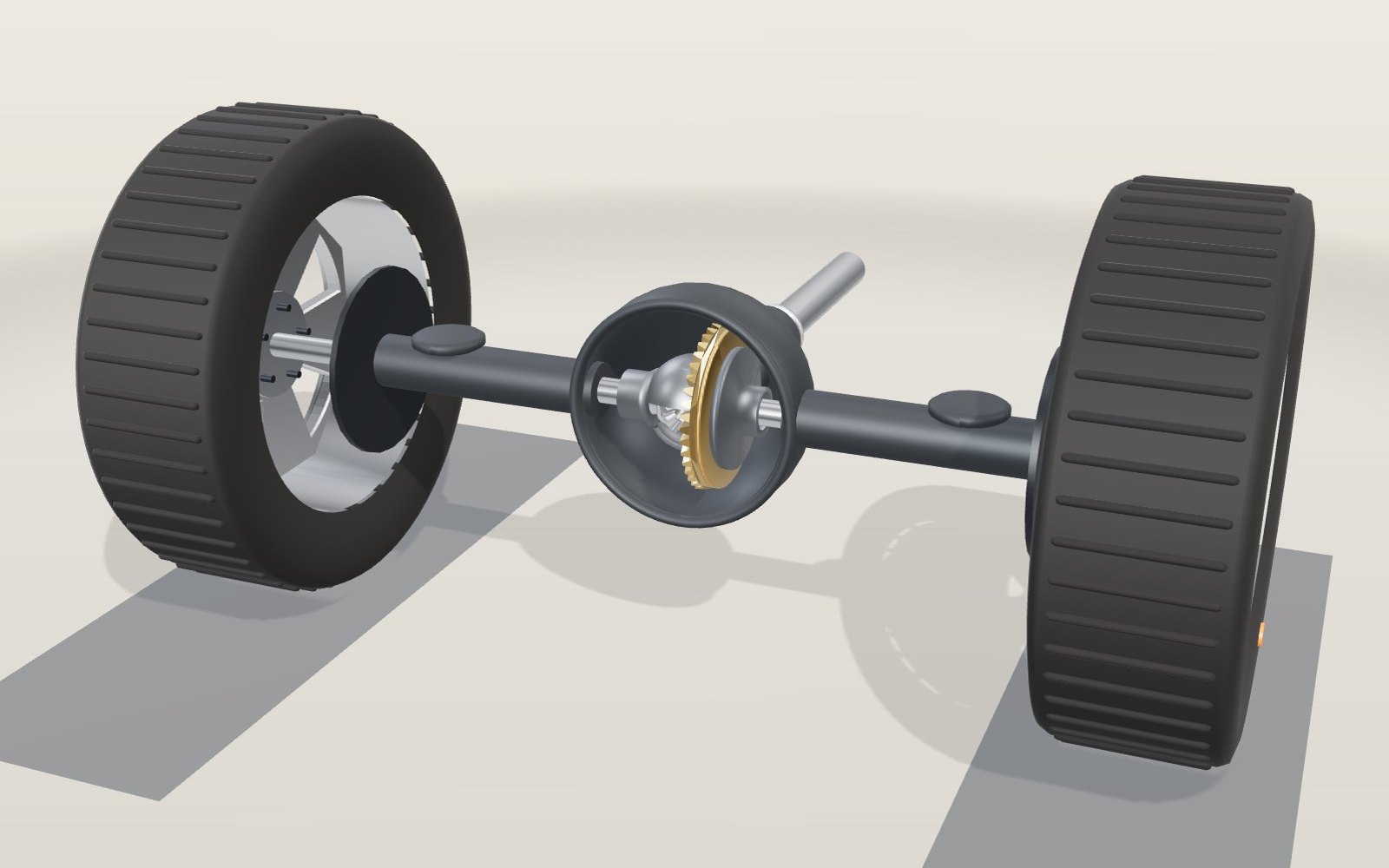
How does a differential work in a car? A 3D gear model
Round a 10 m bend at 50 km/h and the outer rear wheel turns 17% faster than the inner one, yet both are driven from the same shaft.
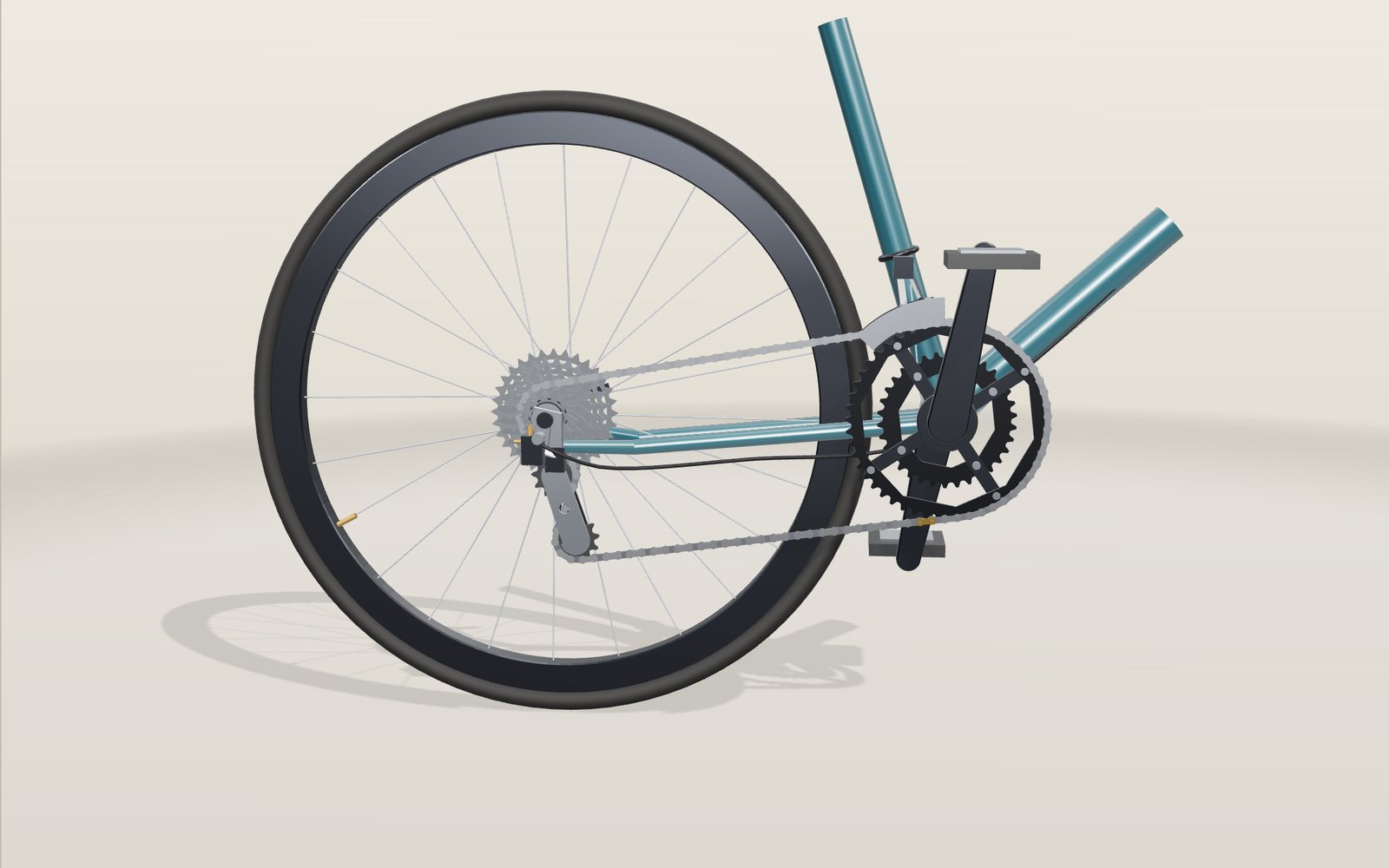
Bicycle gears: which gear makes climbing a hill easier
In a 50 by 11 gear one turn of the pedals moves a road bike 9.57 metres; in 34 by 32 it moves 2.24 metres.
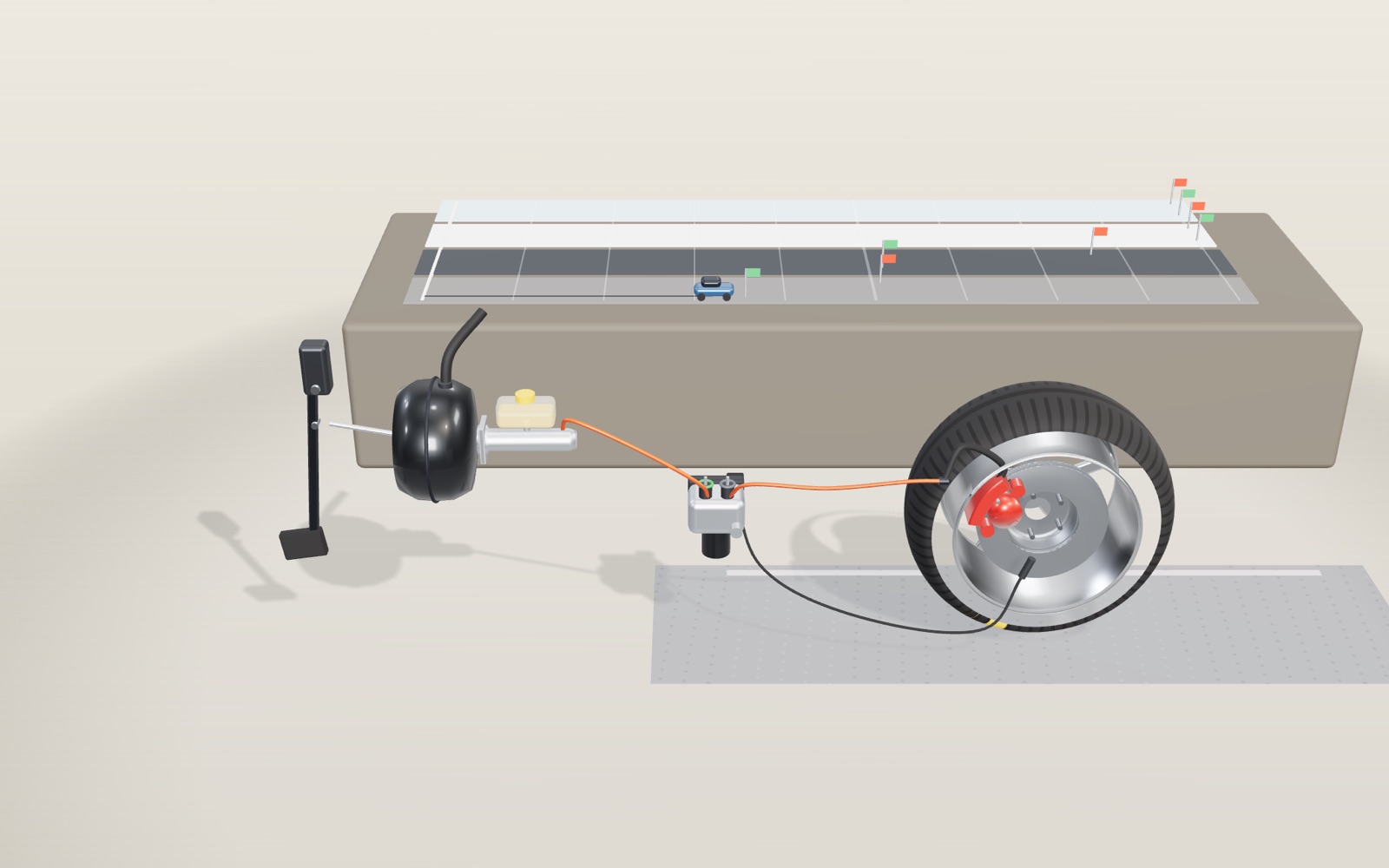
Disc brake and ABS simulator: how they work, step by step
On a dry road at 100 km/h a skidding tyre needs about 51 m to stop, while a tyre that ABS keeps turning stops the same model car in 36 m.
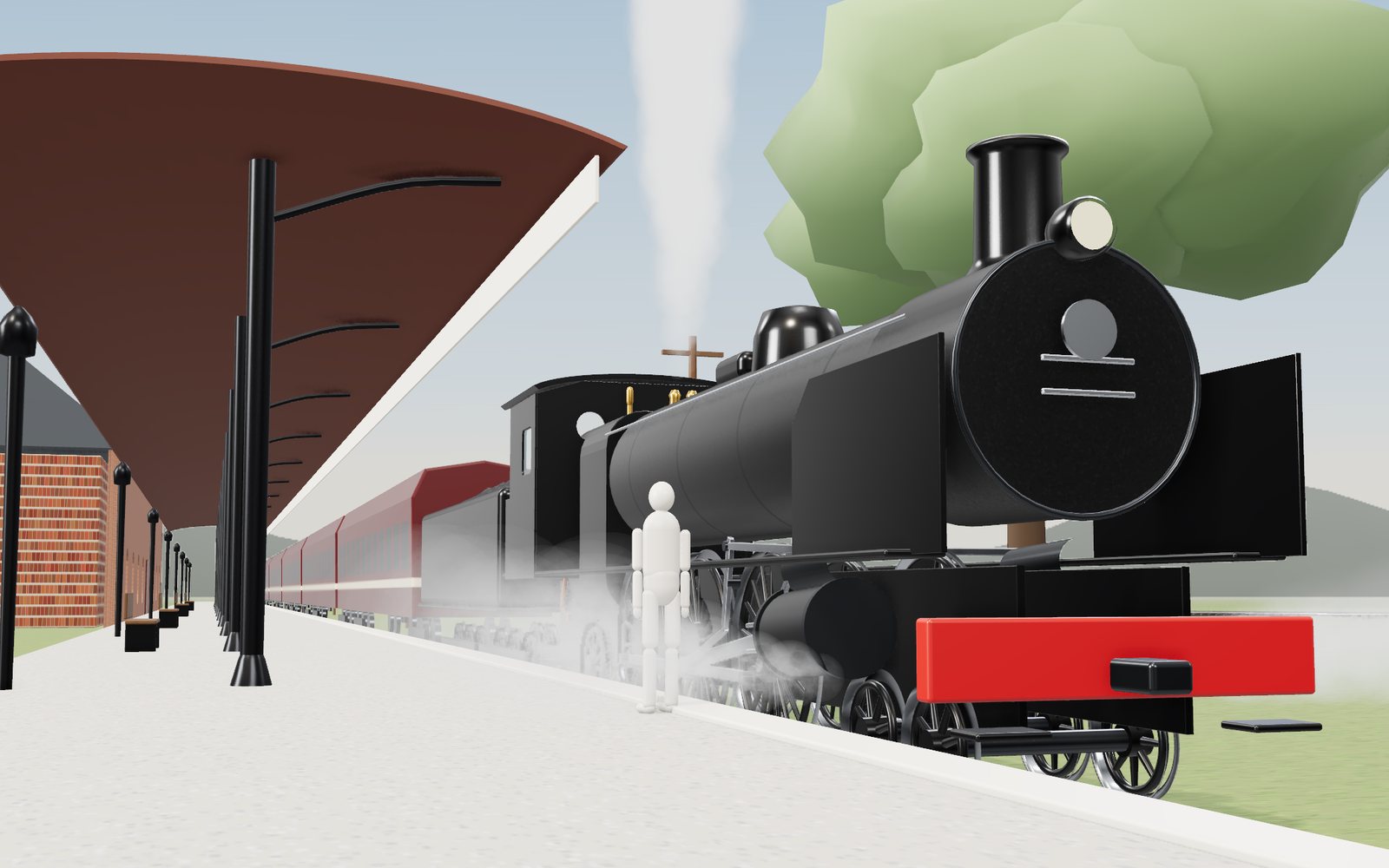
How a steam locomotive works
Mallard's driving wheels are 2.03 m across, taller than most people, and at its record 126 mph they turned almost nine times a second.
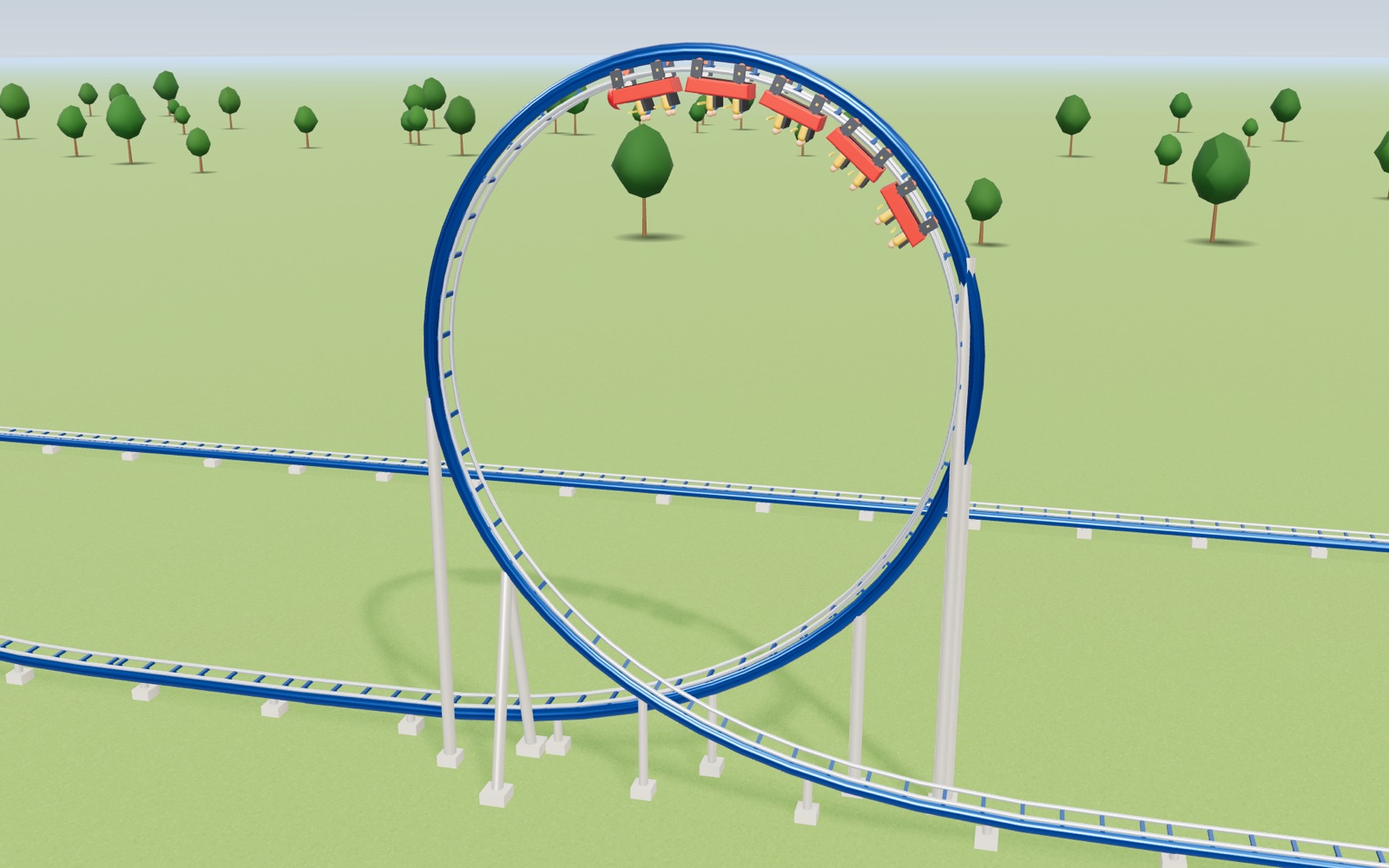
Roller coaster physics: how roller coasters work
A train that creeps over a 42 m lift hill at 3 m/s is doing 99 km/h at the bottom, and nothing but gravity has pushed it.
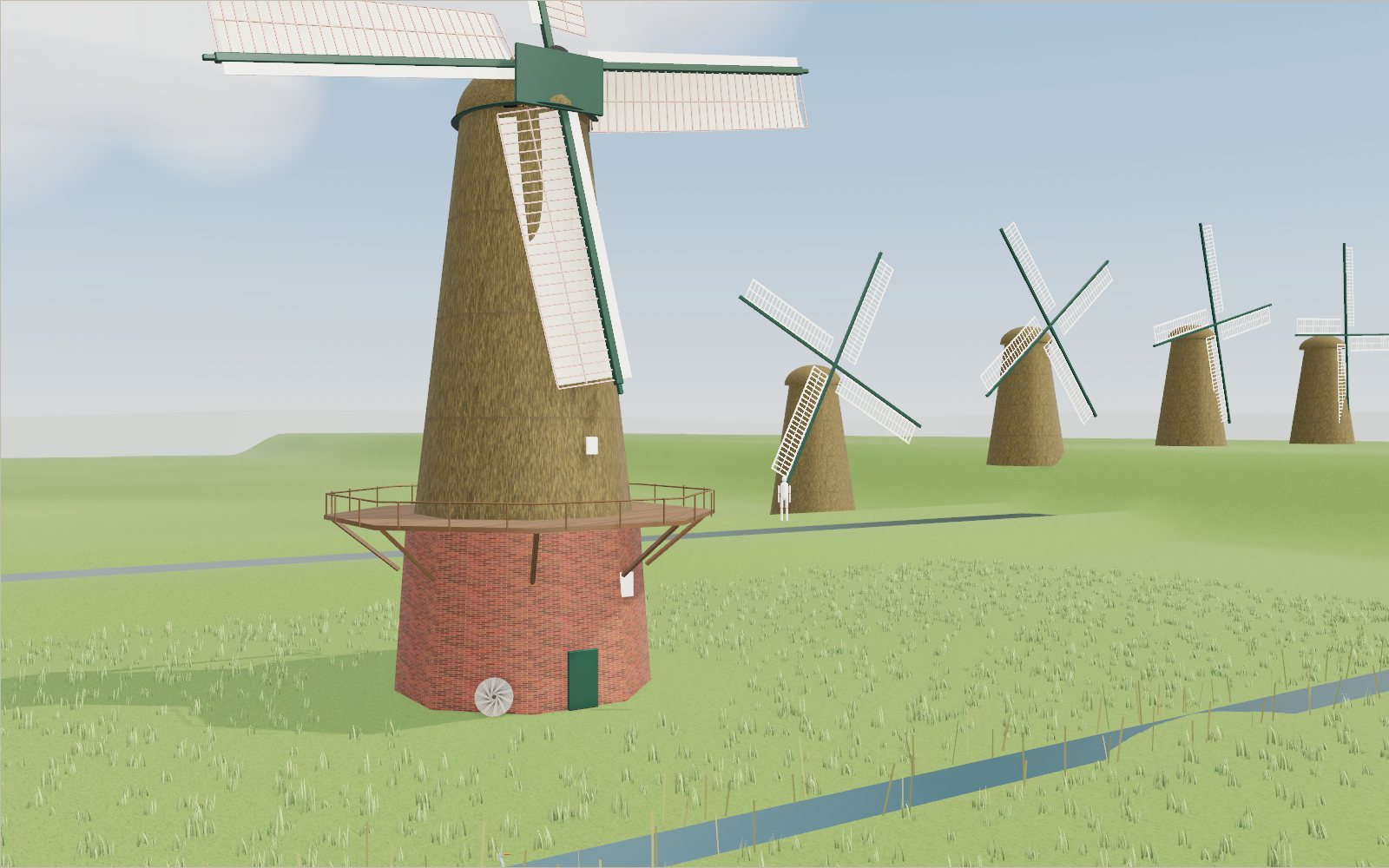
How windmills and watermills work
The sails of a Dutch mill are as wide as an eight-storey building is tall, and at 7 m/s they still take only about a fifth of the wind.