Loading the model
This device cannot show the 3D model. You can read the guide steps below as text.
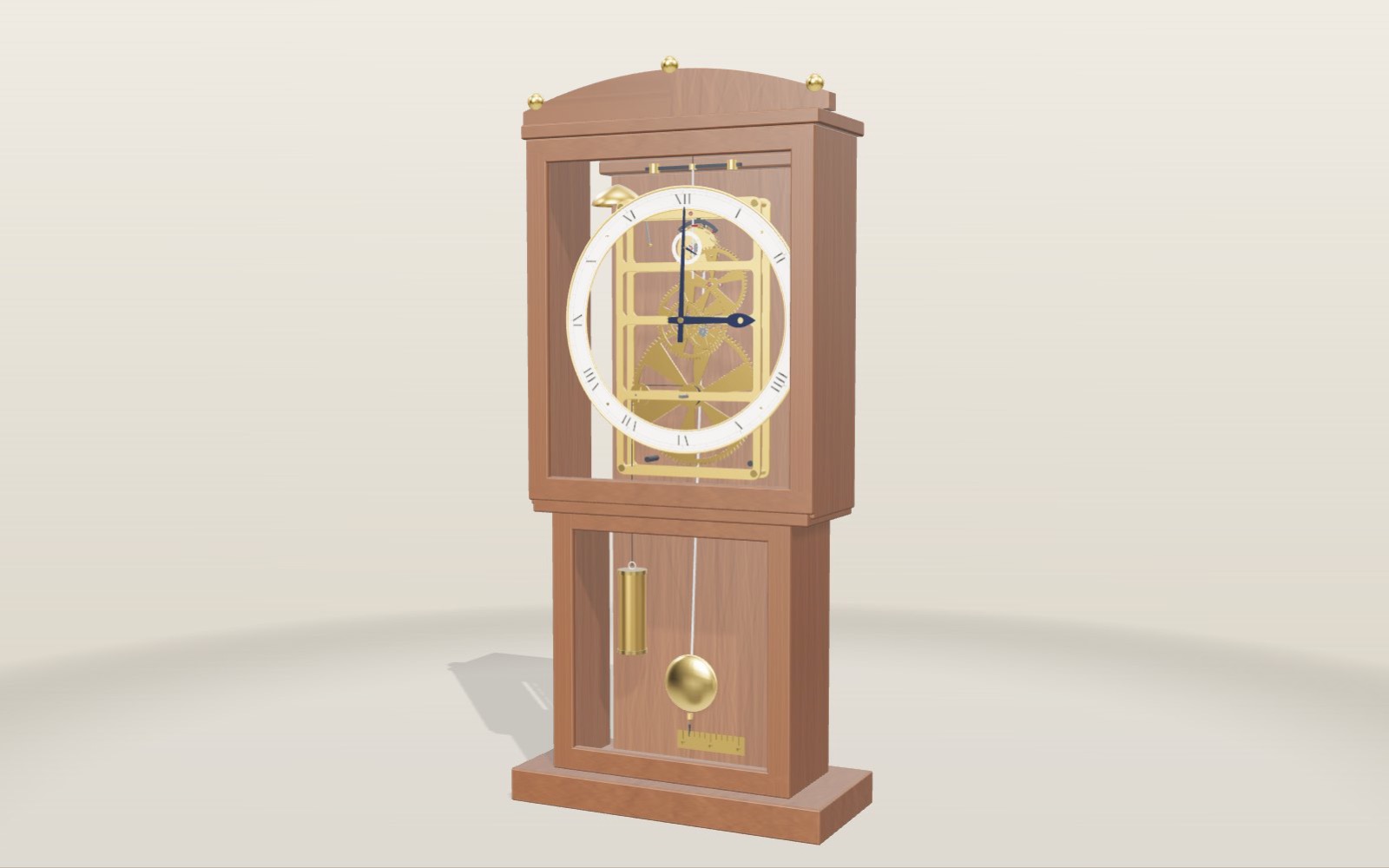
1 / 14 The whole clock A longcase clock about 1.6 m tall: a weight, four wheels, an escapement, a pendulum about a metre long and a bell. Drag to turn it, and scroll or pinch to zoom. The panel on the stage shows the beat and the error per day.
Drag to turn. Scroll or pinch to zoom.
Guide Parts Controls
01 The whole clock A longcase clock about 1.6 m tall: a weight, four wheels, an escapement, a pendulum about a metre long and a bell. Drag to turn it, and scroll or pinch to zoom. The panel on the stage shows the beat and the error per day.
02 The weight drives the clock The weight hangs on a cord wound round the drum. On its own it would drop to the floor in a moment and spin every wheel. The rest of the clock is there to slow that fall to about a centimetre an hour.
03 The going train Each wheel drives a small pinion of 8 leaves on the next arbor. 96/8 × 64/8 × 60/8 = 720, so the escape wheel turns 720 times for each turn of the great wheel.
04 What happens in one tick This step runs in slow motion. A tooth rests on one pallet while the pendulum swings. Near the bottom of the swing it slides across the pallet's slope, gives the pendulum a small push and drops onto the other pallet. That is the tick.
05 The pendulum sets the pace A pendulum 0.994 m long takes one second per swing. The wheel moves half a tooth per swing, so the 30-tooth wheel turns once a minute. Try the Pendulum length control: a quarter of the length beats twice as fast.
06 From seconds to hours The seconds hand sits on the escape arbor and the minute hand on the centre arbor, which turns 60 times more slowly. The hour hand is geared down 12 to 1 from the minute hand.
07 Before the pendulum: verge and foliot Tower clocks of the 14th century had no pendulum. A bar with two weights swings back and forth on a vertical staff, and the crown wheel pushes it each way. Its beat depends on how hard the weight pulls, so a heavier weight makes it run fast.
08 The recoil anchor From about 1671 the anchor let the pendulum swing only a few degrees. Watch the escape wheel: each time a tooth locks, the pallet pushes it back a little. That backward jerk is the recoil.
09 Harrison's grasshopper John Harrison's grasshopper escapement catches each tooth with hinged arms that kick away without sliding, so it needs no oil. His longcase clocks of the 1720s kept time to about a second a month.
10 Heat makes the pendulum longer At 30 °C a plain steel rod is about 0.1 mm longer than at 20 °C and the clock loses about 5 seconds a day. This step uses a gridiron: brass rods expand upwards while steel rods expand downwards, and the two cancel.
11 Gravity changes from place to place The clock was regulated at 45° latitude. Taken to the equator, where gravity is 0.26% weaker, it loses about 114 seconds a day. The rating nut under the bob is how a clockmaker corrects it.
12 Striking the hours A second train, with its own weight in many clocks, lifts a hammer against the bell. A spinning fly spaces the blows. The clock strikes once at one o'clock and twelve times at noon, 78 blows every 12 hours.
13 A tower clock: Big Ben The Great Clock of Westminster, here at 1:8. Its 4.4 m pendulum beats every 2 seconds, it drives four dials 7 m across, and it is regulated with old pennies: each one makes it gain 0.4 seconds a day.
14 The gravity escapement Wind on the huge hands would push the train and upset the pendulum. Denison's gravity escapement stops that: the train only lifts two arms, and the pendulum is pushed by the arms falling under their own weight, always the same push.
Weight Stores the energy. Its pull on the cord turns the great wheel; a heavier weight swings the pendulum wider. Great wheel 96 teeth on the drum arbor. One turn every 12 hours. Centre wheel 64 teeth. Its arbor carries the minute hand: one turn per hour. Third wheel 60 teeth, turning 8 times an hour. Escape wheel 30 pointed teeth. One turn per minute, carrying the seconds hand. Anchor and pallets Rocks with the pendulum and locks and releases the escape wheel. Three kinds to choose: recoil anchor, Graham deadbeat, Harrison grasshopper. Pendulum About 0.994 m to the centre of oscillation, one second per swing. Five rods to choose: steel, wood, gridiron, mercury jar, invar. The rating nut under the bob regulates it. Motion works 12:1 gearing that drives the hour hand from the minute arbor. Chapter ring Hour ring and seconds ring. Hands Blued steel. Set to your local time when the page opened. Front plate Holds the front pivots. X-ray makes it transparent. Back plate Holds the rear pivots and the pendulum suspension. Longcase Walnut trunk and hood with glass doors. See inside makes it transparent; the Inside view takes it away. Verge and foliot The oldest escapement: a vertical staff with two flags across a crown wheel, and a bar with two regulating weights. No natural period of its own. Bell Struck once for each hour: 78 blows in 12 hours. Hammer and fly The hammer lifts and drops on the bell; the fly is an air brake that spaces the blows. Tower dial One of the four Big Ben dials, 7 m across in the real clock, with IV for four o'clock. Model at 1:8. Flatbed frame Cast iron frame 4.7 m by 1.4 m carrying the quarter, going and hour trains side by side. Tower pendulum 4.4 m long and 310 kg in the real clock, beating every 2 seconds. Old pennies on its tray regulate it. Gravity escapement Denison's double three-legged gravity escapement: the train only lifts two arms, and the arms give the pendulum its push. Great Bell The 13.5 tonne hour bell, cast in 1858.