Loading the model
This device cannot show the 3D model. You can read the guide steps below as text.
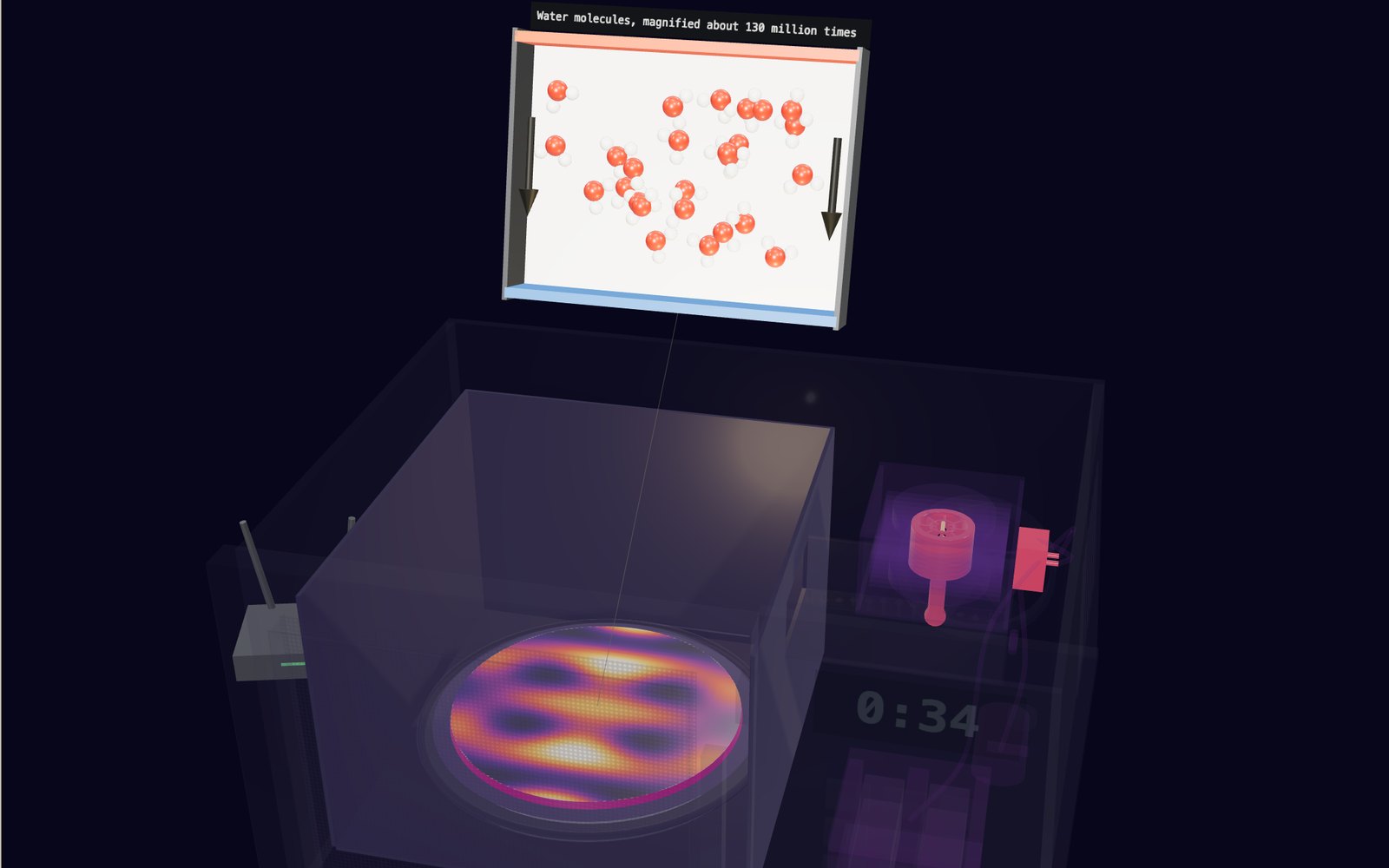
1 / 11 A microwave oven at work The door closes, the top turns to glass and the oven starts. Dots leave the waveguide and bounce off the metal walls, the water molecules in the magnifier start to turn, and the thermal camera shows where the cheese heats.
Drag to turn. Scroll or pinch to zoom.
Guide Parts Controls
01 A microwave oven at work The door closes, the top turns to glass and the oven starts. Dots leave the waveguide and bounce off the metal walls, the water molecules in the magnifier start to turn, and the thermal camera shows where the cheese heats.
02 The magnetron makes the waves Inside the magnetron a hot cathode releases electrons. The ring magnets bend their paths so they swirl past eight copper vanes, and the gaps between the vanes ring at 2.45 GHz like a whistle.
03 Through the waveguide A short antenna sends the wave into a rectangular metal pipe. In a pipe this size the wave pattern repeats every 17.3 cm. It leaves through the opening in the side wall of the chamber.
04 Waves that stand still The metal walls reflect the wave, and the reflections add up into a standing wave. At the blue nodes the field barely moves; at the orange antinodes it swings hardest, 2.45 billion times a second.
05 Hot spots in the cheese Through the thermal camera, with the turntable off, the cheese heats in spots and stripes over the antinodes and stays cool over the nodes. The stripes are 6.26 cm apart, close to half a wavelength, 6.12 cm.
06 The turntable evens it out The same 40 seconds with the turntable on. Each part of the cheese passes through hot and cold places, so the spots smear into rings and the temperature range narrows from about 80 to about 45 degrees.
07 Water molecules turn back and forth A water molecule has a negative end and a positive end. The field pulls it one way, then the other, and as the molecules turn they knock into their neighbours. That disorder is heat.
08 Ice hardly heats In ice the molecules are held in a crystal and can barely turn, so a frozen cube absorbs little. Once some of it melts, the meltwater takes most of the energy: thawing speeds up by itself.
09 The speed of light from chocolate With the turntable off, the chocolate melts first at the antinodes. Press two neighbouring melted spots: twice their distance times 2.45 GHz gives the speed of light, here within about 2 percent.
10 Holes that hold the waves in The magnifier now shows the door screen at actual size. A 2 mm hole is about 60 times smaller than the 12.2 cm wave, so it reflects back. Make the holes bigger with the slider and watch the wave get through.
11 Metal that sparks A fork is different from the smooth walls: its pointed tines gather charge, and the air between them can spark. If you ever see sparks, stop the oven and take the metal out once it is off.
Outer case The painted steel box with the controls and a fan that blows air over the magnetron. See inside turns its top to glass. Cooking chamber A metal box 29.5 cm wide, 31.3 cm deep and 21 cm high. Its walls reflect microwaves, so the waves bounce back and forth until food absorbs them. Magnetron The vacuum tube that makes the microwaves. Electrons leave a hot cathode in the middle and swirl past copper vanes; the gaps between the vanes are the resonant cavities. Magnets and casing Two ferrite ring magnets with a steel frame that closes the magnetic path, plus aluminium fins that carry heat away. Their steady field bends the electrons into curved paths. Waveguide A rectangular metal pipe, 8.64 by 4.32 cm inside, that carries the wave from the magnetron's antenna into the chamber through an opening covered by a mica plate. High-voltage supply A transformer, capacitor and diode that turn mains electricity into the roughly 4,000 volts the magnetron needs. Standing wave Arrows show the electric field at this instant and glowing dots trace reflections. Orange areas are antinodes, where the field swings hardest; blue areas are nodes, where it hardly moves. Turntable A glass tray on a ring of rollers, turned by a small motor under the floor. Here it turns once every 12 seconds. Food Cheese, chocolate, a cup of water or an ice cube on the turntable. Drag it to another place; its colour shows how hot each spot has become. Dish Glass and ceramic let microwaves through. A steel bowl reflects them, so the food inside hardly heats. Magnifier Water molecules magnified about 130 million times, each with a negative oxygen end and a positive hydrogen end, so the field keeps turning them. With the door hole slider it shows the door screen at actual size instead. Door and screen A metal sheet with 2 mm holes on a 3 mm pitch behind the glass, and two hooks that press the interlock switches. Press the door to open it: the magnetron stops. Metal fork Never put one in. Charge piles up at the tips of the tines, and the field there can become strong enough to make sparks.