Loading the model
This device cannot show the 3D model. You can read the guide steps below as text.
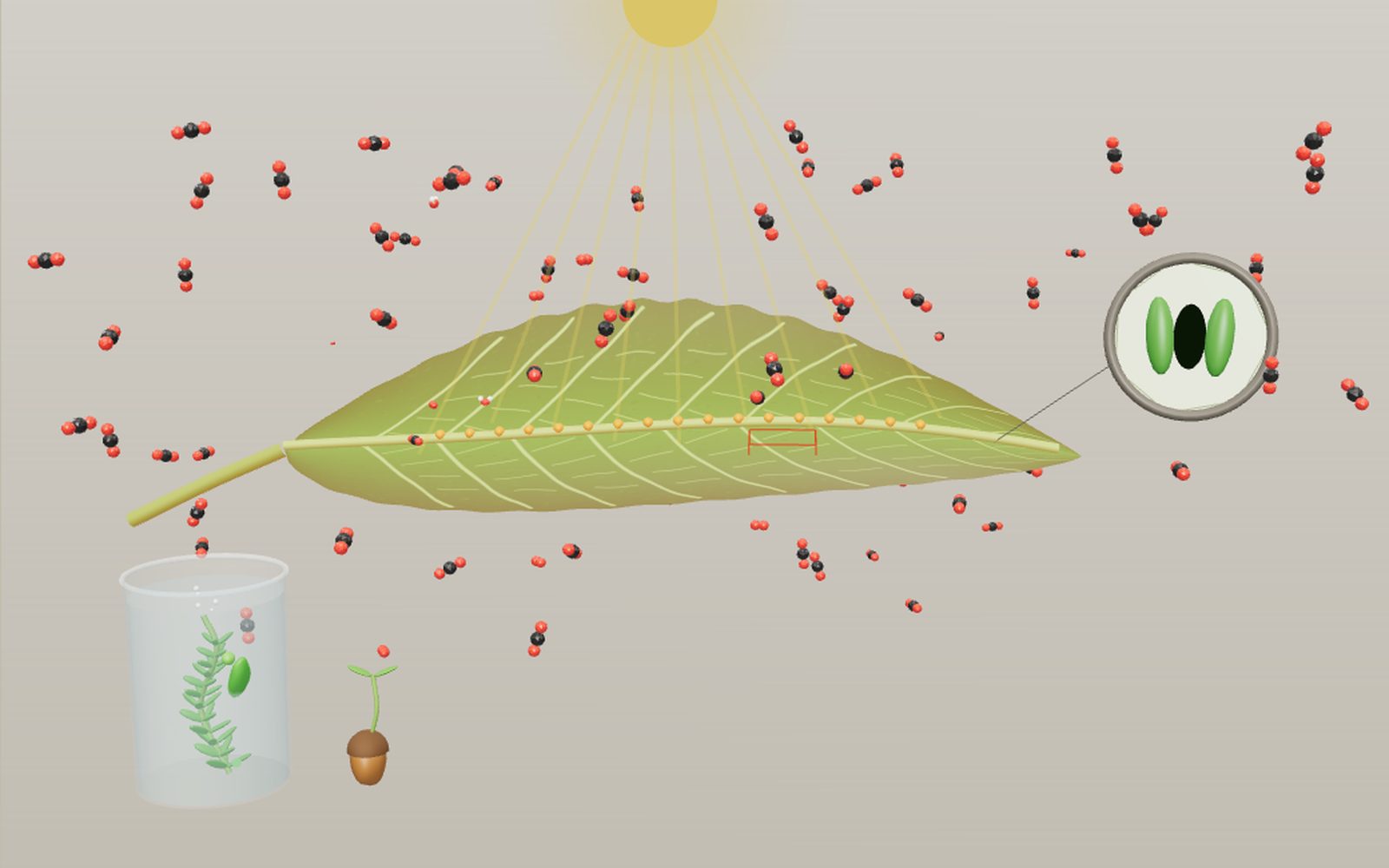
1 / 8 A leaf in sunlight This leaf is the starting point. Drag the sun to tilt the light, and watch the air: CO₂ molecules drift in, O₂ leaves, and the pondweed in the beaker bubbles. The red box marks the block we cut out next.
Drag to turn. Scroll or pinch to zoom.
Guide Parts Controls
01 A leaf in sunlight This leaf is the starting point. Drag the sun to tilt the light, and watch the air: CO₂ molecules drift in, O₂ leaves, and the pondweed in the beaker bubbles. The red box marks the block we cut out next.
02 Inside the leaf Here is the block in cross-section. A waxy cuticle and a clear epidermis cover the top. Below them stand the palisade cells, full of chloroplasts, then the looser spongy cells and a vein.
03 Stomata let gas in and water out Seen from underneath, each pore sits between two guard cells. Grey and red molecules of CO₂ go in, blue and white water vapour comes out. Close the stomata with the slider and both flows stop.
04 One chloroplast Each green bead in the palisade cells is a chloroplast like this one, drawn with its envelope see-through. The stacks of discs are grana, made of thylakoid membrane.
05 Light splits water at photosystem II Now we are on a thylakoid membrane, stroma above and lumen below. Yellow streaks are photons. Each one absorbed at photosystem II sends an electron (cyan) off, and the cluster below takes another from water.
06 Electrons travel to NADPH The electron passes through plastoquinone, cytochrome b6f and plastocyanin to photosystem I, where a second photon lifts it again. Ferredoxin and FNR then load two electrons at a time onto NADP⁺.
07 Protons turn ATP synthase Water splitting and b6f fill the lumen with protons (red). They can only leave through ATP synthase. 14 of them turn its ring once, and the head above releases three ATP.
08 The Calvin cycle builds sugar In the stroma, Rubisco fixes one CO₂ each time a bead passes it. Each fixed CO₂ uses 3 ATP and 2 NADPH. Try the CO₂ and Temperature sliders and watch the cycle and the curve change.
Leaf A broad leaf with a midrib and a net of veins. Its job is to hold a thin layer of green cells up to the light while letting air reach them. Palisade mesophyll Column-shaped cells packed tightly under the upper epidermis. Most of the leaf's chloroplasts sit here, the dark green beads in each column. Spongy mesophyll Loose, irregular cells with air spaces between them. Carbon dioxide that comes in through the stomata spreads through these gaps to the cells above. Stomata Pores on the underside, each between two guard cells. When the guard cells swell the pore opens; carbon dioxide gets in and water vapour gets out. Chloroplast envelope The two membranes around a chloroplast. Inside is the stroma, a watery space where the Calvin cycle runs. Thylakoids and grana Flat membrane sacs stacked into grana and joined by single sheets called stroma lamellae. The light reactions happen in these membranes. Photosystem II A protein complex with an antenna of chlorophyll. Light drives an electron out of its reaction centre (P680), and its manganese cluster takes replacement electrons from water, releasing oxygen. Plastoquinone, cytochrome b6f, plastocyanin The chain between the two photosystems. Plastoquinone (yellow) moves in the membrane, b6f moves protons into the lumen, and plastocyanin (blue) carries electrons along the lumen side. Photosystem I and FNR A second photon re-energises each electron at P700. Ferredoxin (orange) passes it to the enzyme FNR, which puts two electrons onto NADP⁺ to make NADPH. ATP synthase Protons flow back from the lumen through its ring of 14 c subunits and turn it. Each turn makes 3 ATP in the head on the stroma side. Calvin cycle and Rubisco Rubisco (top) joins CO₂ to RuBP, giving 3-PGA. ATP and NADPH turn that into G3P. Most G3P rebuilds RuBP; one in three turns' worth leaves as sugar.