Loading the model
This device cannot show the 3D model. You can read the guide steps below as text.
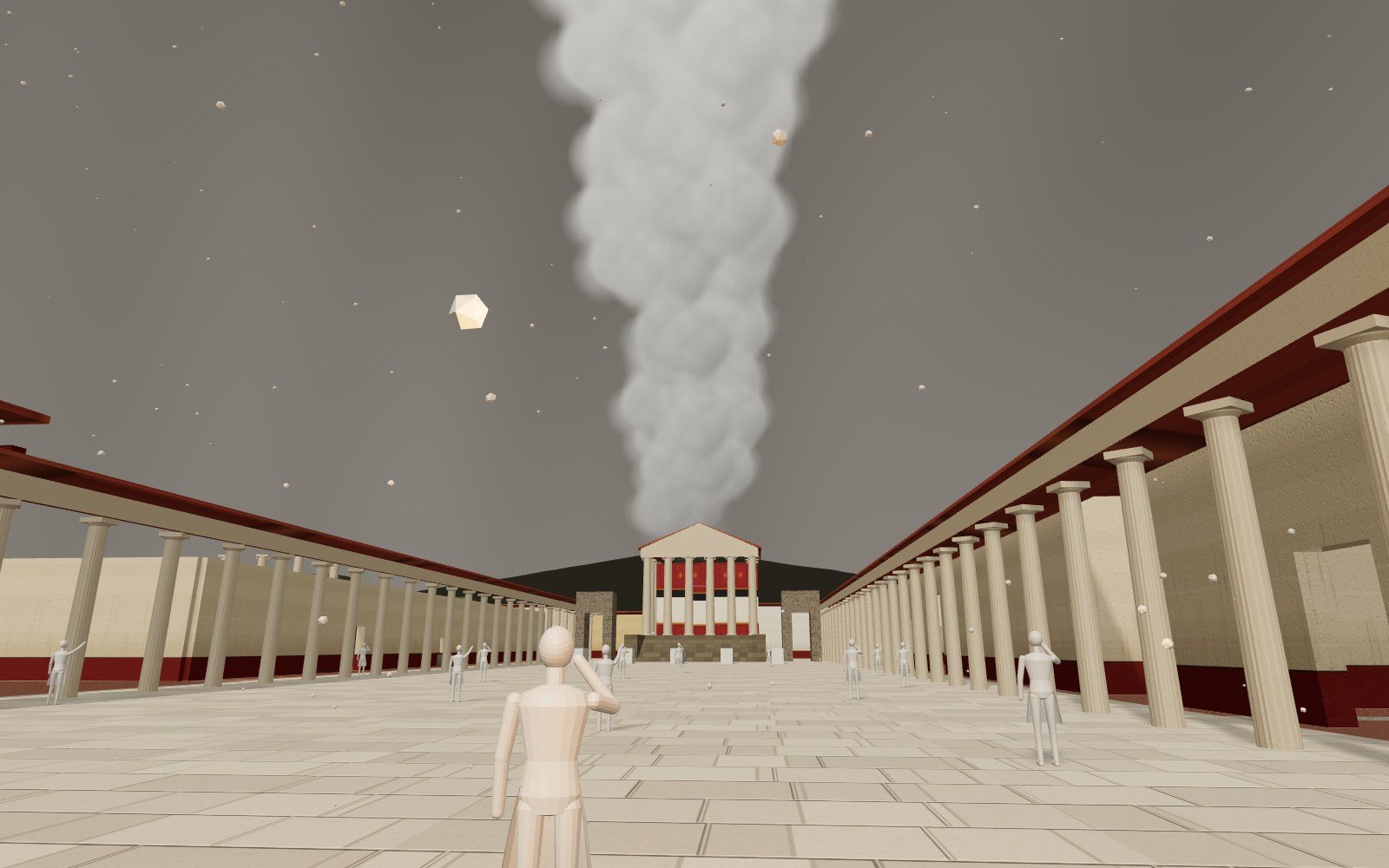
1 / 18 The column rises You stand in the forum at about half past one in the afternoon. Behind the Temple of Jupiter a column of ash and pumice is rising out of Vesuvius, and the people in the square have stopped to look. The clock under the stage runs from the morning of the first day to the next morning, then to today.
Drag to turn. Scroll or pinch to zoom.
Guide Parts Controls
01 The column rises You stand in the forum at about half past one in the afternoon. Behind the Temple of Jupiter a column of ash and pumice is rising out of Vesuvius, and the people in the square have stopped to look. The clock under the stage runs from the morning of the first day to the next morning, then to today.
02 Looking straight up Walk to the foot of the temple and look up. Pompeii is about 10 km from the crater, and in the first hour the column already stands far higher than anything you have seen from the ground. Pliny the Younger, watching from across the bay, compared its shape to a pine tree.
03 How high it went The ruler beside the column marks every 5 km. In the evening the falling pumice turned grey and the column grew to about 32 km (a 2024 study gives up to 34 km). From the forum its top would stand almost overhead.
04 Pumice in the street At the corner of the two main streets a pole is marked every 50 cm, and the orange figure has your height (enter it under Me). Pumice piled up at about 12 to 15 cm an hour, light stones that crunch underfoot. Turn on the sound to hear them land.
05 Roofs give way From above the roofs at seven in the evening. After two or three hours of fall the weight of pumice started to bring roofs down; in the model the roofs go one by one as the depth grows. Many people left the town in these hours.
06 A bakery in the morning Back to the morning, before anything happened. Grain was ground between the two parts of these hourglass mills, turned by slaves or donkeys, then baked in the domed oven. The loaves on the ledge are round and scored into eight wedges.
07 House of the Faun A whole block of about 3,000 m². The word HAVE, welcome, is set in the pavement at the door, and the bronze dancing faun stands in the pool of the atrium. Walk through to the gardens at the back.
08 Alexander and Darius Between the two peristyle gardens lies the mosaic of the battle between Alexander the Great and the Persian king Darius. The model shows an impression of it; in the house today there is a copy, and the original is in the National Archaeological Museum of Naples.
09 Stabian Baths Courtyard and pool first, then rooms that get warmer: changing room, the round cold bath, the warm room and the hot room, where part of the floor is left open to show the small brick pillars that hot air ran between.
10 Via dell'Abbondanza The long shopping street. Bars served hot food from jars set in their counters, election notices are painted in red on the walls, and two rows of stepping stones cross the street at pavement height.
11 The amphitheatre Built in 70 BC for up to 20,000 people, the oldest Roman amphitheatre known. You come in through the tunnels at both ends or climb the stair on the west side. In AD 59 a riot here led Rome to ban games for ten years.
12 One in the morning Night on the first day of the eruption, with about 1.5 m of pumice in the streets. You walk on it at the height of shop counters. Most roofs are down. On the mountain, fires glow; Pliny wrote of broad sheets of flame on Vesuvius.
13 From the shore Outside the Marina Gate the road runs down to the sea. Where Pompeii's harbour lay is not known exactly; this pier is a reconstruction. From here Pliny the Elder's ships crossed the bay towards the column.
14 The fourth surge Just before seven on the second morning. The column has partly collapsed, and a cloud of hot ash and gas rolls in from the north. The clock shows it slowly; the real cloud crossed the town in a minute or two. Nobody still in the town survived it.
15 Layers in the bank Today. At the north edge an unexcavated bank shows the deposit in section: white pumice at the bottom, grey pumice, the thin ash of the surges, then later soil. There is no lava in it.
16 17 October? In this house a charcoal note reads XVI K NOV, 17 October, with no year. It was hailed in 2018 as proof of an autumn eruption. In 2023 the park wrote the same kind of note on the same wall; ten months later it was still easy to read, so the note proves less than it seemed.
17 Same place, now The forum as excavated: no roofs, walls broken off at different heights, plaster mostly gone, the same mountain behind the temple. Move the clock back and forth to compare.
18 Places and challenges Places lists 121 sites of the Archaeological Park, with the 26 built in this model. Hidden finds holds 26 cards, eight of which turn a common story around. Challenges asks twelve questions you can answer from the clock and the town.
Forum The main square with the Temple of Jupiter and Vesuvius behind it. Temple of Jupiter The temple on its podium, lined up with the mountain. House of the Faun The door with HAVE in the pavement and the atrium with the dancing faun. Bakery Five lava mills and the bread oven. Stabian Baths Courtyard, pool and the rooms from cold to hot. Stepping stones Stepping stones across Via dell'Abbondanza. Amphitheatre The arena and the seats, from the north tunnel. Marina Gate The Marina Gate from the road outside. Pier The pier below the gate, looking north to the mountain. Section through the deposit The deposit in section at the edge of the excavation. Amphitheatre Built in 70 BC for up to 20,000 spectators from Pompeii and nearby towns. The oldest known Roman amphitheatre. Bakery of Popidius Priscus Mill and bakery in one: five lava mills, a large oven, bread sold on the spot or by street sellers. Basilica The grandest building of the forum, about 1,500 m², used for business and for the law courts. House with the Garden A house of Regio V with a frescoed garden portico. The charcoal note dated 17 October was found here. Central Baths The largest baths in town, still being built in 79. Unfinished pools and loose capitals remain. Comitium and town offices Where votes were counted and new magistrates announced, next to the council house and offices. Forum Baths Public baths behind the Temple of Jupiter, built soon after 80 BC, with separate entrances for men and women. Forum The main square, surrounded by temples, courts, offices and markets. Fullery of Stephanus A laundry made out of a house: a big tub in the atrium and a drying terrace on top. Garden of the Fugitives A vineyard where 13 people were found who had tried to reach the Nocera Gate over 3.5 m of pumice. Honorary Arches Two brick arches beside the Temple of Jupiter, once faced with marble and topped by statues. House of the Golden Bracelet Terraced houses over the town wall looking out to sea; several casts come from here. House of Siricus SALVE LUCRU, "Welcome, money!", reads the floor at the door of Publius Vedius Siricus. House of the Faun One of the largest houses, about 3,000 m², with the dancing faun and the Alexander mosaic. House of the Lovers Named after a verse painted beside two ducks: lovers lead a life as sweet as honey. House of the Tragic Poet CAVE CANEM, "beware of the dog", reads the mosaic at its door. Macellum The market hall of the forum, with a shrine for the imperial cult. Marina Gate The grandest of the seven gates, on the road down to the sea. Mensa Ponderaria The stone counter for checking measures of grain, wine and oil. Building of Eumachia Built by Eumachia, priestess of Venus, the most imposing building on the east side of the forum. Sanctuary of Apollo One of the oldest places of worship in the town, beside the forum. Sanctuary of Venus The temple of the town's patron goddess on a terrace above the bay. Stabian Baths Among the oldest public baths of the Roman world, 2nd century BC. Suburban Baths Private baths outside the Marina Gate, built against the town wall. Temple of Jupiter The temple at the north end of the forum, lined up with Vesuvius. Thermopolium of Asellina Asellina and her co-workers are named on the front; 22 wine jars were found at the back.