Loading the model
This device cannot show the 3D model. You can read the guide steps below as text.
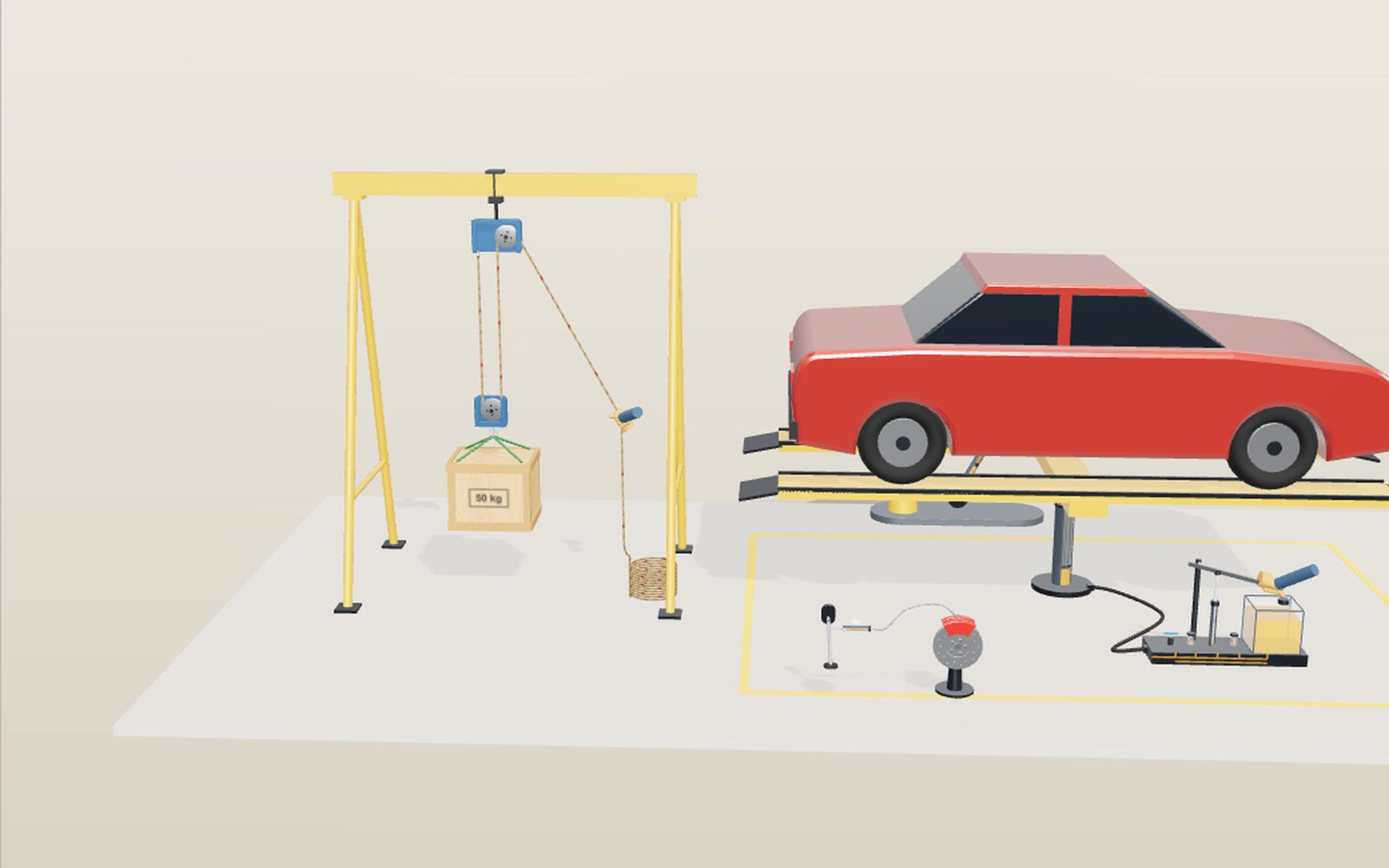
1 / 11 A workshop with two ways to lift On the left a 50 kg crate hangs from a rope and pulleys. On the right a 1,200 kg car stands on a hydraulic lift. The panel in the corner shows force and distance for both, and you can drag the hand on the rope down to lift the crate.
Drag to turn. Scroll or pinch to zoom.
Guide Parts Controls
01 A workshop with two ways to lift On the left a 50 kg crate hangs from a rope and pulleys. On the right a 1,200 kg car stands on a hydraulic lift. The panel in the corner shows force and distance for both, and you can drag the hand on the rope down to lift the crate.
02 One fixed pulley A single pulley fixed to the beam only turns the rope. The hand pulls with 490 N, the full weight of the crate, and each metre of rope pulled raises the crate one metre.
03 A moving pulley halves the pull Now the rope runs down around a pulley that rides on the crate, then back up. Two rope parts hold the crate, so each carries 245 N. To raise the crate 0.3 m the hand has to pull 0.6 m of rope.
04 Six parts of rope With three sheaves above and three below, six rope parts share the load and the pull drops to 82 N. Count the numbered parts. Raising the crate 0.5 m now takes 3 m of rope, which piles up in the coil on the floor.
05 Friction takes its share Real sheaves lose a little at every turn. With 5% lost at each of the six sheaves the pull rises from 82 N to 97 N, and only 84% of the work done by the hand reaches the crate.
06 Pressing the small piston The lever pushes a plunger 20 mm across into oil. By Pascal's principle the pressure, 1.04 MPa here, is the same everywhere in the oil, so the ram, 120 mm across with 36 times the area, pushes 36 times harder.
07 Two check valves Each stroke has two halves. Lifting the plunger opens the inlet ball and draws oil from the tank. Pressing it shuts the inlet and opens the outlet ball toward the ram, and between strokes that valve holds the car up.
08 Many small strokes One 50 mm stroke lifts the car 1.39 mm, so raising it 0.3 m takes 216 strokes. A bigger small piston lifts the car faster, but the force at the lever goes up by the same factor.
09 A chain hoist that needs no gears Press Chain hoist to swap the rope tackle for a Weston differential pulley. Two chain wheels of 10 and 9 pockets turn together, so each turn takes up a little more chain than it lets out. The hand chain moves 20 times as far as the 200 kg load, and the pull drops to about 98 N without friction.
10 An excavator boom cylinder Behind the car lift a double acting cylinder with the 120 mm bore of a SANY SY215C boom cylinder lifts a boom carrying 3,000 kg. The pressure is set by the load, about 9.3 MPa here, far below the 34.3 MPa relief setting. Oil pushes the piston out on the wide side and pulls it back on the narrow rod side.
11 A brake circuit At the front a 100 N push on the pedal becomes 500 N on a 5 mm pedal cylinder through a 5 to 1 lever. The line pressure, 25.5 MPa, reaches a 25 mm caliper piston that squeezes the disc with 12,500 N. The pedal piston has to move 25 times as far as the caliper piston.
Fixed block Hangs from the beam and never moves. Its sheaves only change the direction of the rope. Depending on the reeving it holds one, one, two or three sheaves. Moving block Hangs from the crate and rises with it. Every rope part that runs down to it helps hold the crate, which is why the pull gets smaller. Rope One rope 17.5 m long and 17 mm thick. Its length never changes: rope that leaves the blocks passes through the hand into the coil. The red tracer marks are 0.4 m apart. Crate 50 kg of pine boards, so it weighs 50 × 9.81 = 490.5 N. The model leaves out the weight of the moving block and of the rope. Hand on the rope Drag it down to lift the crate. The red tag shows its force. The rope it pulls is the number of rope parts times the height the crate rises. Pump lever The hand sits 0.5 m from the pivot and the plunger 0.1 m, so the lever multiplies the force five times before the oil does anything. Click it to pump once. Small piston A plunger 20 mm across by default (10 to 40 mm), moving 50 mm per stroke. The force on it is the oil pressure times its area. Check valves Two spring-loaded balls that let oil pass one way only. The inlet valve opens toward the pump, the outlet valve toward the ram. Oil tank Holds the oil the pump draws in. As the ram rises, the level drops by the volume that now sits under the ram. Ram (large piston) 120 mm across by default (60 to 200 mm). The oil under it pushes up with pressure times area, and that holds up the 11,772 N car. Release valve Opening it lets the oil under the ram flow back to the tank, and the car settles slowly under its own weight. Car 1,200 kg on the lift platform, a weight of 11,772 N. The weight of the platform and the ram is left out. Chain hoist A Weston differential pulley: two chain wheels with different numbers of pockets on one axle, an endless chain and a lower sheave with a hook. The advantage is twice the big wheel divided by the difference of the two wheels. Boom cylinder A double acting cylinder with the 120 mm bore and 1,285 mm stroke of a SANY SY215C boom cylinder, cut open to show the piston, the rod and the oil on both sides. The bench is drawn at 0.45 scale. Brake circuit Pedal, pedal cylinder, brake line, caliper and disc. The pedal lever multiplies the push by 5, and the oil multiplies it again by the area ratio of the caliper piston to the pedal piston.