Loading the model
This device cannot show the 3D model. You can read the guide steps below as text.
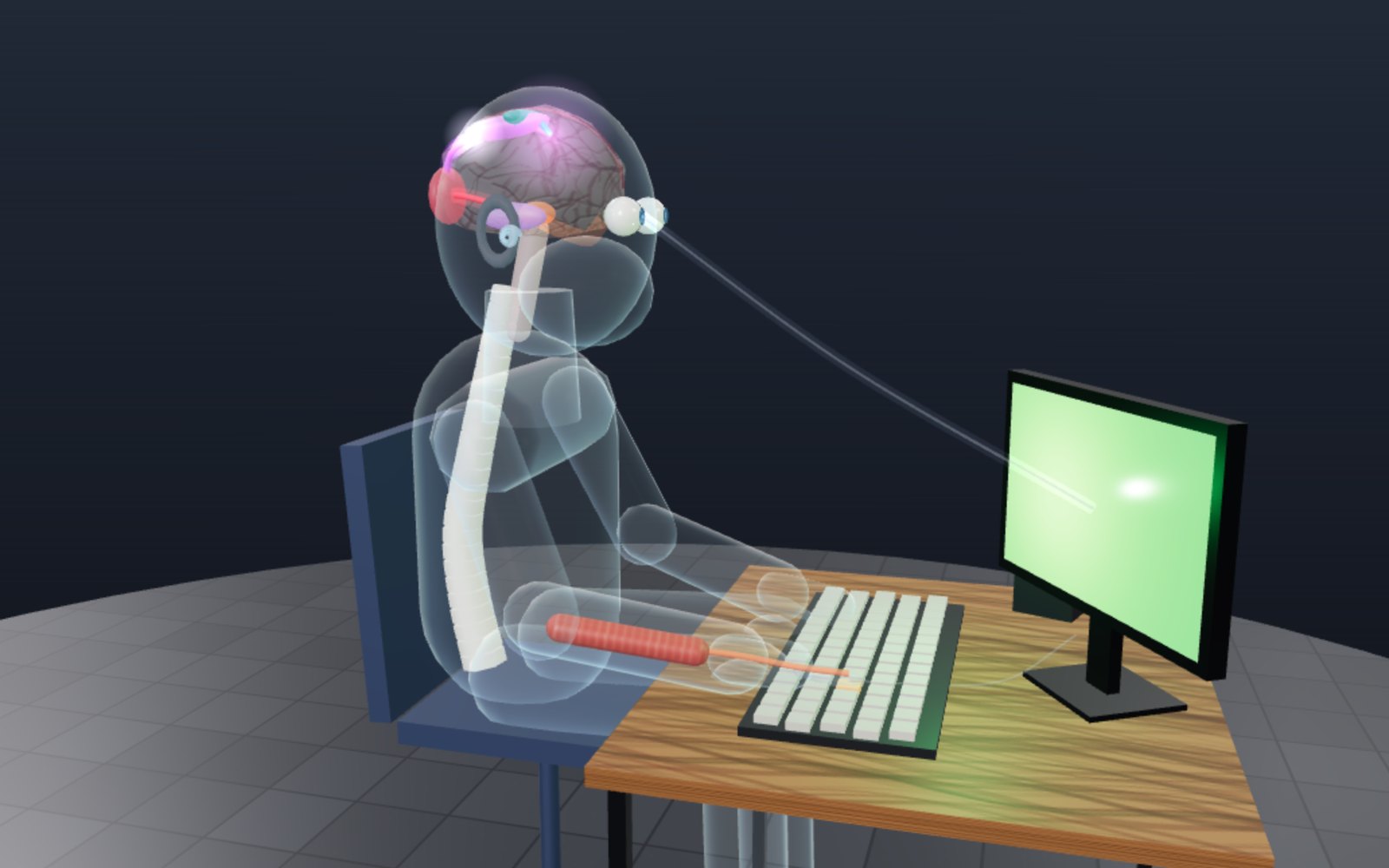
1 / 12 About a fifth of a second Press the test strip above the stage and wait for green. Most people need 200 to 250 ms. The pulse below shows where those milliseconds go, slowed 20 times.
Drag to turn. Scroll or pinch to zoom.
Guide Parts Controls
01 About a fifth of a second Press the test strip above the stage and wait for green. Most people need 200 to 250 ms. The pulse below shows where those milliseconds go, slowed 20 times.
02 The screen goes first Before your eye sees anything, the screen has to draw the new colour. That waits for the next refresh, about 8 ms on average at 60 Hz.
03 Eye, optic nerve, thalamus The retina needs about 20 ms to turn light into a signal. The optic nerve carries it back, half the fibres cross over, and the thalamus passes it on.
04 The visual cortex at the back The signal reaches the visual cortex at about 48 ms. Seeing that something changed is still not the same as deciding to move.
05 Deciding, then the command Around 130 ms the brain has detected the change. The motor cortex sends the command down the brainstem and spinal cord to the neck.
06 Down the arm to the finger From motor cortex to a hand muscle takes about 20 ms. Then the muscle has to build force and push the key down, which takes longer than the nerve trip.
07 Sound takes a shortcut Hair cells in the ear open their channels mechanically, and the auditory cortex responds at about 25 ms. The same head start carries through to the finger.
08 More choices, more deciding With 8 boxes to pick from, only the deciding stop gets longer. Hick's law says it grows by roughly the same step each time the choices double.
09 What your devices add At 30 Hz a screen adds about 17 ms on average, and a slow mouse a few more. Try the Screen refresh and Mouse or keyboard rate sliders.
10 Holding back is a reaction too In the Go/no-go test a red square means do nothing. Stopping a press you were already preparing happens in the deciding stage, so mistakes rise when you rush. After 20 shapes the page shows your go median and your mistakes.
11 Out of the corner of your eye The Edge test puts a dot in the centre or near the border while you look at the cross. The centre of the retina is packed with cones; the edge catches movement well but detail poorly. In a wide search study, targets 50° out took about 0.88 s against 0.62 s at 10°.
12 Taking out the device Press Check this device under the test. The page measures your screen's frame and, with a mouse, how often the mouse reports, then takes half of each off your median. Pixel switching and key or touch scanning cannot be measured here and stay in, so the corrected value is still on the high side.
Signal pulse The bright dot is the signal. It runs through each stop in the time the model gives, slowed down so you can follow it. Its colour changes with the stop. Screen Where the test colour appears. A new colour waits for the screen's next refresh, on average half a frame: 8.3 ms at 60 Hz. Eye The retina turns light into nerve signals. Photoreceptors work through a chemical cascade, which is the slow first step of the visual route. Optic nerve Carries signals from the eye. At the optic chiasm half the fibres cross so each side of the brain gets one half of what you see. Thalamus The relay deep in the middle of the brain. Sight passes through its lateral geniculate nucleus, sound through the medial geniculate nucleus. Visual cortex At the back of the head. In MEG recordings it starts to respond about 48 ms after a flash appears. Deciding Areas between the senses and movement, in the parietal and frontal lobes. Most of a reaction is spent here, and choices make it longer. Motor cortex The strip across the top of the brain that sends movement commands. The hand has a large patch of its own. Brainstem Joins the brain to the spinal cord. The motor fibres cross to the other side here, so the left brain moves the right hand. Spinal cord The command runs down to the neck. Nerves for the hand leave the cord between the lowest neck vertebrae. Arm nerve Motor fibres run from the neck to the forearm at about 50 to 60 m/s, one metre in under 20 ms. Finger muscle Forearm muscles pull the finger through tendons. The electrical signal reaches the muscle before force builds up and the key moves. Keyboard and mouse A USB device is read a set number of times a second. At 125 Hz a press waits up to 8 ms before the computer hears about it. Ear Sound moves tiny hairs in the inner ear and opens their channels directly. No chemical cascade is needed, so hearing starts faster than sight. Auditory nerve Carries sound signals from the cochlea through several brainstem stations up to the thalamus. Auditory cortex On the side of the brain. It responds about 25 ms after a sound, more than 20 ms before the visual cortex responds to light. Speaker Sound crosses 50 cm of air in about 1.5 ms, so the distance to the speaker barely matters. Brain Drawn as a simple folded shape. Coloured patches mark the areas the signal passes. Spine The column of vertebrae that protects the spinal cord, drawn as simple discs. Body outline A see-through outline of a seated person. It is a diagram, not a portrait, so it has no face. Desk The test setup: screen, keyboard and speaker, at the distances of a normal desk. Chair Seated posture, as in most laboratory reaction tests.