Loading the model
This device cannot show the 3D model. You can read the guide steps below as text.
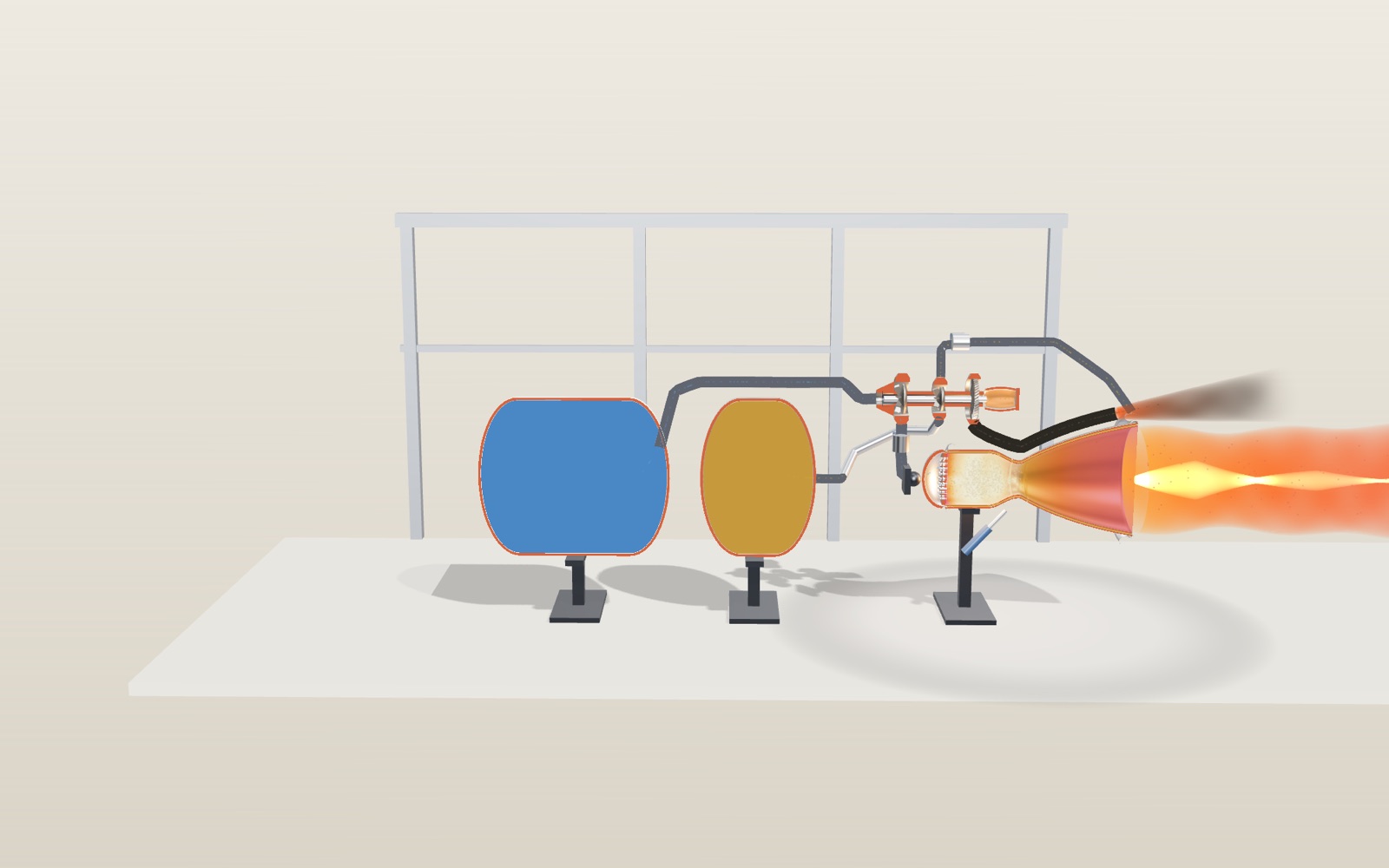
1 / 10 A rocket engine cut along its axis The half facing you is cut away and the red faces show the cut. The engine lies on its side, so the flame points right. Blue dots are liquid oxygen, amber dots are kerosene, and the hot gas changes colour with temperature. The readout gives thrust at sea level.
Drag to turn. Scroll or pinch to zoom.
Guide Parts Controls
01 A rocket engine cut along its axis The half facing you is cut away and the red faces show the cut. The engine lies on its side, so the flame points right. Blue dots are liquid oxygen, amber dots are kerosene, and the hot gas changes colour with temperature. The readout gives thrust at sea level.
02 Two tanks, two liquids A rocket carries its own oxygen, so it needs two tanks. Liquid oxygen boils at −183 °C. The tanks here are drawn short. On Nuri they are 3.5 m wide, with walls only 2.5 to 3 mm thick at the thinnest point.
03 Pumps driven by a small burner Tank pressure alone is far too low to force propellant into a 60 bar chamber. A turbopump does it. Its turbine runs on gas from the gas generator, which burns about 3 percent of the propellant and then dumps it through the exhaust duct.
04 Mixing and burning The injector sprays oxygen and kerosene into the chamber. They burn at 60 bar and about 3,400 K, yet the gas creeps along at Mach 0.2. Colours now show temperature: white is hottest.
05 The throat, where the gas reaches Mach 1 The colours now show Mach number. Blue is slower than sound, white is exactly Mach 1, and orange is faster. The white band sits at the narrowest point. Past it, a widening passage makes supersonic gas go faster, not slower.
06 The bell turns heat into speed Along the bell the gas cools from about 3,400 K to 1,830 K and its pressure drops to 0.66 bar, while it speeds up to 2,813 m/s. Try the expansion ratio slider: a longer bell makes the gas leave faster and at lower pressure.
07 Fuel cools the wall first No metal survives 3,400 K. Kerosene from the pump goes to a ring at the nozzle exit, runs back through 72 channels in the copper wall, and only then reaches the injector. The cut channels show in amber.
08 The same engine in space Altitude is now 100 km. Nothing pushes back on the exit any more, so thrust rises from 671 kN to 762 kN and specific impulse from 268 s to 305 s. The plume, held narrow by air at sea level, now spreads wide.
09 Other ways to drive the pumps The cycle is now staged combustion. The small burner has become a preburner, and its gas no longer goes overboard: the duct takes it down into the injector to burn again. Nothing is wasted, so the pumps can push the chamber to 150 bar in the model. Try the four cycles on the Cycle slider or tap the bars in the Controls tab.
10 Steering by tilting the nozzle The nozzle is tilted 5 degrees on its gimbal. Most of the thrust still pushes forward, but about 9 percent now pushes sideways, which turns the rocket. The readout under More shows that side force.
Liquid oxygen tank Holds the oxidiser at −183 °C. Each second the model engine drinks 161 litres of it, about 2.6 kg for every kilogram of kerosene. Fuel tank Kerosene in the model. Switch the fuel to liquid hydrogen and this tank grows six-fold for the same mass of propellant. Turbopump One shaft carries the oxygen pump, the fuel pump and a small turbine. It raises the pressure of 255 kg of propellant a second well above the 60 bar in the chamber. Gas generator A small burner that takes about 3 percent of the propellant, burns it rich in fuel so the gas stays cool enough for the turbine blades, and drives the turbopump. Turbine exhaust After the turbine the gas is thrown overboard through this duct. It still gives 7 kN of thrust, but far less per kilogram than the main nozzle. Injector A plate with rings of small elements that spray oxygen and fuel into the chamber so they mix and burn within centimetres. Combustion chamber Gas at 60 bar and about 3,400 K in the model. It moves slowly here, at about Mach 0.2. Nozzle throat The narrowest point. The gas reaches the speed of sound here, and the throat area sets how much gas the chamber can push out. Bell nozzle Widens 12 times in area at the model's default. The gas speeds up to Mach 3.3 and 2,813 m/s while it cools and loses pressure. Regenerative cooling channels 72 channels in the copper wall. Kerosene from the pump runs through them toward the injector, carrying heat away from the wall before it is burned. Main valves One valve after each pump. Opening and closing them starts and stops the engine; on a throttling engine they also set the flow. Gimbal and actuator A ball bearing on top of the injector lets the chamber and nozzle tilt a few degrees. An actuator pushes the nozzle, and the sideways part of the thrust steers the rocket. Hot-gas duct In a staged-combustion engine the turbine gas still holds most of the propellant, so this duct takes it into the injector to burn in the main chamber. In an expander it carries warm fuel from the cooling jacket to the turbine and back. Electric motor and battery The electric-pump cycle replaces the turbine with a motor fed by a battery pack. Rocket Lab's Rutherford engine on Electron works this way.