FIG. 58How It Works
Liquid rocket engine: interactive model, how it works
Nuri's 75-tonne engine burns 255 kg of kerosene and liquid oxygen every second, and the same engine pushes about 13 percent harder in space than at sea level.
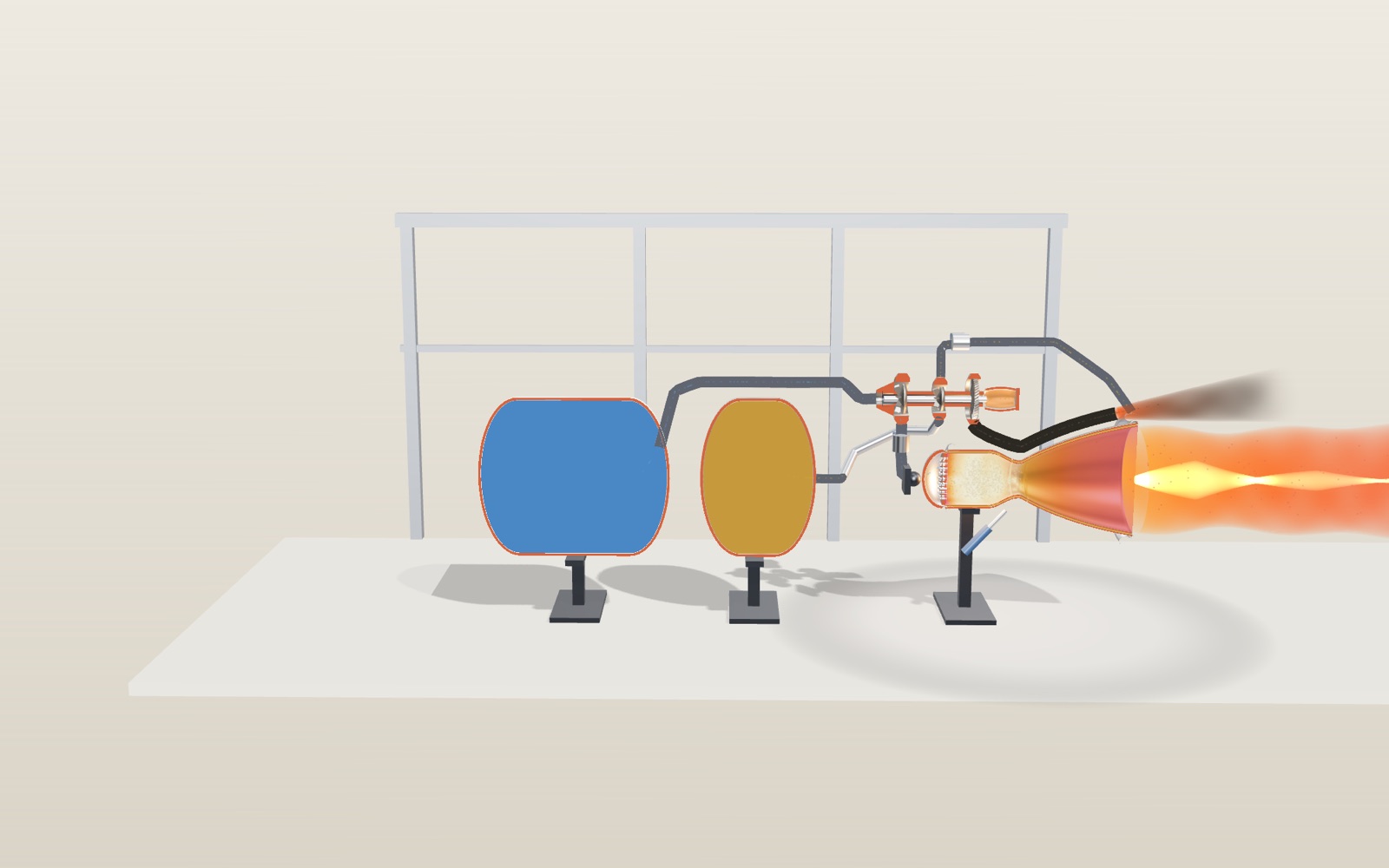
This device cannot show the 3D model. You can read the guide steps below as text.
1 / 10 A rocket engine cut along its axisThe half facing you is cut away and the red faces show the cut. The engine lies on its side, so the flame points right. Blue dots are liquid oxygen, amber dots are kerosene, and the hot gas changes colour with temperature. The readout gives thrust at sea level.
Drag to turn. Scroll or pinch to zoom.
What the model shows
A launch vehicle on the pad looks like a tall white tube with a fire at the bottom. Almost all of that tube is tank. The engine underneath is about a tonne of metal, and its job is to turn a quarter of a tonne of liquid every second into a jet moving faster than a rifle bullet. This exhibit follows that liquid from the tanks to the end of the nozzle.
The model is a gas-generator-cycle liquid rocket engine cut in half along its axis, lying on its side so the flame points to the right. The red faces show where it was cut. It is sized to match the two performance figures the Korea Aerospace Research Institute (KARI) publishes for the 75-tonne-class engine on Nuri: 674.7 kN of thrust at sea level and a specific impulse of 304.8 s in vacuum, with about 255 kg of kerosene and liquid oxygen burned every second. The chamber pressure, the nozzle shape, the cooling channels and the losses are model values. They are typical of engines of this size, but they are not KARI's design data.
Blue dots are liquid oxygen and amber dots are kerosene. Once they burn, the gas is coloured by temperature, or by Mach number if you switch that on in Controls. The small readout on the stage shows thrust and specific impulse; More opens the flow, the pressures, the exit speed and the side force. The Controls tab holds the rest. There you can pick one of 20 real engines, compare the four pump cycles and the three fuels, and see the thrust equation worked through with the current numbers. Two charts follow thrust from sea level to 100 km, and Mach number and temperature along the axis from the injector to the exit.
Why the pumps need so much power
A rocket carries its own oxygen, so it needs two tanks. KARI says Nuri's tanks are up to 10 m tall and 3.5 m wide, with walls as thin as 2.5 to 3 mm at the thinnest point, and they hold four to six times atmospheric pressure in flight. That is a few bar. The combustion chamber in the model runs at 60 bar. Pushing propellant from a 5 bar tank into a 60 bar chamber would need a tank as thick as a pressure vessel, so a pump does it instead.
The turbopump puts an oxygen pump, a fuel pump and a turbine on one shaft. Something has to drive the turbine, and in a gas-generator engine that something is a second, much smaller burner. The gas generator takes about 3 percent of the propellant in the model, burns it with far more fuel than the oxygen can use, and so keeps the gas cool enough for the turbine blades. After the turbine the gas is thrown overboard through the exhaust duct. It still makes a little thrust, 6.9 kN in the model, but much less per kilogram than the main nozzle. That loss is the price of a simple design, and it is why this layout is called an open cycle.
Burning slowly, then choking at the throat
The injector at the back of the chamber is a plate with rings of small holes. It sprays oxygen and kerosene so they meet, break into droplets and burn within a few centimetres. In the model they burn at 3,403 K. KARI describes the inside of Nuri's chamber as reaching 3,000 °C, which is close.
What surprises most people about the chamber is how slowly the gas moves. It is wide, 2.8 times the throat area in the model, so the gas creeps along at about Mach 0.22. Then the wall closes in. Where a passage narrows, slow gas speeds up, and at the narrowest point, the throat, it reaches exactly the speed of sound. Switch on Mach colours and the white band sits right at the throat.
Once the throat is at Mach 1 the flow is choked. Pressure changes further downstream cannot travel back upstream, so the throat alone decides how much gas leaves the chamber. The mass flow is the chamber pressure times the throat area divided by the characteristic velocity, c*, a property of the propellant. In the model c* is 1,815 m/s and the throat area is 0.0748 m², so at 60 bar the chamber passes 247 kg/s. Move the throttle and the pressure and the flow change together.
How a widening bell makes gas go faster
Below the speed of sound a narrowing pipe speeds gas up. Above it the rule turns round, and a widening pipe does the speeding up. Supersonic gas that gets more room expands, cools and loses pressure, and the energy it gives up goes into speed. The bell nozzle is shaped to let that happen smoothly.
In the model the exit is 12 times the area of the throat. Along the bell the gas cools from 3,403 K to 1,829 K, its pressure falls from 60 bar to 0.66 bar, and it leaves at Mach 3.28 and 2,813 m/s. The second chart in the readout shows the two curves crossing: temperature drops as Mach number climbs.
Fuel that cools the wall before it burns
No metal survives 3,400 K for long. The answer used on most large engines is regenerative cooling. In the model, kerosene from the pump goes first to a ring near the nozzle exit, then runs back toward the injector through 72 narrow channels in the copper wall of the chamber. By the time it reaches the injector it has carried away much of the heat that came into the wall, and that heat goes back into the chamber with the fuel. The cut channels show in amber in the seventh step of the guide. Real engines often add a thin film of fuel along the inside of the wall as well, which the model leaves out.
Four ways to drive the pumps
The pumps on an engine this size need several megawatts. Where that power comes from is the engine's cycle, and the Cycle slider switches between four of them. The throat and the nozzle stay the same, so what changes is the chamber pressure each cycle can reach and what happens to the gas that turned the turbine.
Gas generator. This is the model's default and the cycle Nuri uses. A small burner takes about 3 percent of the propellant, runs it rich in fuel so the gas stays cool enough for the blades, and dumps it overboard after the turbine. That dumped gas still gives 6.9 kN, but it leaves the duct at only about 900 m/s in the model, so every kilogram of it is worth far less than a kilogram through the main nozzle. In vacuum the model makes 762 kN at 304.8 s.
Staged combustion. Here the small burner becomes a preburner, and its gas is not thrown away. After the turbine it goes down a duct into the injector and burns again in the main chamber. Because nothing is dumped, the turbine can be given far more gas and the pumps can push much harder. The model allows 150 bar in the chamber instead of 60. With the same throat that raises the flow from 255 kg/s to 618 kg/s and the sea-level thrust from 671 kN to 1,797 kN. Vacuum specific impulse rises from 304.8 s to 311.4 s, the 6.6 s that the gas generator was throwing away. RS-25, RD-180 and Raptor all work this way. The price is plumbing that runs very hot at very high pressure.
Expander. There is no burner at all. Fuel picks up heat in the cooling channels, turns to warm gas and spins the turbine before it reaches the injector. The heat the wall can pass on limits the power, so the model stops at 40 bar and 413 kN at sea level. In vacuum it matches staged combustion at 311.4 s, because nothing is dumped. Real expanders burn hydrogen, which turns to gas easily and cools well. RL10, Vinci and Japan's LE-5B use it, and LE-9 on the H3 first stage uses a version that bleeds a little gas overboard.
Electric pump. A battery and an electric motor take the turbine's place. Rocket Lab's Rutherford engine on Electron does this. The plumbing is the simplest of the four, but the battery has to be carried all the way and does not get lighter as it empties, so the power is small. The model stops at 25 bar, where the 12 : 1 bell over-expands at sea level and the flow separates from the wall. Turn the expansion ratio down to 4 and the separation goes away.
Kerosene, hydrogen or methane
The Fuel slider changes the propellant, and the table in the Controls tab lists what changes with it. The numbers come from the same NASA SP-125 tables the model is tuned to. Kerosene burns hottest, at about 3,403 K at its best mixture of 2.58 kg of oxygen per kilogram of fuel. Hydrogen burns cooler, at 2,740 K, but its exhaust is so light that the model's vacuum specific impulse jumps to 393.5 s. Methane sits between them at 3,260 K and 314.4 s.
The tank column shows the catch. One tonne of kerosene and oxygen fits in 0.97 m³. One tonne of hydrogen and oxygen needs 3.45 m³, more than three times as much, which is why hydrogen stages are fat and why the model's fuel tank grows when you switch. Methane needs 1.22 m³. It also boils at a temperature close to liquid oxygen, which lets the two tanks share a wall more easily, and it leaves less soot than kerosene in reusable engines.
Steering by tilting the nozzle
A rocket steers by pointing its thrust. The chamber and nozzle in the model hang from a ball bearing on top of the injector dome, the gimbal, and an actuator pushes the nozzle to one side. The Gimbal slider tilts it up to 6 degrees either way. At 5 degrees the side force is F sin 5° = 671 kN × 0.087 = 58.5 kN, while the forward push only drops by 0.38 percent. A small tilt buys a large turning force at almost no cost in thrust, which is why nearly every large liquid engine is gimballed. The feed lines on a real engine have flexible bellows so they can follow the movement.
The thrust equation, worked out
NASA's Glenn Research Center gives the rocket thrust equation as
F = ṁ v_e + (p_e − p_a) A_e
The first term is momentum: mass flow times exhaust speed. The second is a pressure term. If the gas at the exit is at a higher pressure than the air around it, it pushes on the exit area and adds thrust. If it is lower, the air pushes back.
With the model at sea level, full throttle, kerosene and an expansion ratio of 12:
- Chamber flow ṁ = 247.3 kg/s and exhaust speed v_e = 2,813 m/s, so ṁ v_e = 695.7 kN.
- Exit pressure p_e = 66.5 kPa, air pressure p_a = 101.3 kPa and exit area A_e = 0.898 m². The pressure term is (66.5 − 101.3) × 0.898 = −31.3 kN.
- The turbine exhaust adds 7.65 kg/s at about 900 m/s, which is 6.9 kN.
- Total F = 695.7 − 31.3 + 6.9 = 671.3 kN.
That is 0.5 percent below KARI's 674.7 kN. The Controls tab shows the same sum and updates it as you move the sliders.
Why the same engine pushes harder in space
Nothing in the first term depends on the air outside. The exhaust speed and the flow are set inside the engine. Only p_a changes with height, and it appears in one place, multiplied by the exit area. At sea level the air presses on the 0.898 m² exit with 101.3 kPa, which is 91 kN. In vacuum that load disappears, and the model's thrust rises to 762.3 kN.
The altitude slider uses the 1976 US Standard Atmosphere. Most of the gain comes early: 738.5 kN at 10 km, 757.3 kN at 20 km, and almost all of it by 30 km, where the air pressure is about 1 percent of its sea-level value. The sky darkens as you go up, and the plume, held narrow by the air at sea level, spreads wide.
KARI's own two numbers show the same effect. At 255 kg/s, a vacuum specific impulse of 304.8 s means a vacuum thrust of 304.8 × 255 × 9.807 = 762.2 kN, about 13 percent more than at sea level. The difference is 87.5 kN. If both figures are for the same flow, that difference is the air pressure times the exit area, which gives an exit area of about 0.86 m² and an exit diameter of about 1.05 m. This is our estimate from the published figures, not a dimension KARI states.
Choosing a nozzle size
Try the expansion ratio slider. In vacuum a longer bell always helps: 738.8 kN at 8, 762.3 kN at 12, 818.7 kN at 40 and 827.5 kN at 50. At sea level the picture is different. The best ratio is close to 8, where the exit pressure is near the air pressure, at 678.1 kN. Past that the gas leaves below air pressure and the pressure term grows more negative.
Push past about 20 and the model warns of flow separation. The air pushes into the bell, the jet comes off the wall, and the outer part of the nozzle stops doing any work. The model uses a common rule of thumb: the flow leaves the wall when its pressure falls below about 40 percent of the outside pressure. Real separation is uneven and can shake a nozzle hard. KARI describes the same problem for Nuri's upper stages. Their engines have larger expansion ratios for thin air, so a ground test suffers flow separation, and KARI tests them in a facility that recreates high-altitude conditions. That is why first-stage engines have short bells and upper-stage engines long ones.
Specific impulse, and what other fuels change
Specific impulse is thrust divided by the weight of propellant used per second:
Isp = F / (ṁ g₀)
For the model at sea level, 671.3 kN / (255.0 × 9.807) = 268.4 s. KARI's sea-level thrust works out the same way to 674.7 kN / (255 × 9.807) = 269.8 s. In vacuum the model gives 304.8 s, matching KARI to within 0.1 s.
The fuel switch changes the propellant while the chamber pressure and the throat stay the same. Liquid hydrogen gives a much lighter exhaust, so the model's vacuum Isp climbs from 305 s to 394 s. The flow drops to 191 kg/s, because hydrogen gas needs less mass to fill the same throat. The catch is volume. Each second the kerosene engine drinks 87 litres of fuel. The hydrogen version needs 524 litres, which is why hydrogen tanks are so big. Methane sits in between, at 314 s and 136 litres per second.
Twenty real engines
The Real engines list in Controls holds 20 engines from Korea, the United States, Europe, Japan and Russia. Picking one switches the stage to its cycle and fuel and shows the thrust and specific impulse the agency or maker publishes. The sizes and numbers on the stage stay model values, so a picked F-1 does not suddenly make 6,770 kN. Where the source prints no figure, the table shows a dash rather than a number from elsewhere.
| Engine | Cycle | Fuel | Published thrust |
|---|---|---|---|
| KRE-075 (Nuri) | gas generator | kerosene | 674.7 kN at sea level, 304.8 s in vacuum |
| F-1 (Saturn V) | gas generator | kerosene | 6,770 kN at sea level |
| RD-180 (Atlas V) | staged combustion | kerosene | 3,825 kN at sea level, 4,148 kN in vacuum |
| RS-25 (Shuttle, SLS) | staged combustion | hydrogen | 1,859 kN at sea level, 2,279 kN in vacuum |
| Vulcain 2 (Ariane 5) | gas generator | hydrogen | 1,350 kN in vacuum, 433 s |
| LE-5B-3 (H3) | expander bleed | hydrogen | 137.2 kN in vacuum, 448 s |
| BE-4 (Vulcan, New Glenn) | staged combustion | methane | 2,450 kN at sea level |
| Rutherford (Electron) | electric pump | kerosene | 24.9 kN at sea level |
The full list in the exhibit adds KRE-007, KARI's staged-combustion research engine, Merlin 1D and its vacuum version, J-2, RL10, Vulcain 2.1, Vinci, LE-7A, LE-9, BE-3U and Raptor 2.
How this model differs from a real engine
- The gas is treated as one ideal gas with fixed properties. Real combustion gas changes composition as it cools, which shifts the numbers by a few percent.
- A single loss factor of 0.934 stands in for incomplete burning, friction and the spread of the jet.
- The chamber pressure, gas-generator share and cooling channel count are model values, not KARI data.
- The tanks are drawn short and close to the engine so they fit on screen.
- Igniters, bellows in the feed lines and the heat exchanger that warms pressurising gas are left out. The main valves and the gimbal are drawn but do not change the flow.
- The four cycles share one throat and one nozzle. Real engines of each cycle are designed around their own pressures, so a picked real engine shows its cycle and fuel, not its size.
From Goddard's first flight to Nuri
Robert Goddard launched the first liquid-fuelled rocket on 16 March 1926 in Auburn, Massachusetts, burning gasoline and liquid oxygen. The German A-4, better known as the V-2, made its first successful flight on 3 October 1942. It had a turbopump, and its chamber was cooled by its own alcohol fuel. The Rocketdyne F-1 that lifted Saturn V used a gas-generator cycle like the model and made about 6.77 MN at sea level.
KARI flew its 75-tonne-class engine first on a single-stage test vehicle on 28 November 2018. It burned for 151 seconds, beyond the 140-second target, and reached 209 km. By November 2020, KARI reports, 25 engines had been built and tested 168 times for a total of 16,690 seconds. Nuri's first stage clusters four of these engines for 300 tonnes of thrust, and the second stage uses one. Nuri has flown on 21 October 2021, 21 June 2022, 25 May 2023, 27 November 2025 and 7 October 2026.
How much propellant a trip to orbit takes
The model gives you thrust and specific impulse. To see what those are for, put them in the rocket equation. NASA Glenn writes it as Δv = Isp · g₀ · ln(MR), where MR is the mass at ignition divided by the mass at burnout. Turned round, MR = e^(Δv / (Isp · g₀)).
Take the model's vacuum specific impulse of 304.8 s. The exhaust speed is 304.8 × 9.807 = 2,989 m/s. Low Earth orbit needs a speed of about 7.8 km/s, and with the speed lost to gravity and air on the way up the rocket has to supply roughly 9.4 km/s. That 9.4 km/s is an assumed round figure, not a value from KARI. Then:
- Δv / v_e = 9,400 / 2,989 = 3.145
- MR = e^3.145 = 23.2
- Propellant share of the launch mass = 1 − 1/23.2 = 95.7 percent
Nearly all of the launch mass would have to be propellant, with 4.3 percent left for tanks, engines and payload together. A single stage cannot manage that. Split the same job into two stages that each add 4.7 km/s and each needs MR = e^(4,700 / 2,989) = 4.82. Each stage then carries 79 percent of its own mass as propellant, which is hard but possible, and the two ratios multiply back to 23.2. That is why Nuri has stages: the empty first stage is dropped and the engine of the next one does not have to lift it.
The same sum for the other fuels at the model's vacuum values gives MR = 11.4 for hydrogen (393.5 s) and 21.1 for methane (314.4 s). The 89 seconds hydrogen gains over kerosene nearly halves the mass ratio. Each doubling of MR adds only v_e × ln 2 = 2,072 m/s, so every extra kilometre per second costs more propellant than the one before. NASA's own example uses an Isp of 350 s and a Δv of about 7.6 km/s and arrives at a mass ratio near 10, so that about 90 percent of the rocket is propellant.
What people often get wrong
"The rocket pushes against the air." If it did, it would work worse in space. The model does the opposite: the air presses back on the nozzle exit, and removing it raises thrust from 671 kN to 762 kN. The push comes from throwing mass backward, and the reaction acts on the engine.
"A rocket cannot go faster than its exhaust." It can. The mass ratio lets the rocket reach a multiple of the exhaust speed. In the example above the rocket ends at 9.4 km/s with an exhaust speed of 2.99 km/s, 3.1 times faster.
"Specific impulse is how long the engine burns." It has units of seconds, but it is thrust per weight of propellant used each second. A 304.8 s engine does not burn for 304.8 s. Nuri's engine ran for 151 s on its 2018 test flight.
"The fire in the chamber is violent and fast." The gas in the model chamber moves at about Mach 0.22 and only reaches the speed of sound at the throat. The speed comes from the nozzle, not from the burning.
"A bigger nozzle is always better." In vacuum it is. At sea level past an expansion ratio of about 8 the thrust falls, and past about 20 the model warns of separation.
Try it on the screen
- Open Controls and note the sea-level thrust with the default settings. It is 671 kN.
- Drag the altitude slider up to 30 km. The thrust climbs toward 762 kN and the plume widens. Compare the figure with the sum in the thrust equation section.
- Set the expansion ratio to 8, then to 40. Read the thrust at sea level and in vacuum each time and see which setting wins where.
- Move the Fuel slider from kerosene to hydrogen. Watch the vacuum specific impulse rise to 393.5 s and the tank column grow. Put each value into Δv = Isp · g₀ · ln(MR) with MR = 10 to see how much speed each fuel buys.
- Raise the Gimbal slider to 5 degrees and read the side force, 58.5 kN, against the forward thrust.
- Switch the Cycle slider to staged combustion and note how much the flow and the thrust rise with the same throat.
Questions
Why does a rocket carry liquid oxygen?
Burning needs oxygen, and above the lower atmosphere there is almost none. A rocket brings its own. In the model about 2.6 kg of oxygen goes with every kilogram of kerosene.
What does the turbopump do?
It raises the pressure of the propellant from the few bar in the tanks to well above the chamber pressure. In a gas-generator engine its turbine runs on gas from a small separate burner.
What is a gas-generator cycle?
A design in which a small share of the propellant is burned to drive the turbine and then dumped overboard. It is simpler than a staged-combustion engine, which feeds the turbine gas into the main chamber, but it wastes a few percent of the propellant.
Why is the nozzle narrow in the middle?
Gas below the speed of sound speeds up as a passage narrows, and gas above it speeds up as the passage widens. The throat is where the gas passes Mach 1, so the nozzle narrows to it and then widens.
Why is thrust higher in space?
At sea level the air pushes back on the nozzle exit. In vacuum that push is gone. For the model it is worth 91 kN, and KARI's figures imply about 87.5 kN for Nuri's engine.
What is specific impulse?
Thrust divided by the weight of propellant burned per second, measured in seconds. It tells you how much push a kilogram of propellant gives. Higher is better.
Why not give every engine a huge nozzle?
At sea level an oversized bell lets the gas fall below air pressure, which costs thrust, and the flow can separate from the wall. Big bells also weigh more. First-stage engines use shorter bells than upper-stage engines.
What is staged combustion?
A cycle in which the gas that drives the turbine is not dumped but fed into the main chamber to burn. Nothing is wasted, and the pumps can reach much higher pressure. In the model it lifts vacuum specific impulse by 6.6 s with kerosene and 9.3 s with hydrogen.
Why do upper stages often burn hydrogen?
In space the extra specific impulse matters most, and hydrogen gives about 90 s more than kerosene in the model. Its bulky tanks hurt less on an upper stage than on a first stage that has to push through the air.
How does a rocket steer?
Most liquid engines tilt on a gimbal. At 5 degrees the model's side force is 58.5 kN while forward thrust drops by less than half a percent.
Can a battery really drive a rocket pump?
Yes, on small engines. Rocket Lab's Rutherford uses battery-powered electric pumps. On large engines a battery heavy enough for the power would weigh more than a turbine and its burner.
Terms
- Propellant: the fuel and oxidiser together.
- Turbopump: pumps and the turbine that drives them on one shaft.
- Gas generator: a small burner that makes gas to drive the turbine.
- Injector: the plate that sprays propellant into the chamber.
- Throat: the narrowest point of the nozzle, where the gas reaches Mach 1.
- Expansion ratio: exit area divided by throat area.
- Regenerative cooling: cooling the wall by running fuel through channels in it before it is burned.
- Characteristic velocity (c*): chamber pressure times throat area divided by mass flow, a measure of the propellant's energy.
- Specific impulse (Isp): thrust per unit weight flow of propellant, in seconds.
- Flow separation: the jet leaving the nozzle wall before the exit.
- Staged combustion: a cycle that burns the turbine gas again in the main chamber.
- Preburner: the small burner that drives the turbine in a staged-combustion engine.
- Expander cycle: a cycle in which fuel warmed by the chamber wall drives the turbine.
- Gimbal: the bearing that lets the engine tilt to steer.
Sources
- Korea Aerospace Research Institute, NURI Engine (sea-level thrust 674.7 kN, vacuum specific impulse 304.8 s, 255 kg/s, chamber temperature, production and test totals, high-altitude testing). https://www.kari.re.kr/eng/contents/180
- 한국항공우주연구원, 누리호 엔진. https://www.kari.re.kr/kor/contents/53
- Korea Aerospace Research Institute, NURI Propellant Tank (height, diameter, wall thickness, tank pressure). https://www.kari.re.kr/eng/contents/181
- Korea Aerospace Research Institute, Korean Launch Vehicle NURI (stages and thrust). https://www.kari.re.kr/eng/contents/178
- 한국항공우주연구원, 한국형발사체 누리호 (launch dates). https://www.kari.re.kr/kor/contents/51
- Korea Aerospace Research Institute, Test Launch Vehicle (2018 flight). https://www.kari.re.kr/eng/contents/179
- NASA Glenn Research Center, Rocket Thrust Equation. https://www1.grc.nasa.gov/beginners-guide-to-aeronautics/rocket-thrust-equation/
- NASA Glenn Research Center, Specific Impulse. https://www1.grc.nasa.gov/beginners-guide-to-aeronautics/specific-impulse/
- NASA Glenn Research Center, Rocket Thrust Summary (choked flow, area ratio). https://www.grc.nasa.gov/www/k-12/airplane/rktthsum.html
- NASA Glenn Research Center, Nozzle Design. https://www.grc.nasa.gov/www/k-12/airplane/nozzle.html
- NASA, NOAA and US Air Force, U.S. Standard Atmosphere, 1976. https://ntrs.nasa.gov/citations/19770009539
- Dieter K. Huzel and David H. Huang, Design of Liquid Propellant Rocket Engines, NASA SP-125, second edition, 1971 (propellant performance tables with mixture ratio and chamber temperature, gas-generator cycle, regenerative cooling, jet separation in overexpanded nozzles). https://ntrs.nasa.gov/citations/19710019929
- NASA History, 95 Years Ago: Goddard's First Liquid-Fueled Rocket (16 March 1926, Auburn, Massachusetts, gasoline and liquid oxygen). https://www.nasa.gov/history/95-years-ago-goddards-first-liquid-fueled-rocket
- Smithsonian National Air and Space Museum, V-2 Missile (first successful flight 3 October 1942, turbopump, fuel of 75 percent alcohol and water whose water helped cool the motor). https://airandspace.si.edu/collection-objects/missile-surface-surface-v-2-4/nasm_A19600342000
- NASA Marshall Space Flight Center, Waking a Giant: Bringing the Saturn F-1 Engine Back to Life, 2013 (1,522,000 lbf at sea level, about 6.77 MN; gas-generator cycle). https://ntrs.nasa.gov/citations/20140011656
- NASA Marshall Space Flight Center, SLS RS-25 Core Stage Engine fact sheet, 2025 (418,000 lbf at sea level, 512,300 lbf in vacuum). https://www.nasa.gov/wp-content/uploads/2025/04/sls-4963-sls-rs-25-engine-fact-sheet-508.pdf
- P. Coffman, Rocketdyne J-2 Saturn V 2nd and 3rd Stage Engine, NASA Technical Reports Server, 2009 (open-cycle gas generator, up to 230,000 lbf). https://ntrs.nasa.gov/citations/20100027318
- L3Harris, Celebrating 60 Years and Counting of Flight for a Trusted National Workhorse, 2023 (RL10, first hydrogen engine, early versions about 15,000 lbf in vacuum). https://www.l3harris.com/newsroom/editorial/2023/11/celebrating-60-years-and-counting-flight-trusted-national-workhorse
- European Space Agency, ESA Bulletin 102, Coulon, Vulcain 2 (1,350 kN in vacuum, 433 s, 115 bar). https://www.esa.int/esapub/bulletin/bullet102/Coulon102.pdf
- European Space Agency, The engines of Ariane 6 (Vulcain 2.1 1,371 kN, Vinci 180 kN, up to four ignitions). https://www.esa.int/Enabling_Support/Space_Transportation/Ariane/The_engines_of_Ariane_6
- JAXA, LE-7A (H-IIA first-stage engine, staged combustion, 1,098 kN in vacuum). https://www.rocket.jaxa.jp/rocket/engine/le7/
- JAXA, H3 Launch Vehicle (LE-9 first-stage engine). https://global.jaxa.jp/projects/rockets/h3/
- Mitsubishi Heavy Industries and JAXA, 2nd qualification test series results of the upper stage engine LE-5B-3 for H3 rocket, EUCASS 2019 (expander bleed cycle, 137.2 kN, 448.0 s, 3.61 MPa). https://www.eucass.eu/doi/EUCASS2019-0626.pdf
- Blue Origin, Engines (BE-4 oxygen-rich staged combustion with liquefied natural gas; BE-3U open expander, 200,000 lbf). https://www.blueorigin.com/engines
- Glavkosmos (Roscosmos), RD-180 (390 / 423 tf at sea level and in vacuum, 311 / 339 s, chamber 261.7 kgf/cm²). https://trade.glavkosmos.com/rd-180/
- SpaceX, Falcon 9 (Merlin 1D 845 kN at sea level, Merlin Vacuum 981 kN, 348 s) and Starship (Raptor 2, 230 tf). https://www.spacex.com/vehicles/falcon-9/ and https://www.spacex.com/vehicles/starship/
- Rocket Lab, Electron (Rutherford, electric pump-fed, 24.9 kN at sea level, 311 s). https://www.rocketlabcorp.com/launch/electron/
- 한국항공우주연구원, 누리호 엔진 (7톤급 엔진, 다단연소 사이클 엔진 선행 연구개발 설계규격). https://www.kari.re.kr/kor/contents/53
- NASA Glenn Research Center, Ideal Rocket Equation (Δv = Isp g₀ ln MR, worked example with Isp 350 s). https://www1.grc.nasa.gov/beginners-guide-to-aeronautics/ideal-rocket-equation/
- NASA Glenn Research Center, Booster Staging Interactive (why launchers drop stages, serial and parallel staging). https://www1.grc.nasa.gov/beginners-guide-to-aeronautics/stage/
- Calculations on this page: a one-dimensional ideal-gas nozzle model with model values (chamber 60 bar, expansion ratio 12, gas generator 3 percent, loss factor 0.934; for the other cycles 150, 40 and 25 bar with nothing dumped). Pages checked 16 and 17 October 2026.
More exhibits
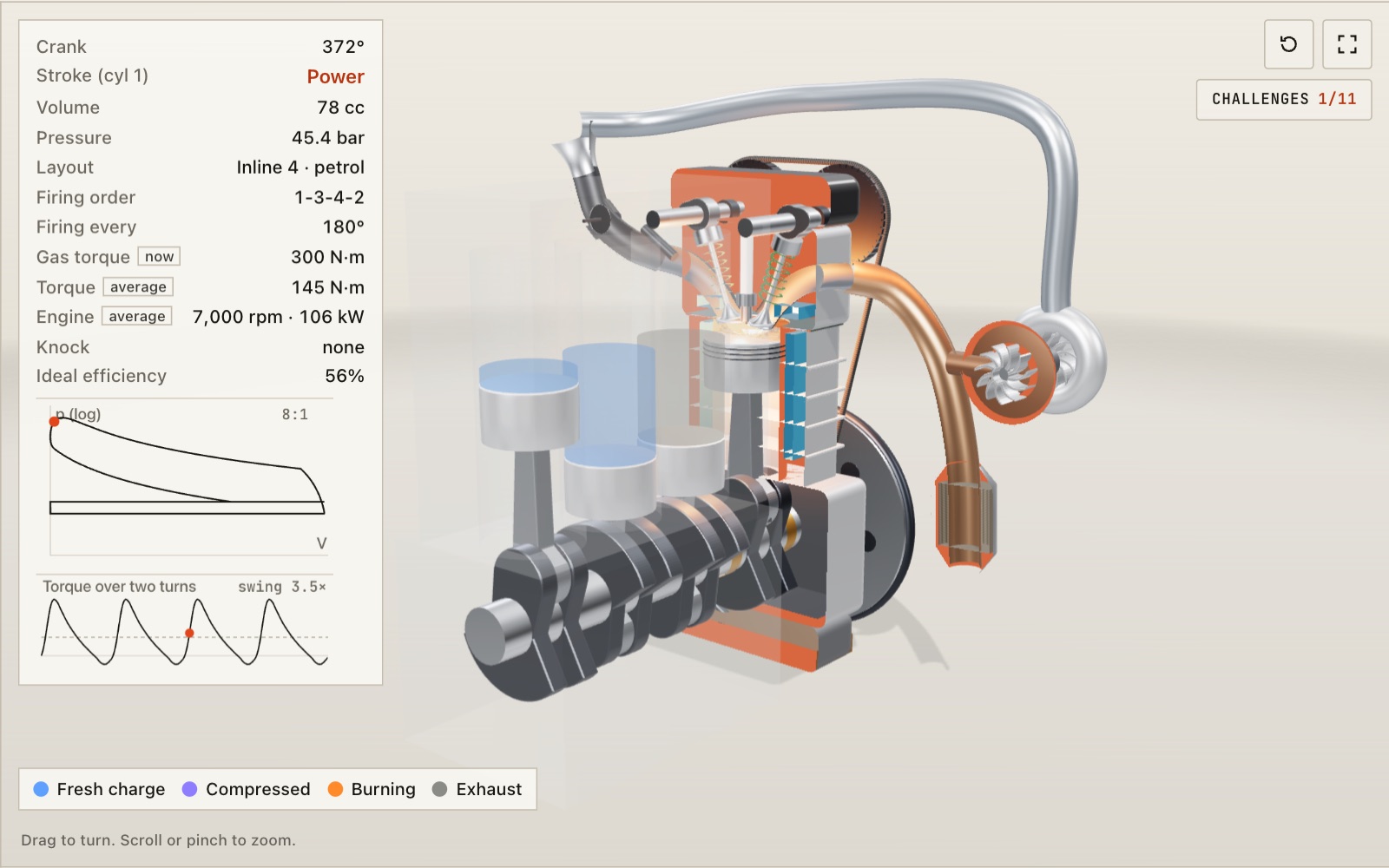
How a four-stroke engine works: two crank turns per cycle
At 3,000 rpm each cylinder fires 25 times a second. Here the engine turns slowly enough to follow every stroke, laid out as anything from a single to a V8 with its own firing order.
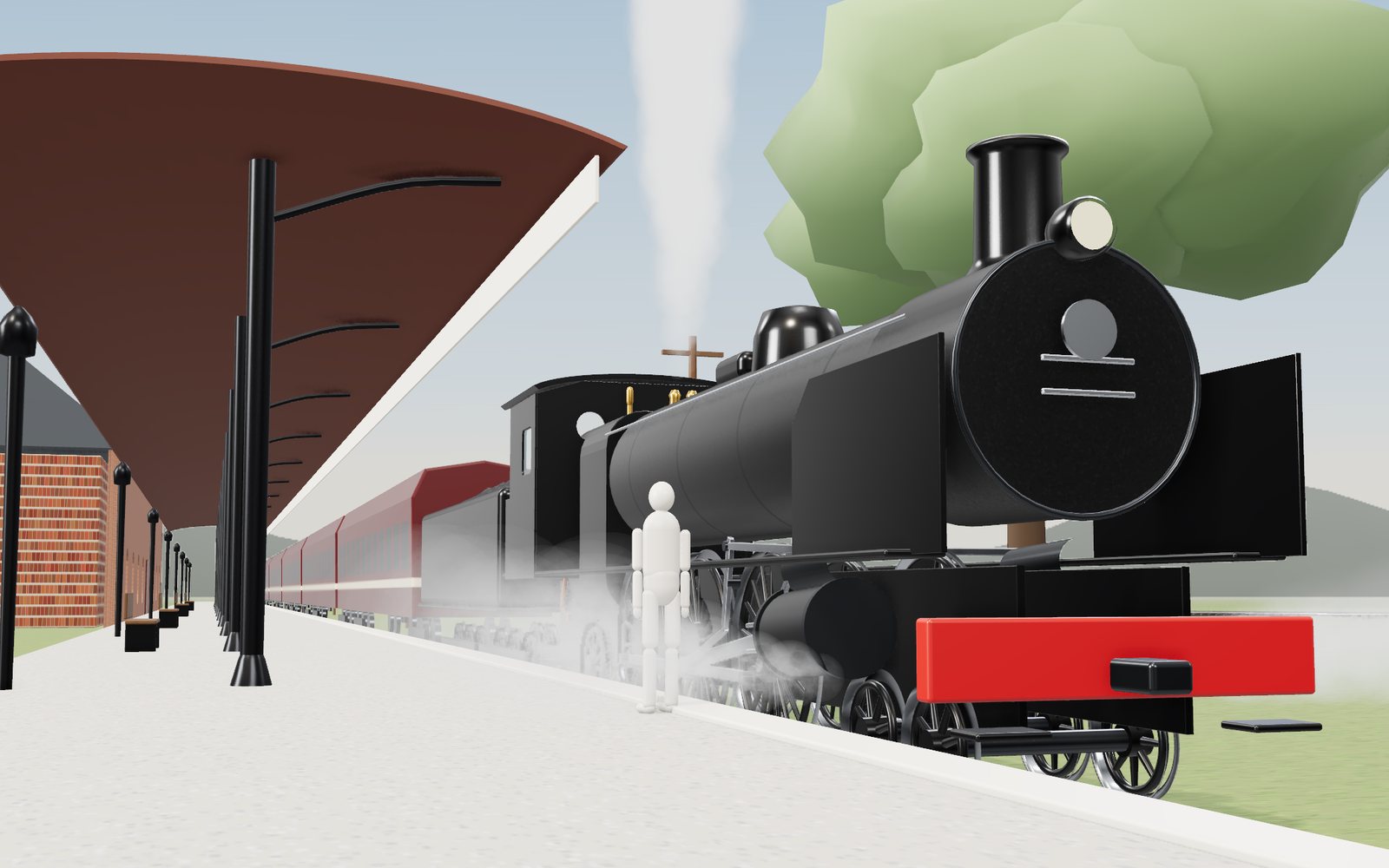
How a steam locomotive works
Mallard's driving wheels are 2.03 m across, taller than most people, and at its record 126 mph they turned almost nine times a second.
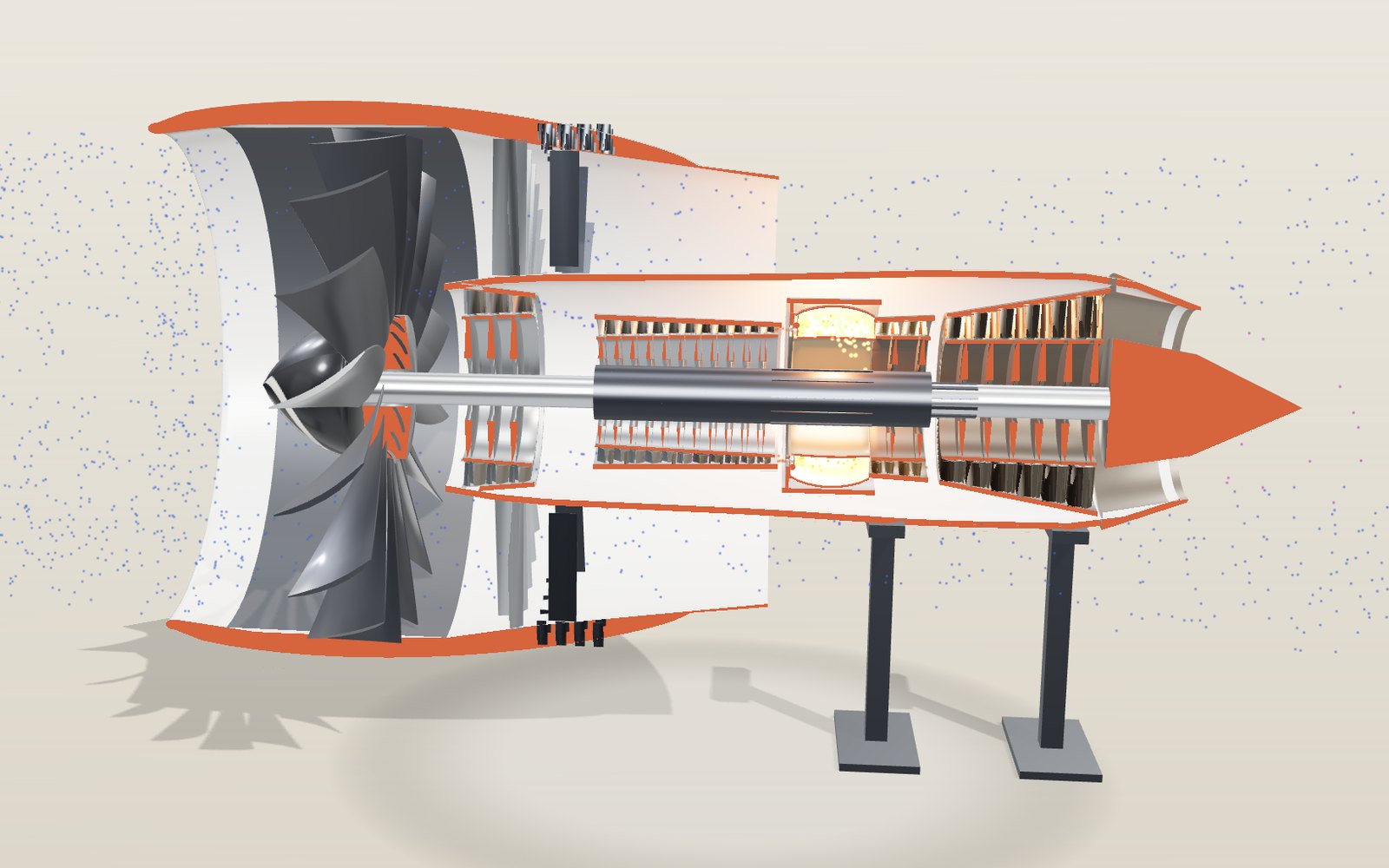
How a jet engine works: where an airliner’s thrust comes from
In an airliner's turbofan only one kilogram of air in eleven passes through the flame. Six other kinds of jet engine split the work differently, and you can open each one here.
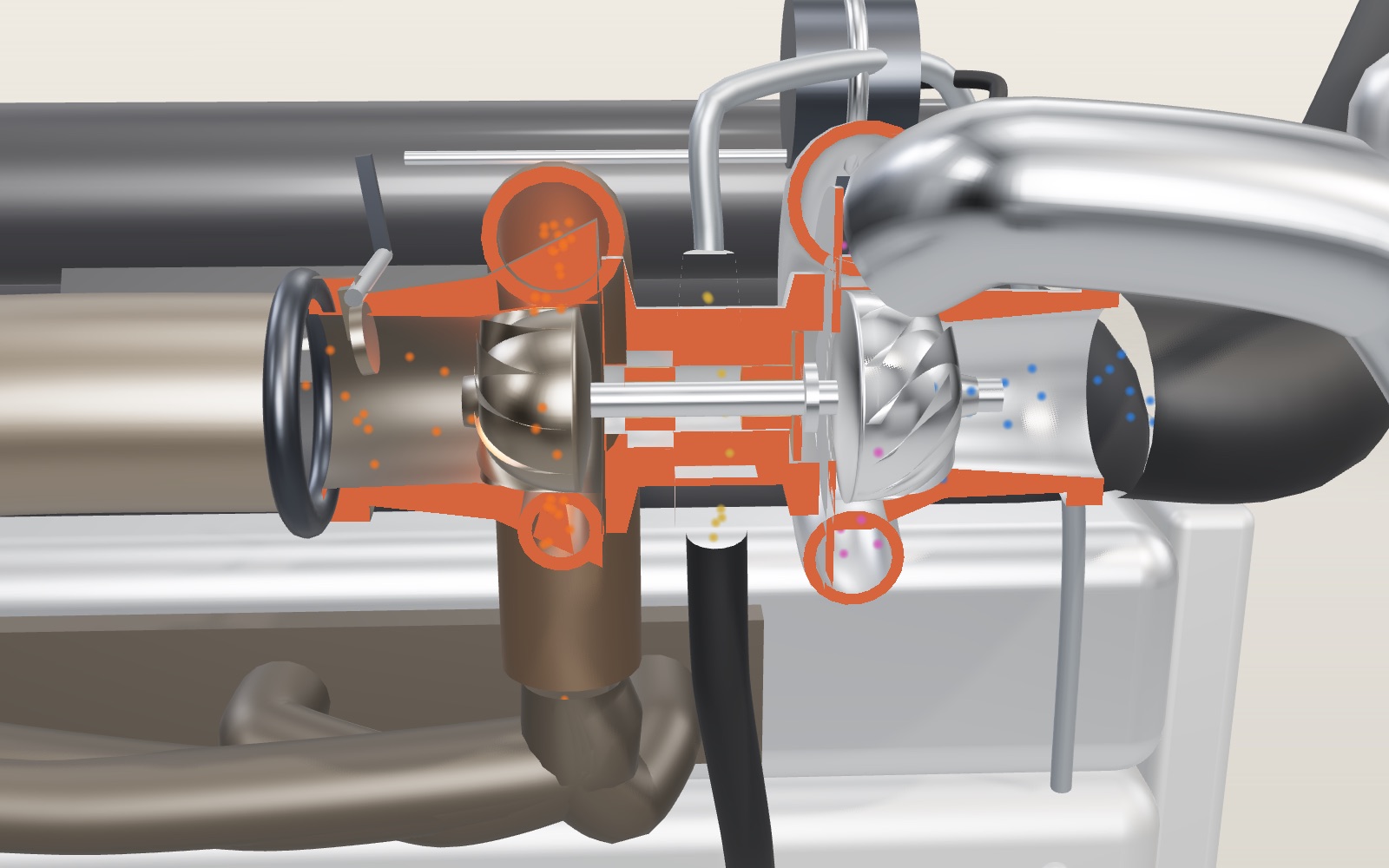
Turbocharger: interactive model, take it apart
On this model 2.0-litre engine, a shaft spinning at 142,000 rpm squeezes almost twice as much air into each cylinder.
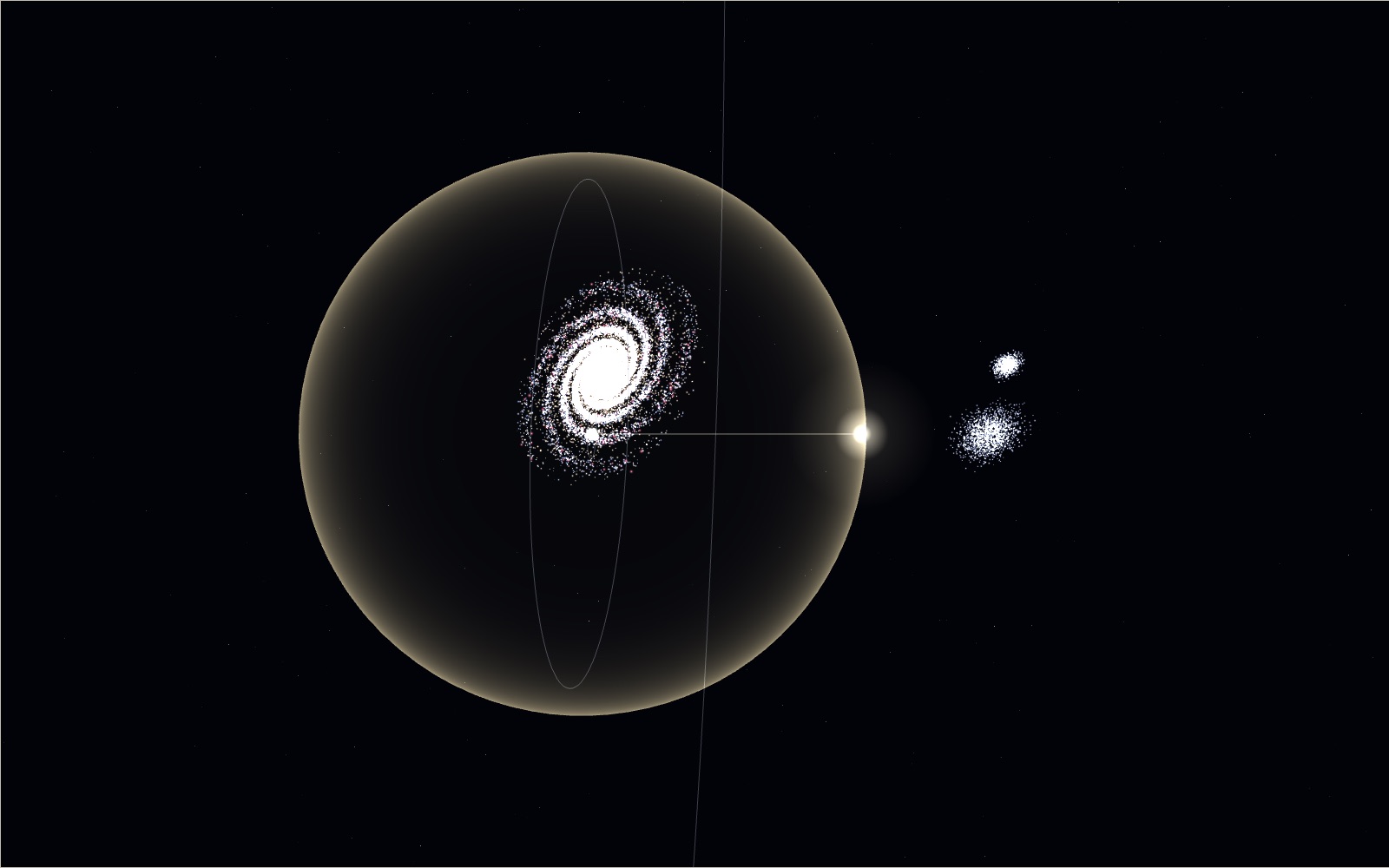
Travelling at the speed of light
Light goes round the equator 7.5 times in a second, yet the same light needs 2.5 million years to reach the Andromeda galaxy.
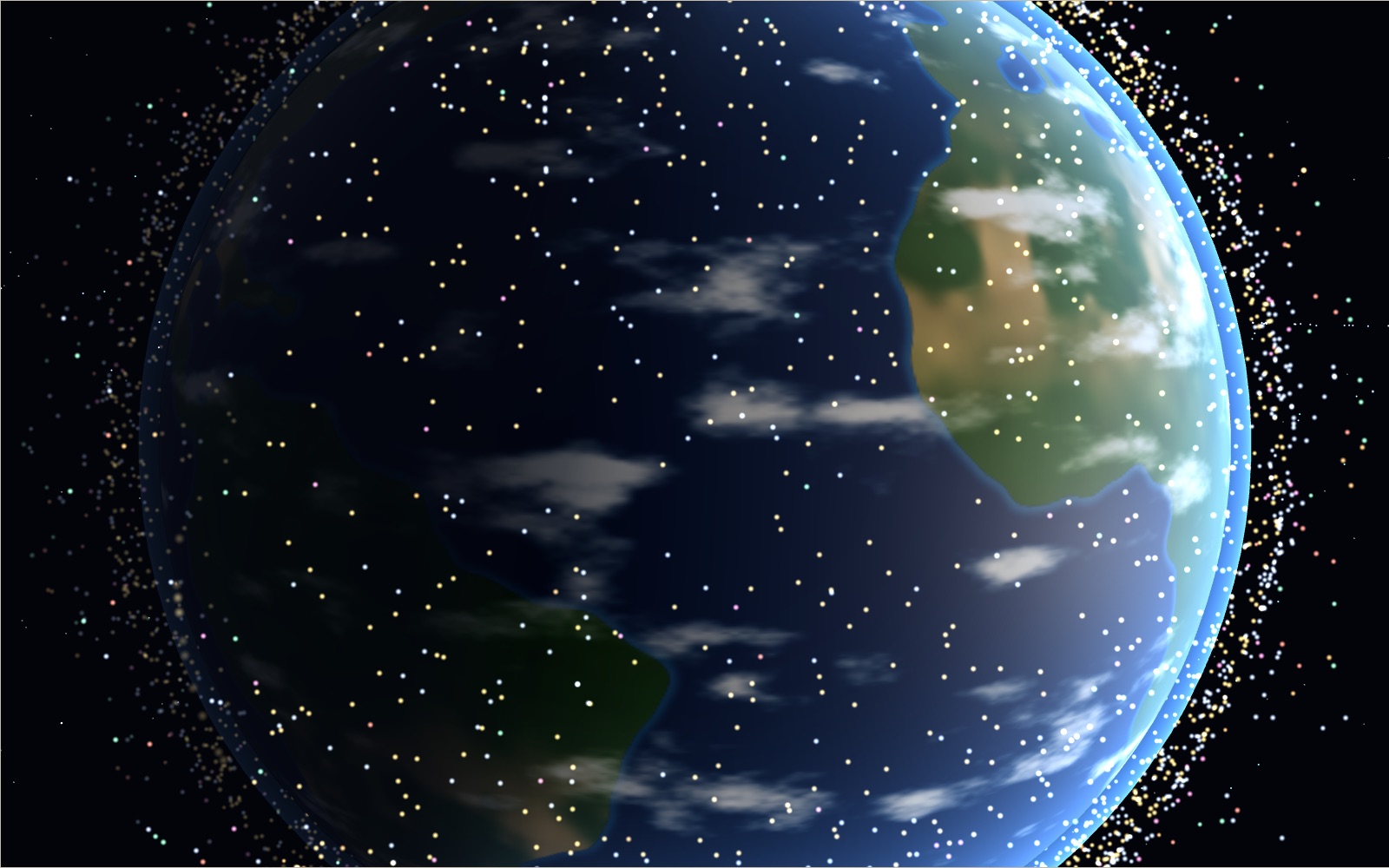
Satellites orbiting Earth right now
On 20 October 2026 the public catalogue listed 16,768 working satellites, and two in every three belonged to one company's internet network.