Loading the model
This device cannot show the 3D model. You can read the guide steps below as text.
1 / 16 The chain lift does all the work A chain pulls the train up a 40° slope at 3 m/s until the riders are 42.5 m up, 40 m above the valley. Every kilogram of train gains 9.81 × 40 = 392 joules. After the crest no motor touches the train until the brakes. With Sound on you hear the anti-rollback dogs clack over the rack.
Drag to turn. Scroll or pinch to zoom.
Guide Parts Controls
01 The chain lift does all the work A chain pulls the train up a 40° slope at 3 m/s until the riders are 42.5 m up, 40 m above the valley. Every kilogram of train gains 9.81 × 40 = 392 joules. After the crest no motor touches the train until the brakes. With Sound on you hear the anti-rollback dogs clack over the rack.
02 Height turns into speed On the way down, potential energy becomes kinetic energy: ½v² = g·h. Without losses, 40 m plus the 3 m/s from the lift gives 28.2 m/s (101 km/h). With friction and air drag on, the model reaches 99 km/h at the bottom.
03 Heavy at the bottom At the bottom the track bends upward, so the seat has to push harder than your weight, by v²/R. The curve is shaped so the load builds smoothly to about 3.5 g. The figure beside the ride button shows that push on a rider's body; the red line in the graph shows it over time.
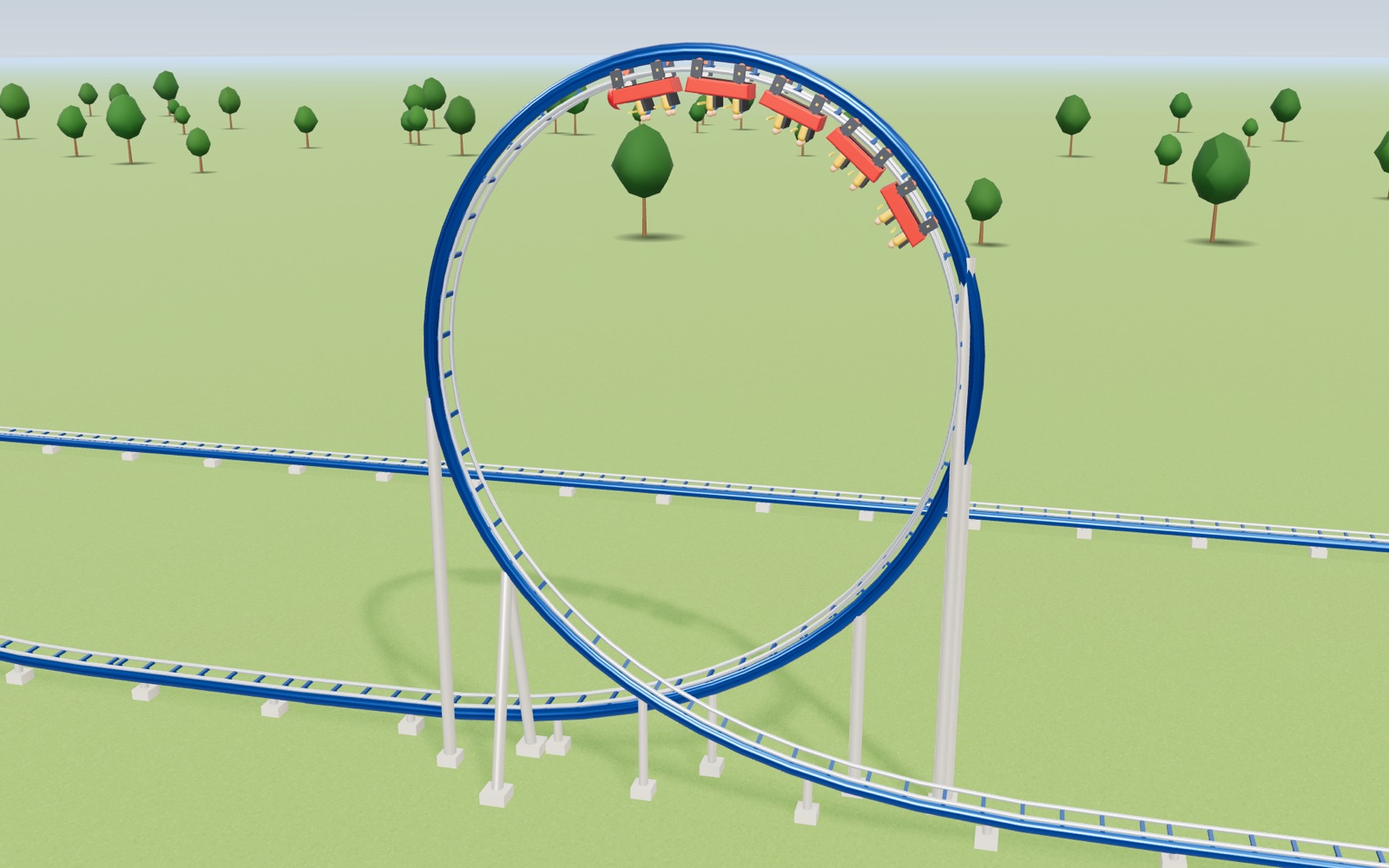
04 The top of the loop Upside down, gravity alone can bend your path into a circle of radius r if v² = g·r. The train arrives at 53 km/h: v² is 214 m²/s² against g·r = 9.81 × 8.2 = 80, so riders are still pressed into their seats, at about 1.7 g.
05 A circular loop hurts This older kind of course has a circular loop 12 m tall. Entered from straight track, a circle starts curving all at once, so the load jumps to over 8 g at the bottom. The steel looper's clothoid loop peaks at about 4.5 g.
06 Floating over the hill The hill top is shaped close to the arc of a thrown ball. The track falls away almost as fast as you fall, so the seat pushes with less than half your weight, about 0.45 g here. Below 0.2 g the readout counts the time as airtime.
07 Hills made for airtime The wooden out-and-back has no loops. Its five hills are shaped for about 0 g at the top, so riders lift off their seats over each one: about 7.7 s of airtime in one ride, against none on the steel looper.
08 A launch instead of a lift Linear motors along a 116 m launch track push the train at 1.4 g, from walking pace to 194 km/h in about 3.8 s. The energy comes from the motors instead of a chain and arrives in seconds.
09 Over the top hat At 54 m/s the energy formula allows a climb of 149 m. The top hat is 135 m high, so with friction and air drag the train goes over at about 42 km/h. Lower the launch speed to 52 m/s and the train rolls back down, where the brakes on the launch track catch it.
10 Hanging under the track On the inverted coaster the rails are above the riders' heads. The zero-g roll twists along the arc a thrown ball would follow, so riders feel close to 0 g while they turn upside down.
11 Rolling round the heart The path in this model is the riders' heartline, the line through their chests. In a heartline roll the rails twist round that line while the heart travels straight, so riders just turn over and hang at -1 g at the middle.
12 Seats that spin On the 4D coaster each pair of seats turns on its own axle. The track is the same for every rider, but the seat turns the body, so the same load can press you into the seat, along your back or out of it.
13 Through the loop backwards The shuttle has no circuit. A launch sends the car through the loop at up to 94 km/h and up a vertical spike. It stops, rolls back through the loop backwards and up the rear spike, then returns to the station, where it is stopped.
14 Magnetic brakes Copper fins along the track pass magnets under the train. Eddy currents in the fins push back with a force that grows with speed, so the speed falls in a straight line with distance. Here the brakes take the train from 90 to 50 km/h before the turn.
15 Three wheels round the rail Each corner of a car has a running wheel on top of the rail, a guide wheel at the side and an upstop wheel underneath. Upside down or over an airtime hill, the upstop wheel holds the car on the track. John Miller patented it in 1919.
16 How much g is too much The family coaster stays between 0.6 and 2.5 g. Rides for small children are often kept near 2 g and family coasters near 3 g, while many big coasters pass 4 g for a second or two.
Chain lift A 40° slope with a moving chain between the rails. Dogs under the cars hook into it and the chain drags the train up at 3 m/s. A toothed rack beside it stops the train rolling back if the chain stops. Launch track Linear motors in a long straight push the train with a steady force, here up to 1.4 g. No chain and no lift hill: the energy arrives in a few seconds. First drop The crest bends over gently, then the track falls steeply. The curve at the bottom is shaped for about 3.5 g so the load builds smoothly. Vertical loop 26 m tall on the steel looper. As a clothoid its radius shrinks from very large at the entry to 8.2 m at the top. Switch Clothoid loop off to get a circle of the same height. Airtime hill A rounded hill whose top is shaped close to the path of a thrown ball, so the seat pushes on riders with less than their weight. Top hat Straight up at 90°, over a rounded top and straight down again. Only a launched train has the energy to get over one this tall. Rolls and corkscrews Pieces that turn riders upside down: a zero-g roll on the arc of a thrown ball, a heartline roll round the riders' chests, and a corkscrew that twists round a line beside the track. Magnetic brakes Rows of copper fins along the track. Magnets under the train passing the fins make eddy currents that slow it, harder the faster it goes. They slow the train before a turn and at the end. Track Two steel rails 1.1 m apart on ties, carried by a large spine tube (a timber deck on the wooden course). Turns are banked so riders are pushed into their seats, not sideways. Vertical spike A dead-end tower on the shuttle loop. The car runs up it until it stops, then comes back down backwards. Supports Steel columns on concrete footings, A-frames where the track is high, wooden bents on the wooden course. Inverted track hangs from arms that reach over the train. Station Loading platform with the operator's booth. Drive tyres in the track start the train and stop it again at the end of the ride. Train Three to seven cars depending on the course: sit-down cars, cars that hang under the track, seats on wings, or 4D seats that spin on their own axle. 6,000 kg full in the model. Wheel assemblies Each corner of a car has three wheels round the rail: running, guide and upstop. A copper fin under the car shows where a magnetic brake would act. Running wheel Rolls on top of the rail and carries the weight of the car and riders. Polyurethane tyres are quieter than steel and roll with less friction than rubber. Guide wheel Rolls against the side of the rail and keeps the car centred in turns. Upstop wheel Runs under the rail. Upside down or over an airtime hill, when the car would lift off, this wheel holds it on the track. Anti-rollback ratchet A toothed rack beside the chain and a hinged dog under the car. The dog drops into each tooth as the car climbs, which makes the clacking sound, and catches the car if it starts to roll back. Magnetic brake Rows of magnets with a copper fin running between them. The moving fin carries eddy currents that push back on it. The force grows with speed and fades to nothing as the car stops.