Loading the model
This device cannot show the 3D model. You can read the guide steps below as text.
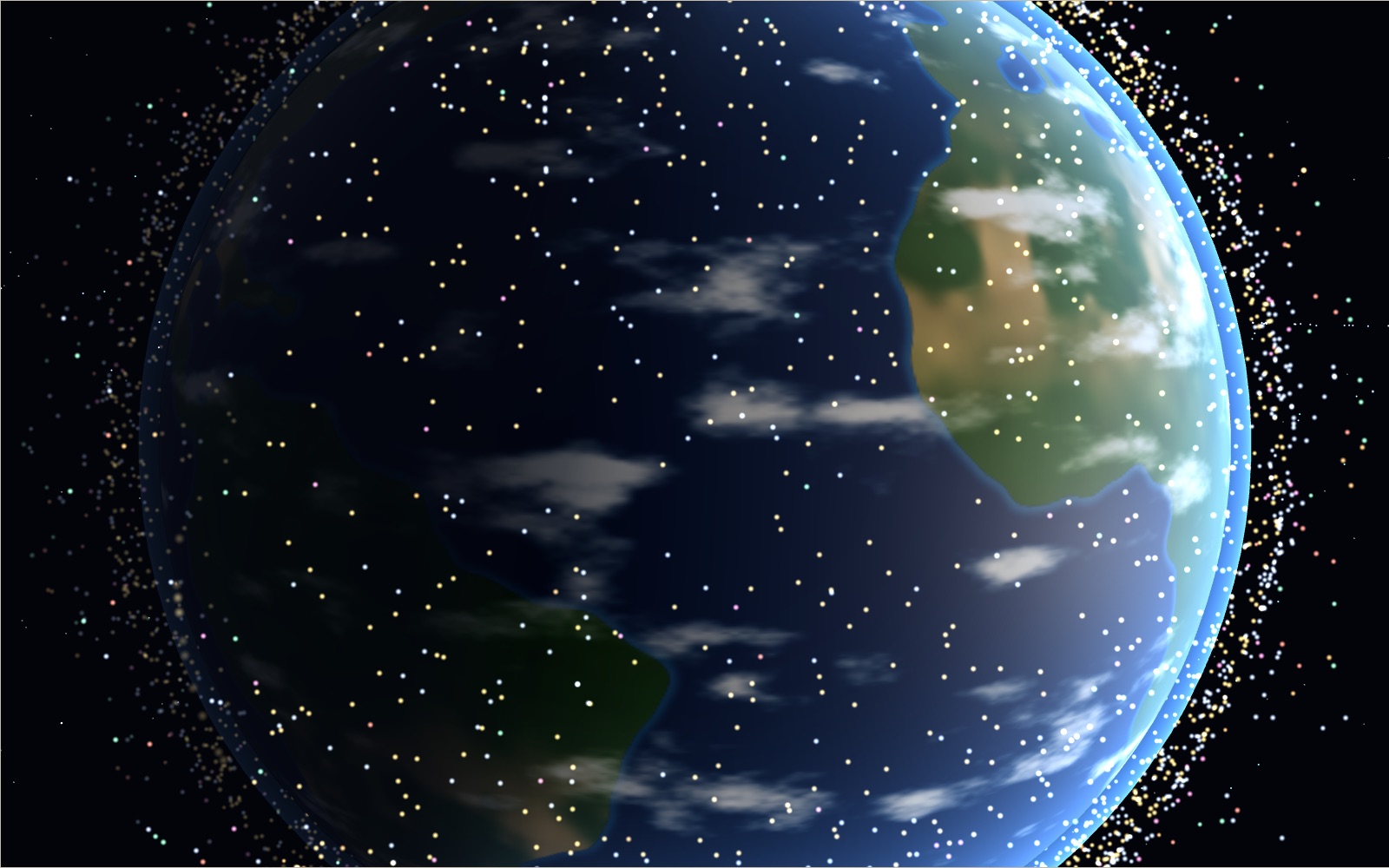
1 / 14 A train of satellites The short line of bright dots is the newest Starlink launch in the snapshot, released together days earlier. Around it, every working satellite of the public catalogue moves on its own orbit. Tap any dot to see what it is.
Drag to turn. Scroll or pinch to zoom.
Guide Parts Controls
01 A train of satellites The short line of bright dots is the newest Starlink launch in the snapshot, released together days earlier. Around it, every working satellite of the public catalogue moves on its own orbit. Tap any dot to see what it is.
02 The ISS The camera follows the International Space Station. It flies about 420 km up at 7.7 km/s and goes round in about 93 minutes.
03 Into the shadow With shading on, satellites in Earth's shadow turn dim. Speed the clock up and the ISS slips into the dark for up to 36 minutes of each lap.
04 Two in three are Starlink Only Starlink is shown now: its shells, about 460 to 480 km up, wrap the planet. One dot stands for three satellites; the count above is exact.
05 Your sky This is the sky over the place you chose. Every satellite above your horizon is on the dome. The list under the stage gives the highest ones, computed with SGP4.
06 When you can see one A satellite shows only when it is in sunlight and your sky is dark. That happens for a few hours after sunset and before sunrise; around midnight the low ones are in Earth's shadow.
07 420 km: 93 minutes Kepler's third law links height and lap time: T = 2π √(a³/GM). Close to Earth a lap takes an hour and a half.
08 20,200 km: 12 hours The GPS satellites fly here and go round twice a day.
09 35,786 km: one day Here a lap takes 23 h 56 min 4 s, the time Earth takes to turn once against the stars. The red dot on the equator keeps step with the satellite.
10 Orbit types Coloured by orbit: blue low orbits, green medium orbits, gold geostationary, pink long ellipses. The lines are four examples.
11 The belt stands still The camera now turns with Earth. The geostationary satellites stop in a ring over the equator while the rest race past.
12 Debris clouds These fragments come from four break-ups. The Fengyun-1C cloud of 2007, at about 850 km, is still mostly in orbit; the Cosmos 1408 cloud of 2021, near 480 km, is almost gone.
13 What radar cannot see Grey dots are an estimate of pieces between 1 and 10 cm, about 1.5 million by ESA's model. One dot stands for 100.
14 Since 1957 From Sputnik 1 to now: every payload ever catalogued, shown for each year. The cloud grows slowly for 60 years, then jumps after 2019.
Earth Turned to the right sidereal time for the clock, lit by the Sun from where it really is. ISS The International Space Station, about 420 km up, one lap in about 93 minutes. Tiangong China's space station, a little lower than the ISS. Starlink train The newest launch in the snapshot, still flying close together. Earth's shadow Satellites on the night side go dark; only lit ones can be seen from the ground. Geostationary belt 35,786 km above the equator, where one lap takes one turn of Earth. GPS About 20,200 km up, two laps a day. Long ellipse A 12-hour orbit tilted 63.4° that hangs over the north for most of each lap. Fengyun-1C debris The largest debris cloud, from a 2007 anti-satellite test. Untracked pieces An estimate: about 1.5 million pieces of 1 to 10 cm (ESA), too small for radar. You A smooth faceless figure at your place; the dome above is your sky. Sun Its height above or below your horizon decides whether satellites can be seen. Test satellite A satellite on a circular orbit at the height of the slider. Moon Earth's natural satellite, 384,400 km away on average. Every payload All payloads ever catalogued, shown for the year on the slider.