Loading the model
This device cannot show the 3D model. You can read the guide steps below as text.
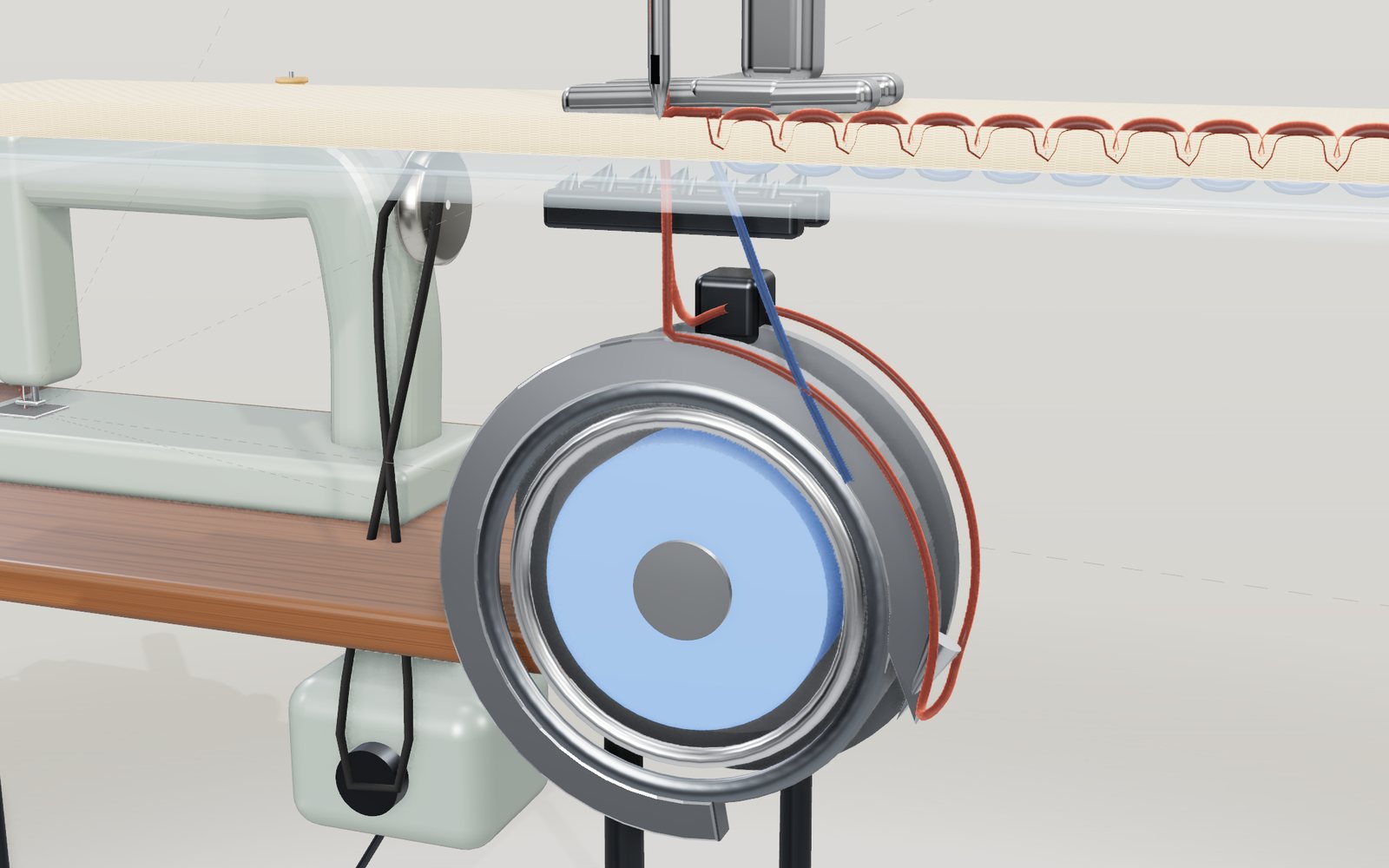
1 / 18 A needle, a hook and two threads This clear model is ten times life size, in front of a real-size industrial machine. Each turn of the shaft makes one stitch, slowed down 300 times here. The red thread comes from the spool on top, the blue one from the bobbin underneath.
Drag to turn. Scroll or pinch to zoom.
Guide Parts Controls
01 A needle, a hook and two threads This clear model is ten times life size, in front of a real-size industrial machine. Each turn of the shaft makes one stitch, slowed down 300 times here. The red thread comes from the spool on top, the blue one from the bobbin underneath.
02 The eye is at the point The needle carries the red thread down through the cloth. Its eye is near the tip, so the needle never passes through; it comes back out of the same hole.
03 A loop opens As the needle starts back up, the cloth grips the thread and a small loop opens behind the eye. In this model the needle has risen 2.4 mm at this moment.
04 The hook takes the loop The pointed end of the rotary hook slides into the loop just above the eye. Press Stop now at this moment for the first task.
05 Round the bobbin The hook carries the loop right round the bobbin case. The bobbin and its blue thread stay still; the red loop passes over both faces of the case.
06 Pulled into the cloth The loop slips off the hook with the blue thread inside it. The take-up lever on the real machine pulls the red thread up and the knot is drawn into the middle of the cloth.
07 The feed dog Under the plate, a toothed bar rises, moves the cloth one stitch length, drops and goes back. It moves only while the needle is out of the cloth.
08 Four parts on one graph The timing graph on the stage shows the needle, the take-up lever, the hook point and the feed dog over one turn. The black line is now. The blue band marks the catch.
09 A drop-in bobbin The electric household machine hides its hook under a clear cover. The hook turns about an upright axis and the loop goes over the top and under the bottom of the bobbin case.
10 Upper tension too high With the upper thread pulled harder than the bobbin thread, the knot is dragged to the top and the blue thread shows as dots on the upper side.
11 Upper tension too low Now the bobbin thread wins. The red thread is pulled through and hangs in loops under the cloth. Look from below.
12 Zigzag The needle swings sideways on alternate stitches, so the seam stretches and can cover a raw edge. Seen from above.
13 A shuttle instead of a hook On the 1850s-type treadle machine a boat-shaped shuttle carries the bobbin straight through each loop and back again.
14 Foot power The treadle rocks, the pitman rod turns the big flywheel and a leather belt drives the handwheel: one turn of the handwheel, one stitch.
15 One thread, a chain The chainstitch machine has no bobbin. Its hook holds each loop open until the next one comes down through it. Sew a few stitches, then press Pull the end.
16 Wrapping an edge The overlock trims the edge with a knife while two loopers wrap it in gold and green thread around the red needle line.
17 6,000 a minute At full speed an industrial machine makes 100 stitches a second and its hook turns 200 times a second. Even in real time the needle is a blur.
18 The room The real machine, the clear model and a 1.7 m mannequin for scale. Small things are hidden in the sewing basket on the side table; click them.
Needle Eye at the point, a long groove down the front for the thread to lie in. Presser foot Holds the cloth down on the feed dog while the needle rises. Needle plate Clear in the model. The needle passes through its hole; the feed dog rises through its slots. Feed dog Rises, moves the cloth one stitch, drops, goes back: the four-motion feed. Cloth Cut open along the seam in the model so the knot inside shows. Needle thread Red. From the spool through the tension discs and the take-up lever to the needle. Bobbin thread Blue. Comes up from the bobbin and is locked by the needle thread at every stitch. Rotary hook Its point takes the needle-thread loop and carries it round the bobbin case. Bobbin case Held still by a finger at the top while the hook turns round it. Bobbin A small spool of lower thread inside the bobbin case. Shuttle Boat-shaped, with the bobbin inside. Passes right through the loop. Lower looper Overlock: carries the green thread under the cloth to the edge. Upper looper Overlock: carries the gold thread over the edge to the needle line. Knife Overlock: trims the edge just ahead of the needle. Bed The flat base the cloth slides over. Arm Carries the main shaft from the handwheel to the head. Handwheel One turn, one stitch. Turn it by hand with the Handwheel control. Needle bar Driven up and down by a crank on the main shaft. Presser bar Spring-loaded bar carrying the presser foot. Take-up lever Gives thread out while the loop goes round, then pulls the stitch tight. Tension discs Two discs squeeze the needle thread; the knob sets how hard. Spool The needle thread starts here. Crank handle Hand machine: turns the handwheel directly. Flywheel Treadle machine: keeps the motion even between strokes of the foot. Treadle Rocked heel and toe; a rod turns the flywheel. Motor pulley Industrial machine: the motor under the table drives the head by a belt.