Loading the model
This device cannot show the 3D model. You can read the guide steps below as text.
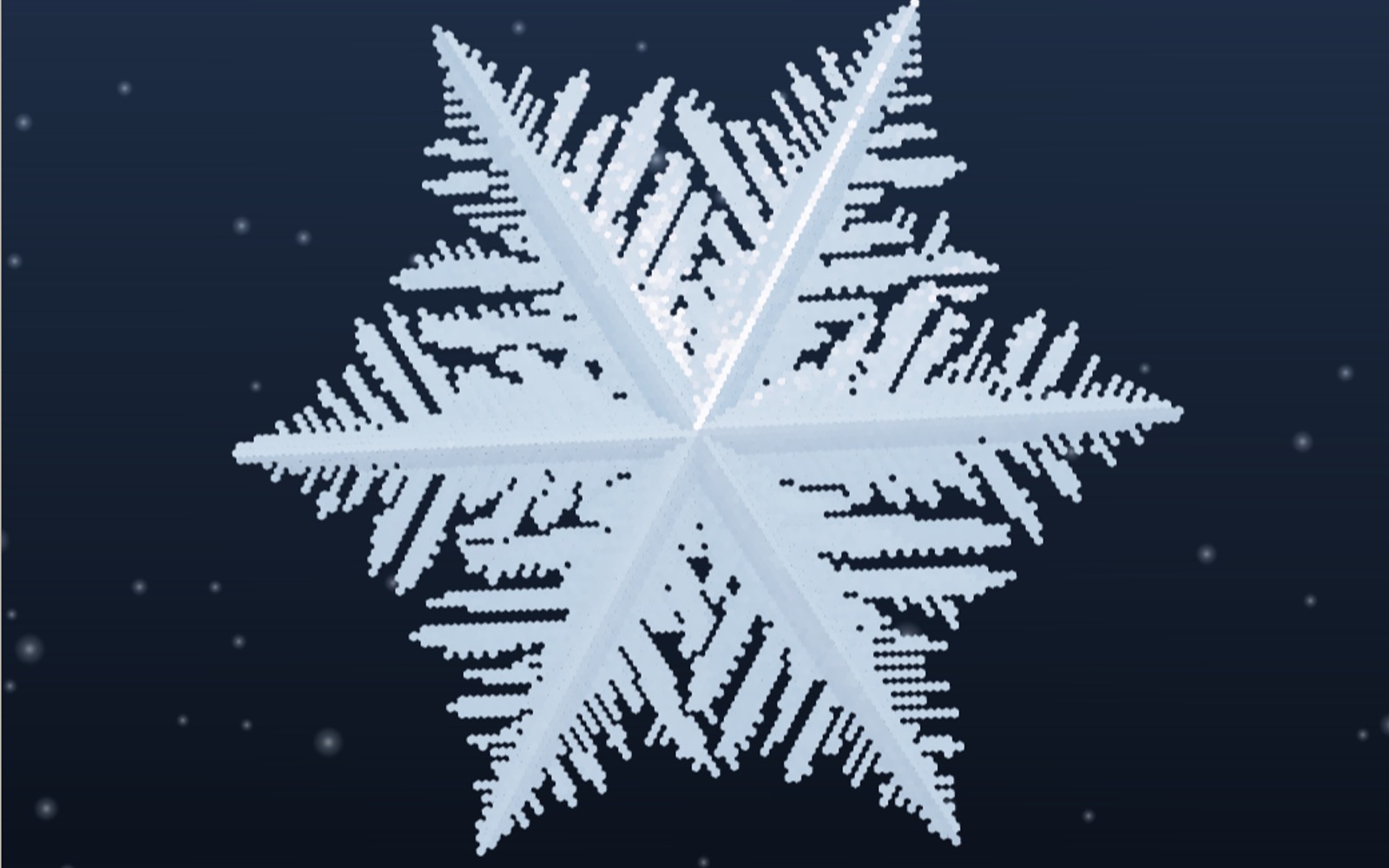
1 / 8 A snow crystal growing at −15 °C The air is at −15 °C and holds as much vapour as it can over water. The model adds ice cell by cell, and six arms with side branches appear. Pick another type from the bar along the bottom, or press Grow again.
Drag to turn. Scroll or pinch to zoom.
Guide Parts Controls
01 A snow crystal growing at −15 °C The air is at −15 °C and holds as much vapour as it can over water. The model adds ice cell by cell, and six arms with side branches appear. Pick another type from the bar along the bottom, or press Grow again.
02 Change the temperature At −2 °C the same model grows a thin hexagonal plate. The chart at the top right is the Nakaya diagram: temperature along the bottom, excess vapour up the side. The dot shows the air you chose.
03 Needles at −5 °C Between about −4 and −10 °C the habit flips: the crystal grows along its c axis. Near −5 °C with plenty of vapour it becomes a needle more than 15 times longer than it is wide.
04 Less vapour, simpler shapes Back at −15 °C with a fifth as much excess vapour, the arms never get ahead of the faces. A plate with faint ridges grows instead of a dendrite. Temperature picks plate or column; vapour picks how branched.
05 Falling through a cloud A real crystal passes through layers of different temperature and humidity on the way down. This one starts high up at −20 °C, grows arms at −15 °C, flattens its tips in drier air and thickens near −6 °C. Each layer leaves its mark.
06 Why six sides Zoom into the ice and the reason is in the molecules. Water molecules in ordinary ice form puckered hexagonal rings around the c axis. A crystal grows by adding layers that keep that order, so its outside keeps the same 60° angles.
07 Two crystals, same air Both grew from the same start in the same air. The only difference is a small random scatter in the air near each cell. The count of cells that differ is shown in the panel. Real air is far less even.
08 Graupel, hail and frost Snow crystals grow straight from vapour. Graupel is a crystal buried in frozen droplets, hail grows from droplets in thunderstorm updrafts, and frost grows from vapour on a cold surface. Hail is shown at the same scale.
Centre The first speck of ice, often a frozen cloud droplet. Everything else grew outward from here, so it is the oldest part. Main arm One of six arms. Each grows from a corner of the first hexagon, where vapour from the air arrives fastest. Side branch Branches that sprout from an arm at 60°. They appear when the tip grows too fast for its sides to keep flat. Arm tip The fastest-growing point. It sticks out furthest into the vapour and catches the most molecules. Ridge A raised line along the middle of an arm. It is thicker because it is older and has been growing longest. Sector A flat, fan-shaped part of the plate between two ridges. Its faint lines show how far the edge reached at each moment. Prism face One of the six side faces. Flat faces grow slowly because molecules have trouble starting a new layer on them. Basal face The broad top and bottom face of a plate. At −15 °C it grows about ten times slower than the edges. Column A six-sided prism that grows longer than it is wide. Between −4 and −10 °C the basal faces grow fastest. Hollow end Cone-shaped hollows in the column ends. The rims catch vapour first and the centres cannot catch up. End plate A plate grown on the end of a column after the crystal moved into plate-growing air. Needle A very long, thin column. It grows near −5 °C when there is a lot of excess vapour. Rime droplets Supercooled cloud droplets that hit the crystal and froze in place. Enough of them turn it into graupel. Oxygen atom The oxygen of one water molecule. In ice each one sits at the centre of four neighbours. Hydrogen bond The link between neighbouring molecules, 0.276 nm long, with one hydrogen along each link. Hexagonal ring Six molecules in a puckered ring. Seen down the c axis, these rings tile the plane, and the crystal keeps that 60° symmetry. c axis The six-fold axis of the crystal. Plates are short along it, columns are long along it.