Loading the model
This device cannot show the 3D model. You can read the guide steps below as text.
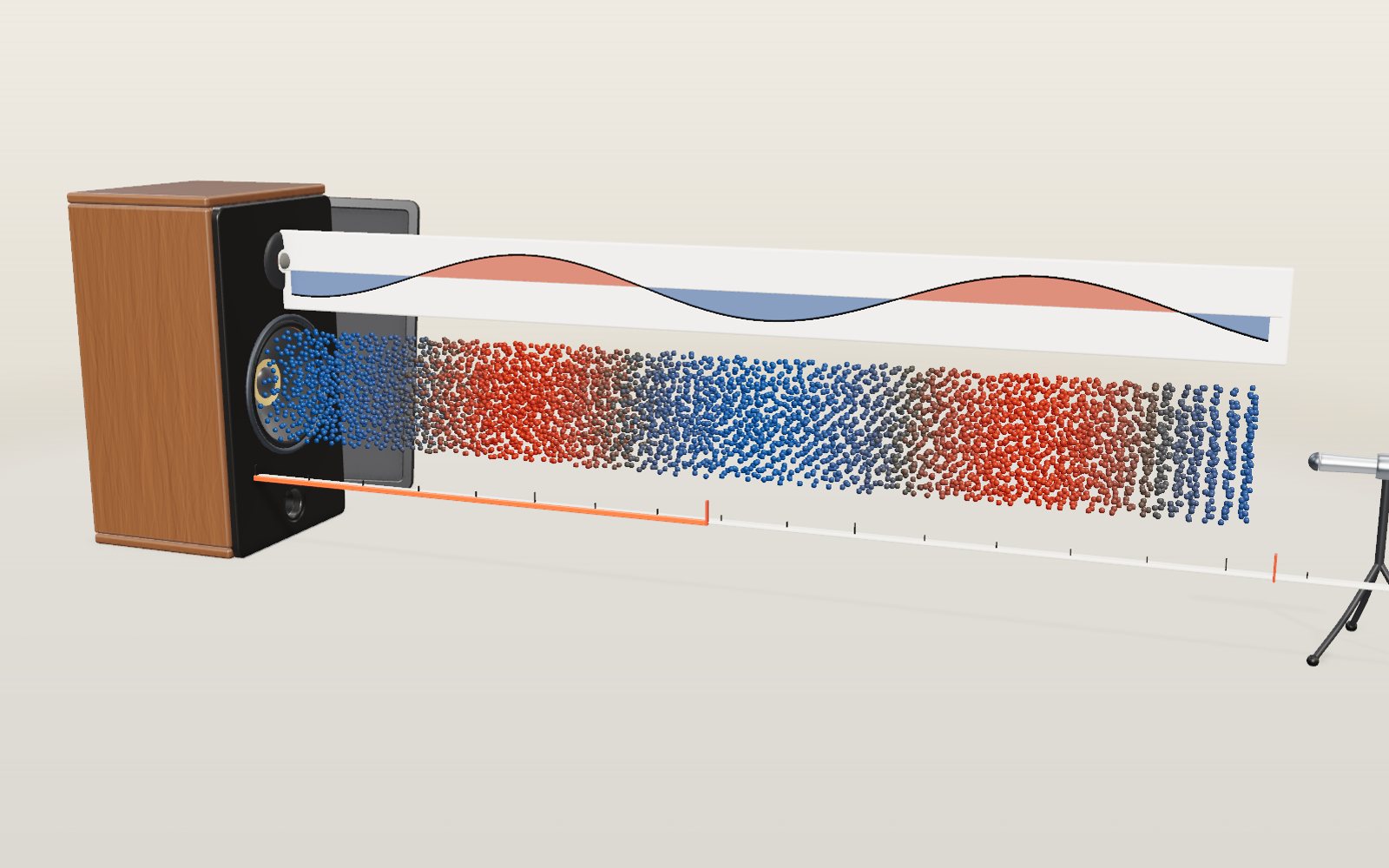
1 / 18 A speaker and a beam of air This is a loudspeaker playing a steady tone into a beam of air, at real size and slowed down. The buttons along the top of the stage open eight more scenes; the screens under the stage show the same sound as a waveform, a spectrum and a spectrogram.
Drag to turn. Scroll or pinch to zoom.
Guide Parts Controls
01 A speaker and a beam of air This is a loudspeaker playing a steady tone into a beam of air, at real size and slowed down. The buttons along the top of the stage open eight more scenes; the screens under the stage show the same sound as a waveform, a spectrum and a spectrogram.
02 The cone pushes the air The paper cone moves forward and back like a piston. Each push squeezes the air in front of it, and each pull leaves the air a little thinner.
03 Coil and magnet An alternating current flows through the voice coil, which sits in the gap of a permanent magnet. The force on the wire follows the current, so the cone copies the electrical signal.
04 Compressions and rarefactions The particles move only back and forth around their own spot. What travels away from the speaker is the pattern of crowded and sparse layers, at 343 m/s in air at 20 °C.
05 One wavelength The distance from one crowded layer to the next is the wavelength: 343 ÷ 440 = 0.78 m. Warm air carries sound faster, helium almost three times faster, and the layers spread out to match.
06 Two tones that almost agree A second tone 4 Hz higher has been added. The two waves fall in and out of step, so the loudness swells and fades 4 times a second, once every 0.25 s.
07 The decibel ladder Each bar is an everyday sound, its height set by its level in decibels. Ten decibels more is ten times the energy, so 120 dB carries a trillion times the energy of 0 dB.
08 Eardrum and three bones The eardrum is about 17 times larger than the oval window, and the bones add a lever of about 1.3. Together they raise the pressure by about 27 dB, enough to move the fluid in the cochlea.
09 Where each pitch lands Unrolled, the basilar membrane is about 35 mm long. A tone makes a wave that grows along it and peaks at one place: 1 kHz about 21 mm from the base. Change the pitch and the peak moves.
10 A string and its overtones A plucked string vibrates at its fundamental and at 2, 3, 4 times that frequency together. Where you pluck decides which overtones are strong: pluck in the middle and the even ones vanish.
11 Open and closed pipes An open pipe resonates at every multiple of its lowest note. Close one end and the lowest note drops an octave and only the odd multiples are left.
12 A drum skin A round skin has modes set by Bessel functions. Their frequencies are 1, 1.59, 2.14, 2.30 times the lowest, not whole numbers, which is why a plain drum has a less definite pitch than a string.
13 Sound from a moving source Each ring left the ambulance at a different place. Ahead of it the rings crowd together and the pitch is higher; behind it they spread out and the pitch is lower.
14 Past the speed of sound At 440 m/s the jet outruns its own sound. The rings pile up along a cone, and the listener hears nothing until the cone sweeps past as a boom.
15 Reverberation After a clap, sound bounces around the room and loses part of its energy at every surface. Sabine’s formula gives the time to fall by 60 dB: 2.0 s in the full Musikverein.
16 Standing waves in a tube At 858 Hz exactly five half waves fit in the 1 m tube. The wave reflects onto itself, and cork dust gathers where the air stays still, every 20 cm.
17 Speed in different materials The same pulse crosses steel in about 1/17 of the time it takes in air. Stiff materials are fast; heavy gases like sulfur hexafluoride are slow.
18 Cancelling noise The headphone plays the noise back upside down. When the phase is right the two cancel; a delay of only 30 µs is a small error at 100 Hz but a large one at 5 kHz.
Cabinet A closed wooden box with rounded edges. It stops the wave from the back of the cone from cancelling the wave from the front. Tweeter A small silk dome for the high notes. A light dome can move fast enough for 20 kHz, which the big cone cannot. Grille A frame covered with thin cloth that protects the drivers. It lets sound through almost untouched, so it is often taken off. Frame and spider The metal basket that holds the driver to the box, and the pleated cloth ring that keeps the coil centred. Magnet A ring magnet with steel plates. It leaves a narrow gap with a strong, steady magnetic field. Voice coil Copper wire wound on a paper tube that sits in the magnet gap. Current through it pushes the cone back and forth. Cone A light, stiff paper cone. It moves like a piston and pushes on the air in front of it. Dust cap The dome in the middle of the cone. It keeps dust out of the magnet gap. Surround The soft rubber roll around the edge of the cone. It lets the cone move a few millimetres and springs it back. Air particles Each dot stands for a small parcel of air. Orange layers are squeezed together, blue layers are spread apart. Pressure graph The air pressure along the beam at this instant. Peaks sit exactly on the orange layers. Wavelength ruler A real-scale ruler starting at the cone. The orange bar is one wavelength: the speed of sound divided by the frequency. Microphone A measuring microphone on a tripod. It turns pressure back into a voltage; the screens under the stage show what it would record. Decibel ladder 15 sounds as bars, height in proportion to their level in dB. Click a bar to choose it. Sound level meter A meter with a foam windscreen. Move it with the Distance slider: in the open, the level drops 6 dB every time the distance doubles. Exposure limits Three rods: 80 dB for 40 hours a week (WHO and ITU), 85 dBA for 8 hours (NIOSH), 90 dB for 8 hours (Korean rule). Outer ear The pinna and the ear canal, about 25 mm long. The canal is a tube closed by the eardrum and rings near 3 kHz. Eardrum A thin cone of skin about 9 mm across. Pressure changes in the canal push it in and out. Ossicles The hammer, anvil and stirrup. They act as a lever and pass the eardrum's motion to the much smaller oval window. Cochlea A fluid-filled spiral of about two and a half turns. Inside it the basilar membrane sorts sound by pitch. Basilar membrane, unrolled The membrane drawn straight and 20 times longer. High pitches peak near the base, low pitches near the apex (Greenwood's formula). Semicircular canals Three loops at right angles to each other. They sense turning of the head, not sound. Auditory nerve About 30,000 nerve fibres carry the signals from the cochlea to the brain. Eustachian tube A tube from the middle ear to the throat. It keeps the air pressure on both sides of the eardrum equal. Temporal bone The skull bone that holds the middle and inner ear, cut open here. Guitar A steel-string guitar with a 648 mm scale. The body and air inside it turn the string's small motion into sound. Vibrating string One string drawn with its real shape after a pluck: the sum of its partials, each decaying at its own rate. Glass pipe A real-size tube of 22 mm radius, open or closed at one end. The dots inside show how the air moves in the chosen mode. Drum A drum skin fixed at its rim. The colours show which parts move up and which move down in the chosen mode. Road A straight road at 1 : 40. Vehicles and the listener are drawn four times larger so you can see them. Wavefronts A ring for each wave crest, spreading at the speed of sound from where the source was when it sent it. Moving source An ambulance, or a jet above 120 m/s. Its speed slider is real; time is slowed eight times. Listener The person at the roadside. The plot shows the pitch they hear as the source passes. Room Floor and three walls; the near wall and roof are cut away. The model is scaled to fit, the numbers are for the real room. Seats and furniture People and upholstered seats absorb a lot of sound, which is why a hall sounds different empty and full. Absorbing panels Fabric panels. Raising the Absorption slider adds panels and shortens the reverberation time. Sound particles Each dot is a bit of sound energy bouncing off the walls. It shrinks a little at every bounce, by the absorption of the surface. Kundt tube A glass tube 1 m long, closed at both ends. At resonance a whole number of half waves fits inside. Driver A small loudspeaker that sets the air in the tube vibrating at the chosen frequency. Cork dust Fine dust on the bottom of the tube. Where the air hardly moves (displacement nodes) it piles up. Standing-wave board Blue: how far the air moves. Orange: how much the pressure changes. One is largest where the other is zero. Material lanes Eight lanes of the same length: four gases, two waters and two metals. The label shows the speed at the current temperature. Sound pulses One pulse per lane, all started together. Each crosses at the speed of sound in its material. Vocal tract A 17 cm tube closed at the vocal folds. Its resonances shape vowels and move up in helium. Headphone A closed headphone. The cushions block high frequencies well; low ones get through, which is what the electronics deal with. Microphones and driver A microphone outside picks up the noise, a second one inside checks what is left, and the driver plays the anti-noise. Three waves Grey: the noise. Blue: the anti-noise. Orange: their sum, what reaches the ear.