Loading the model
This device cannot show the 3D model. You can read the guide steps below as text.
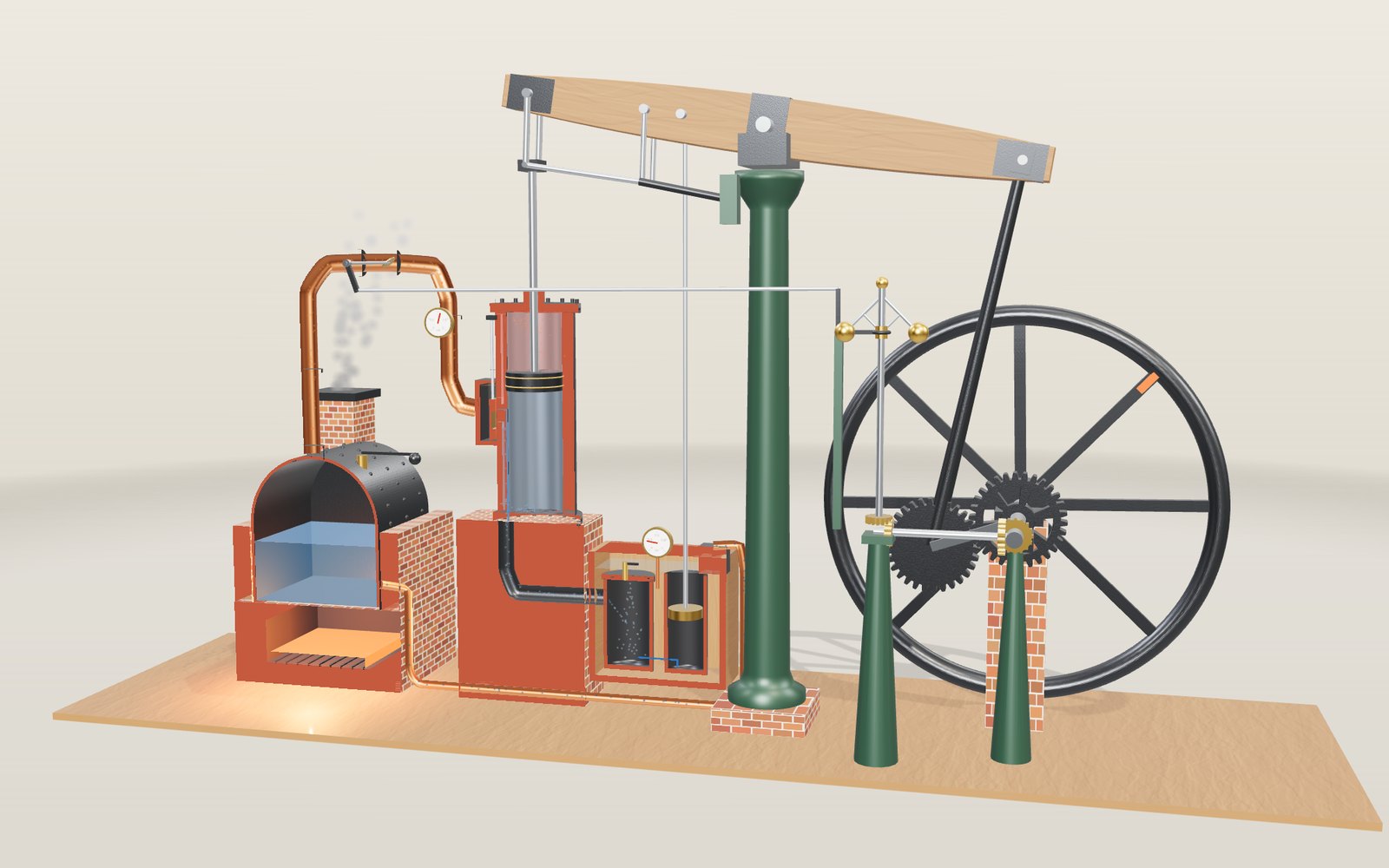
1 / 10 A rotative beam engine This is a 1:10 model of a Boulton and Watt engine of the 1780s, cut down the middle. Red faces are cut surfaces. Live steam is orange, exhaust steam pale blue and water dark blue.
Drag to turn. Scroll or pinch to zoom.
Guide Parts Controls
01 A rotative beam engine This is a 1:10 model of a Boulton and Watt engine of the 1780s, cut down the middle. Red faces are cut surfaces. Live steam is orange, exhaust steam pale blue and water dark blue.
02 Steam from the boiler Coal burns under a wagon-shaped boiler. The steam collects above the water and goes up the copper pipe, through the throttle, to the valve chest beside the cylinder.
03 The slide valve Slowed down. The valve slides up and down across three ports. When it lets steam into one end of the cylinder, its hollow underside joins the other end to the exhaust.
04 Steam on both sides Steam pushes the piston down, then up. The valve cuts the steam off a little before half-stroke, and the steam already inside expands to finish it. Watch the dot on the pressure graph.
05 The separate condenser The exhaust goes to a vessel standing in cold water, where a jet of water turns it back into water. The cylinder stays hot, and the piston works against a near vacuum.
06 Parallel motion The end of the beam moves on an arc, but the piston rod has to move straight to stay sealed. Watt's linkage of bars and a radius rod makes it do that.
07 Sun and planet The gear on the connecting rod rolls round the gear on the shaft. Because it cannot turn on the rod, the shaft makes two turns for every up-and-down stroke.
08 The governor Change the load in Controls. If the engine slows, the balls drop and the throttle opens. If it speeds up, they rise and close it. Switch the governor off to compare.
09 Newcomen against Watt The model is now set like a Newcomen engine: the cold jet goes into the cylinder itself, so the walls are cooled every stroke. Compare the coal figures in Controls with Watt's separate condenser.
10 Engines in history Back to Watt's own settings. In Controls you can pick 22 engines from Savery's pump of 1698 to a power station of today, and change the cut-off and boiler pressure yourself.
Boiler A wagon boiler on a brick setting. In the model it holds steam at 1.45 bar absolute, about 0.44 bar above the air outside. Steam pipe and throttle A butterfly valve in the pipe. The governor turns it to pass more or less steam. Slide valve Its edges overlap the ports, so steam is cut off near half-stroke (46% going down, 55% going up) and expansion does the rest. Double-acting cylinder Bore 635 mm. Steam pushes on the top and the bottom of the piston in turn. Piston and rod Stroke 1.83 m. The rod slides through a packed gland in the top cover. Parallel motion Watt's linkage keeps the piston rod moving straight up and down while the beam end swings on an arc. Beam and column Oak, 5.2 m between the end pins. It rocks about 21° each way on a cast-iron column. Connecting rod 4 m long. The gear on its lower end is fixed to the rod and never turns on it. Sun and planet gear Two 30-tooth gears of the same size, so the shaft turns twice for each double stroke of the piston. Flywheel 4.27 m across. It carries the shaft past the two dead points of every stroke. Centrifugal governor Two brass balls on 0.5 m arms. When the engine speeds up they swing out, lift the sleeve and close the throttle. Condenser Exhaust steam meets a jet of cold water and turns back into water. The pressure inside stays at about 0.2 bar. Furnace and brick setting Coal burns on iron grate bars under the boiler. The hot gas runs along flues in the brickwork before it reaches the chimney. Chimney Draws air through the fire. In the model the smoke thickens as the engine burns more coal. Steam gauge Reads the pressure in the valve chest, after the throttle. It falls when the governor closes the throttle. Vacuum gauge Reads the pressure in the condenser: 0.2 bar with Watt's condenser, 0.55 bar with the jet inside the cylinder. Crosshead The block on top of the piston rod. The parallel motion holds it so the rod stays upright. Radius rod A bar swinging from a fixed bracket. It pulls the parallel motion back onto a straight line. Crankshaft and bearings The flywheel shaft runs in a bearing on a brick pier and another on a slim iron pedestal. Governor drive Bevel gears and a countershaft turn the governor spindle 1.25 times for each turn of the flywheel. Bell crank and throttle rod Turns the up-and-down movement of the governor sleeve into a pull on the throttle lever. Air pump A bucket pump worked from the beam. It draws water and air out of the condenser so the vacuum holds. Cold-water cistern A wooden tank of cold water. The condenser and air pump stand in it. Hot well The air pump empties warm condensed water here. The feed pipe takes it back to the boiler. Injection cock Lets the cold jet into the condenser. Opening it further condenses steam faster. Exhaust pipe Takes spent steam from the cylinder to the condenser. Feed pipe Returns warm water from the hot well to the boiler, so less coal is spent heating it. Foundation Brickwork under the cylinder. A real engine house also used its walls to carry the beam.