Loading the model
This device cannot show the 3D model. You can read the guide steps below as text.
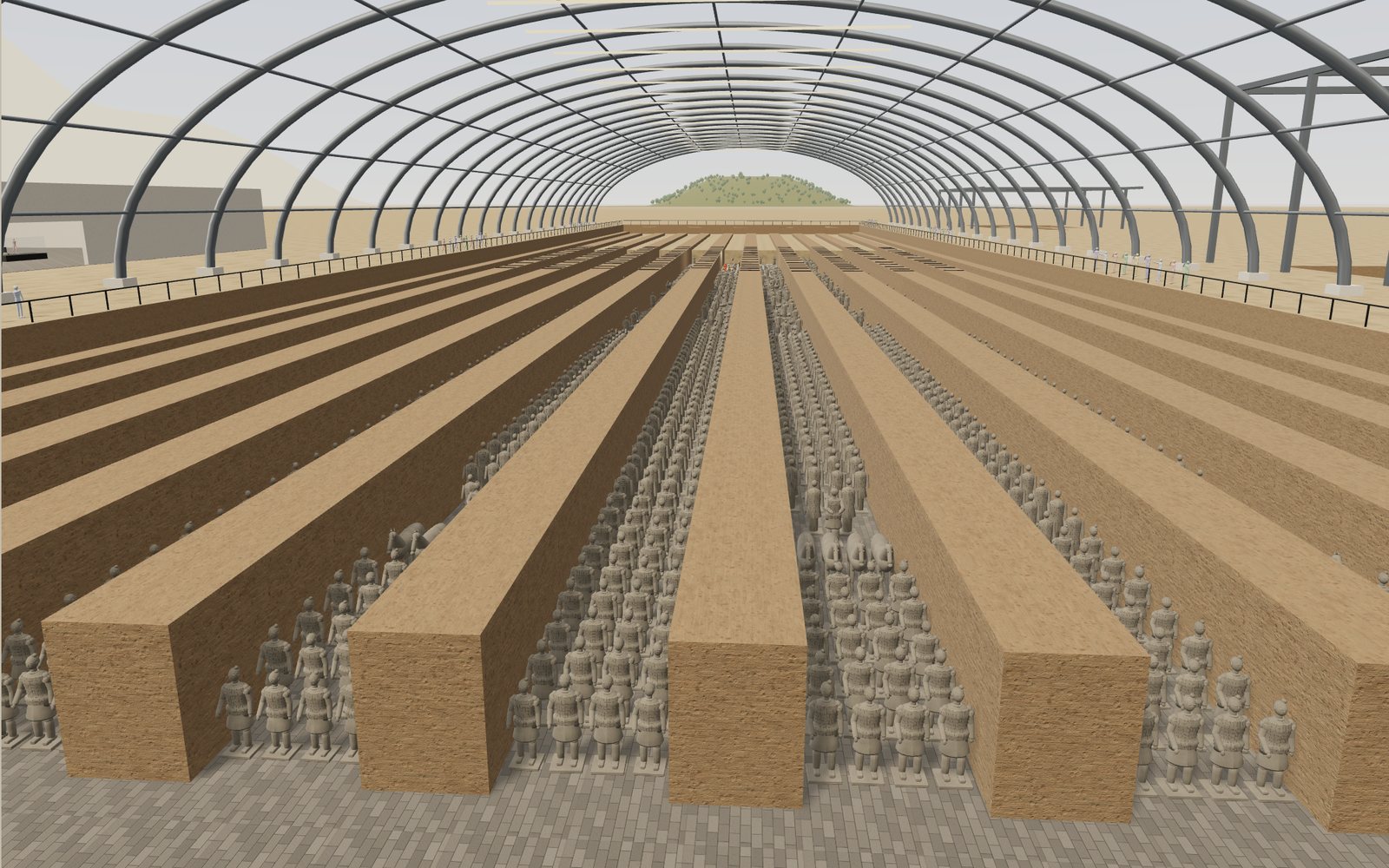
1 / 13 The front ranks You stand at the east end of Pit 1. In front of you the vanguard faces east: three rows of 68 soldiers in robes. Behind them the corridors run 230 m west, and the figures in them are estimated at about 6,000 with the horses. The hall lights switch on bay by bay.
Drag to turn. Scroll or pinch to zoom.
Guide Parts Controls
01 The front ranks You stand at the east end of Pit 1. In front of you the vanguard faces east: three rows of 68 soldiers in robes. Behind them the corridors run 230 m west, and the figures in them are estimated at about 6,000 with the horses. The hall lights switch on bay by bay.
02 On a wall top The corridors are separated by walls of rammed earth. Walking on top of one you look down on the heads of the ranks: infantry four abreast, a chariot team with its four horses, officers by the chariots. No two heads are finished alike.
03 A warrior in parts At the restorers’ bench a warrior lies in parts and assembles: plinth, legs, robe, armour, arms and head. The figures were built this way, from a few moulds, and then finished by hand. On the shelf are eight heads, one for each mould in the model.
04 It was painted This kneeling archer from Pit 2 kept much of its paint. The colours sat on a ground of lacquer. When excavated figures dry out, the lacquer curls and the paint flakes off within minutes. Open "Paint" and let it dry.
05 210 BC Move the year back and the army stands complete and painted, with bronze weapons on wooden shafts and wooden chariots behind their horses. The model lifts the roof so you can see in. Pit 1 alone holds an estimated 6,000 figures and horses.
06 Under the roof This is how the pits were closed: beams over the corridors, reed mats on the beams, earth on top. Inside Pit 3, the command post, it is dark; you carry a torch. Pit 3 is the one pit that never burned.
07 The fire Pits 1 and 2 burned. The beams glowed, sagged and fell in with the earth on top of them, and the figures broke under the weight. Who lit the fire is not recorded; linking it to the fall of Qin is an inference.
08 The well of 1974 For two thousand years the army lay under fields. In March 1974 farmers digging a well in a drought brought up pieces of a pottery figure. Over a year of trial digging showed the largest pit of all.
09 Crossbowmen of Pit 2 Pit 2 is L-shaped and mixes all arms: crossbowmen here in the north-east corner, chariots in the south, cavalry in the north. The museum counts 939 figures, 472 horses and 89 chariots; most still lie under the burned roof.
10 Pit 3 The smallest pit is shaped like a U: a chariot with four horses in the middle, men lining the walls of the two wings, facing each other. Some scholars see it as the headquarters of the other two pits.
11 The bronze chariots Two painted bronze chariots, half life-size, were dug up west of the mound in 1980. Chariot 2 alone has 3,462 parts and weighs 1,241 kg; the two carry 14 kg of gold and silver.
12 The mound The First Emperor’s tomb lies under this mound, 51.3 m high today, never excavated. Sima Qian wrote of rivers of mercury inside; soil and air over the mound do carry more mercury than the land round it.
13 All of it, from above From 70 m up, in 210 BC, with each unit in its own colour: the vanguard, flanks, main body and rear guard of Pit 1; the crossbowmen, chariots, cavalry and mixed unit of Pit 2; the command post of Pit 3. Switch "Still in the earth" on in today’s view to see how much of this is still buried.
Front ranks The east end of Pit 1, where the vanguard stands. On a wall top Above the ranks, on a rammed-earth wall. Excavation The floor of Pit 1 where fragments are lifted. Restorers’ bench A warrior in parts and eight head moulds. Painted archer A kneeling archer that kept its paint. Weapons case Swords, the pi, a halberd and a quiver of 100. Crossbowmen The kneeling and standing archers of Pit 2. Cavalry Cavalrymen beside saddled horses in Pit 2. Pit 3 One chariot and 68 men: the command post? Bronze chariots Two chariots at half size. The well of 1974 Where the first fragments came up. The mound The unexcavated tomb, 1.5 km to the west. Top of the mound Where the mercury readings are highest. The vanguard Three rows of 68 across the east end, in robes without armour, facing east. Kneeling archer 128 cm, left knee up, right knee down, hands at the right side holding a crossbow. High-ranking officer Double robe, coloured scale armour, cap, hands crossed on a long sword: the highest rank found. Charioteer 192 cm, arms forward to hold the reins, long armour without shoulder pieces. Chariot horse Life-size pottery horses, four to a chariot. A quiver of arrows Bundles of 100: one quiver each. Crossbow trigger 216 triggers from the east of Pit 1, in three parts held by two bolts. The burned roof of Pit 2 Most of Pit 2 is still under its burned roof. Bronze chariot 2 Chariot 2: a closed carriage, 3,462 parts, 1,241 kg. Bronze water birds (K0007) Bronze cranes, swans and geese: a palace garden. Stone armour (K9801) Limestone plates tied with bronze wire: 612 in a suit.