Loading the model
This device cannot show the 3D model. You can read the guide steps below as text.
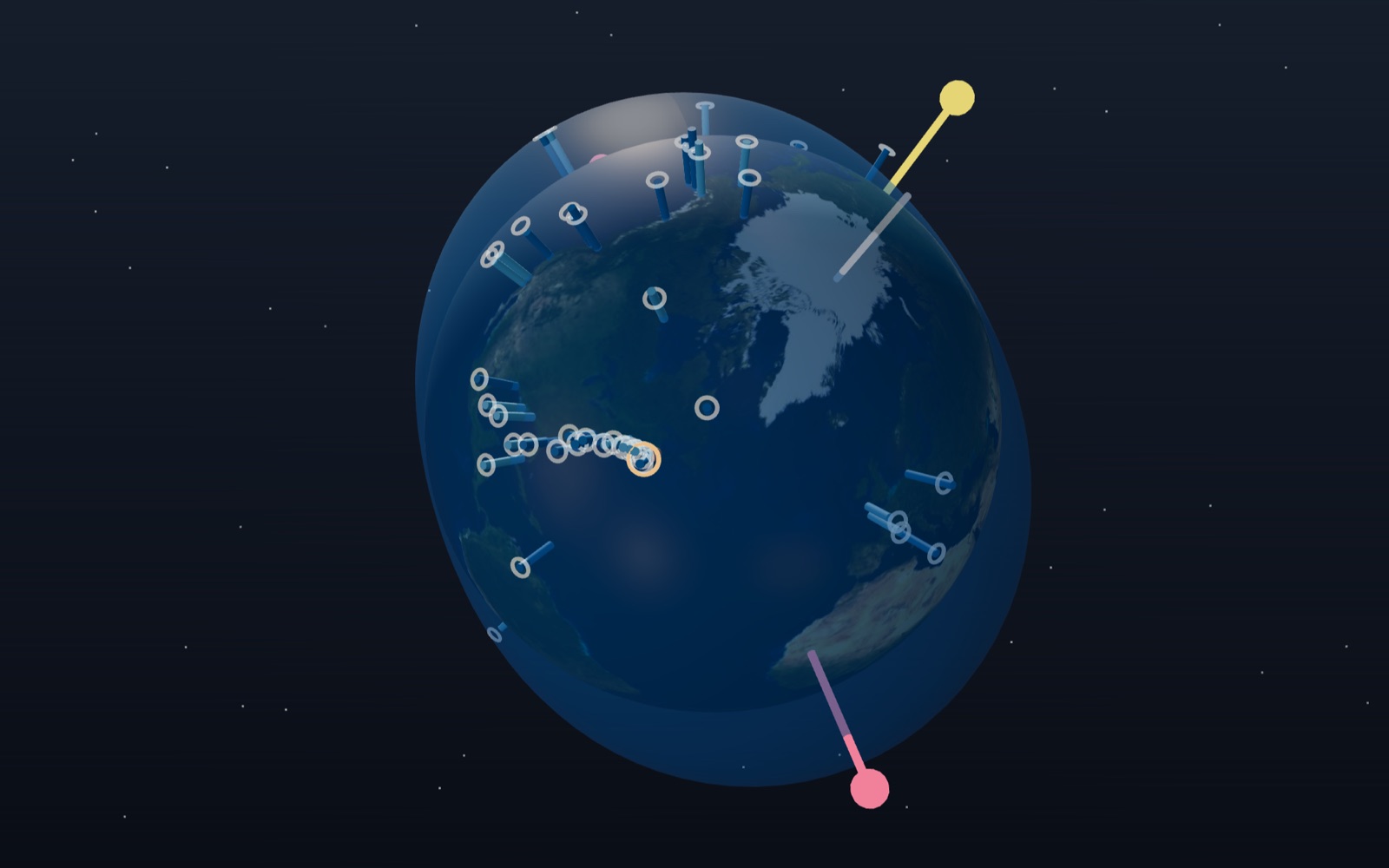
1 / 8 Earth, Moon, Sun and two bulges The Sun stays on the left; this frame turns with the Earth. The blue shell is the sea, with its height stretched 2.5 million times. Use the date and time sliders on the Controls tab to move through two months.
Drag to turn. Scroll or pinch to zoom.
Guide Parts Controls
01 Earth, Moon, Sun and two bulges The Sun stays on the left; this frame turns with the Earth. The blue shell is the sea, with its height stretched 2.5 million times. Use the date and time sliders on the Controls tab to move through two months.
02 The Moon pulls harder on the near side This is the next full moon, with the Moon on the right. Gravity weakens with distance, so the near side is pulled more than the centre and the centre more than the far side. The arrows use the shrunk distance; on the real Earth they differ by about 3%.
03 Take away the pull on the centre The whole Earth falls toward the Moon at the rate of its centre. Subtract that and what remains points away from the Earth on both the near and the far side, and inward around the middle. This leftover is the tidal force, about one nine-millionth of g.
04 The Earth turns under the bulges The yellow pin is a site near Incheon. It is carried through both bulges as the Earth turns. The Moon moves on meanwhile, so the pin needs 24 h 50 min to come back under it, and the two high waters come about 12 h 25 min apart.
05 The Sun's tide is 46% of the Moon's The Sun pulls the Earth about 180 times harder than the Moon does, but it is 389 times further away. Tidal force falls with the cube of distance, so the Sun's orange arrows end up at 46% of the Moon's.
06 Spring tide This is the next new moon. The Moon and the Sun are in line, the two sets of bulges add up, and the range is 1.46 times the Moon's alone. Spring tides come at both new and full moon, about every 14.8 days.
07 Neap tide At first quarter the Sun is at a right angle to the Moon. The Sun's tide now fills the Moon's low water and trims its high water, and the range drops to 0.54 times. The ratio of spring to neap range is 2.7.
08 Real coasts are different With True height on, the bulges vanish: the whole equilibrium range is under 80 cm. Real coasts answer with their own basins. KHOA forecast a 9.9 m range at Incheon in October 2016, and the Bay of Fundy reaches 16 m.
Sun Drawn 3 units away and 0.6 units wide. At the Earth's scale here it would be 61 units wide and about 6,600 units away. Earth Turned to the right hour of the day, with the axis leaning 23.44°. Map: NASA Blue Marble. Ocean bulges The equilibrium tide, stretched 2.5 million times. With the Moon alone the water stands 36 cm above average under the Moon and 18 cm below it at 90°. Moon True size next to the Earth (0.27 of its width). The distance is shrunk about 10.6 times. Moon's orbit Tilted 5.1° to the plane of the Earth's orbit, so the Moon can sit up to about 28° north or south of the equator. Moon's pull The Moon's gravity at the near side, the centre and the far side. At this drawn distance the near arrow is 1.47 times the centre one; on the real Earth the difference is 3.4%. Tidal force (Moon) What is left of the Moon's pull once the pull on the Earth's centre is taken away: outward on both sides along the Moon line, inward around the middle. Tidal force (Sun) The same pattern from the Sun, drawn at 46% of the Moon's arrows. It always lines up with the Sun on the left. High-water line Joins the two highest points of the water. It points at the Moon at spring and neap tides and leans up to 13.7° toward the Sun in between. Observing site A point near Incheon (37.45°N, 126.6°E). The graph in the corner shows the equilibrium tide there for 48 hours.