Loading the model
This device cannot show the 3D model. You can read the guide steps below as text.
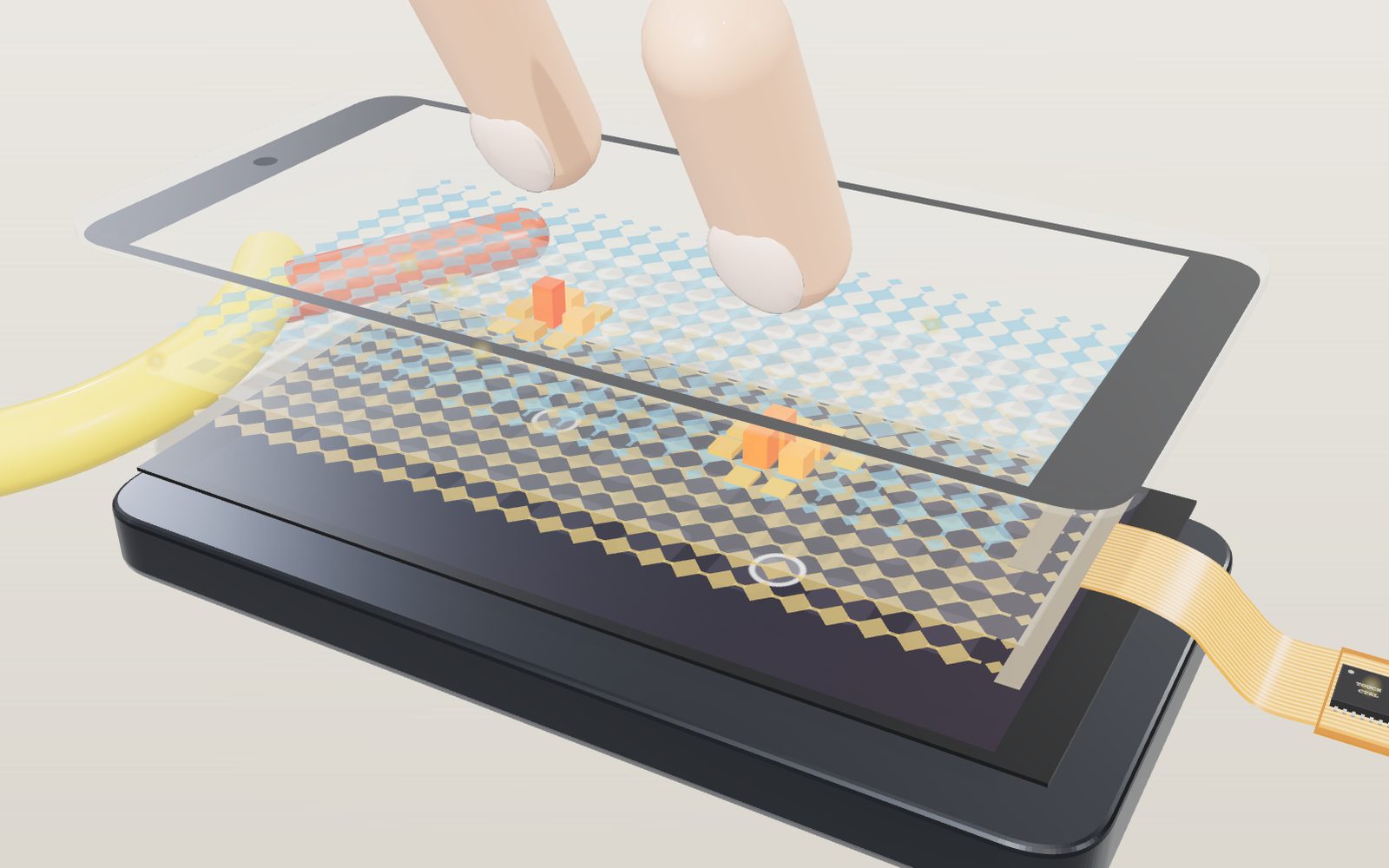
1 / 10 A finger comes down A finger lowers toward the glass and the capacitance at the crossing under it drops, shown in the panel at the bottom of the stage. Then the screen comes apart into layers. Press the test screen, or switch on Press the glass and touch the model itself, with one or more fingers.
Drag to turn. Scroll or pinch to zoom.
Guide Parts Controls
01 A finger comes down A finger lowers toward the glass and the capacitance at the crossing under it drops, shown in the panel at the bottom of the stage. Then the screen comes apart into layers. Press the test screen, or switch on Press the glass and touch the model itself, with one or more fingers.
02 Cover glass You only ever touch glass. The electrodes are under it, so the screen has to sense your finger through a millimetre or so of insulator.
03 Rows and columns Two layers of transparent indium tin oxide, cut into chains of diamonds. In this model 12 rows sit under 24 columns, 5 mm apart, so they cross at 288 points.
04 A finger takes away part of the field Each crossing works as a tiny capacitor. Some of its field lines bulge up through the glass, and a finger there draws them off to ground, so less charge reaches the column.
05 One row at a time The slowest scan setting. The controller drives a single row and reads all 24 columns at once, then moves to the next row. The node map fills in row by row.
06 Finer than the grid A finger covers several crossings. The controller takes a weighted average of the strongest node and its neighbours, so the displayed position comes out in 0.1 mm increments, not a guarantee of accuracy.
07 Two fingers and ghost points Self-capacitance scan is on. Measuring whole rows and whole columns gives two rows and two columns, which fit four points. Turn it off and the 288 separate crossings show only the real two.
08 When it is not a bare finger Change what is touching the glass. A stylus needs a tip wide enough to cover a node, a loose drop of water pushes the numbers the wrong way, and a banana or a sausage held in the hand works almost like a finger. Glove thickness applies only to a finger.
09 Water and a thick protector Drops lie on the glass and a 0.6 mm protector covers it. Each drop reads slightly negative until a finger reaches it; then it is grounded through the finger and its spot jumps up. The protector moves the finger further from the electrodes, so the peaks shrink and spread.
10 A noisy charger A cheap charger makes the phone's ground swing against the earth, and the finger injects that noise into the electrodes under it. Ghost touches appear along the finger's columns. Turn on the noise filter, which moves the scan to a quieter frequency.
Cover glass Chemically strengthened glass, usually 0.55 to 1.1 mm thick on a phone. Your finger never touches the electrodes, only this. Receive electrodes (columns) 24 columns of indium tin oxide diamonds. The controller measures how much charge arrives on each one. Insulating layer and node map Keeps rows and columns apart. In the model it also shows the value measured at each of the 288 crossings. Transmit electrodes (rows) 12 rows of ITO diamonds. The controller drives them one at a time with a switching voltage. Display The OLED or LCD panel that makes the picture. It sits under the touch layers and is also their biggest source of electrical noise. Phone body The frame that holds the display, the battery and the main board. Flexible cable A printed ribbon that carries every row and column line from the sensor to the controller. Touch controller A chip that drives the rows, reads the columns, subtracts the baseline and turns the grid of numbers into coordinates. Touching object A finger, with or without a glove, a stylus, a water drop, a banana, a sausage or a pencil. What matters is whether it conducts, how big a patch of the grid it covers and how far it is held from the electrodes. Electric field between electrodes Field lines from a row to a column. Some of them arch up through the glass, and a finger above them takes those away.