Loading the model
This device cannot show the 3D model. You can read the guide steps below as text.
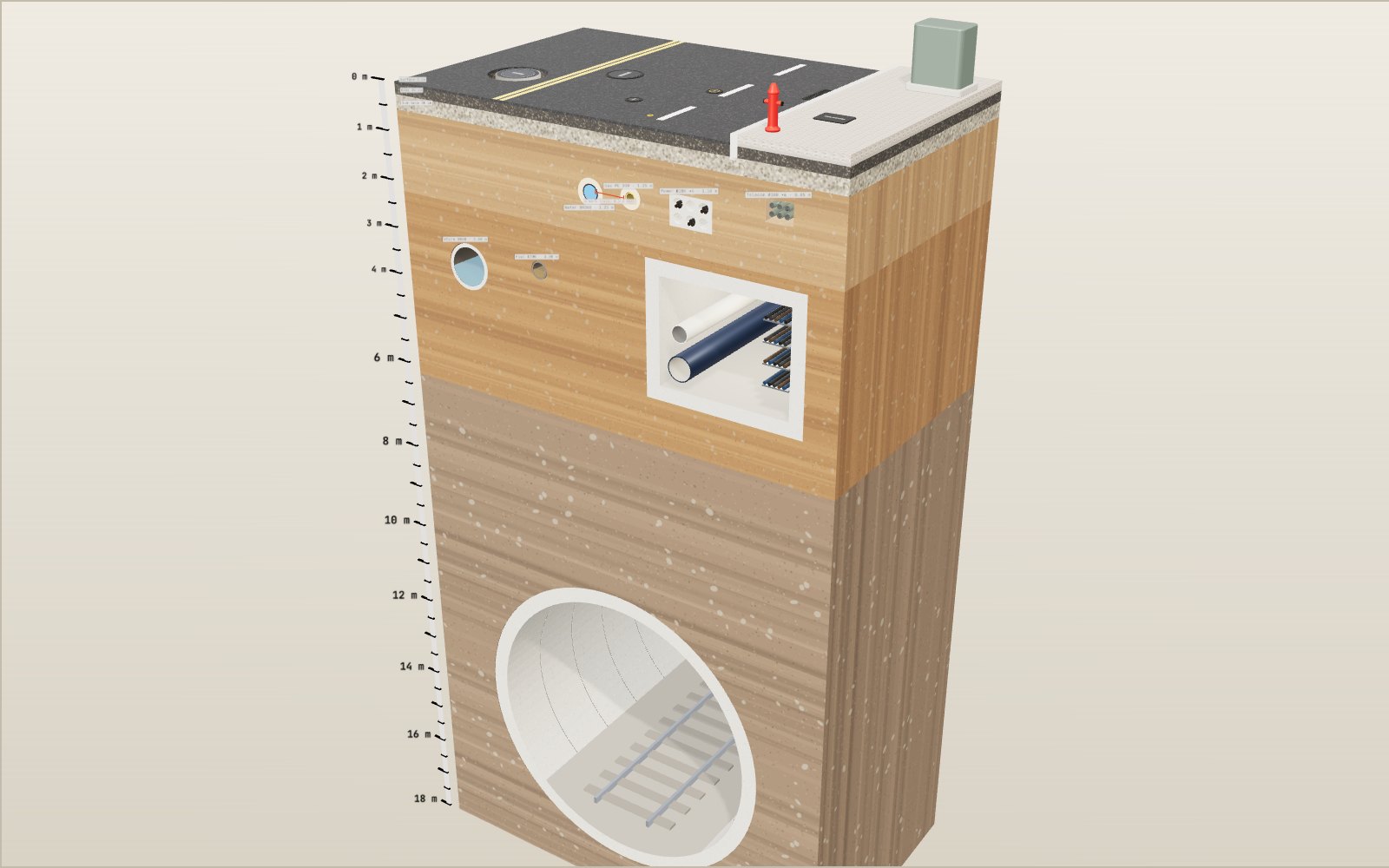
1 / 11 A block of street cut out This is a 10 m by 6 m piece of a city road, cut down to 18 m. Drag to turn it. Scroll or pinch to zoom. The ruler on the left reads depth below the road surface in metres.
Drag to turn. Scroll or pinch to zoom.
Guide Parts Controls
01 A block of street cut out This is a 10 m by 6 m piece of a city road, cut down to 18 m. Drag to turn it. Scroll or pinch to zoom. The ruler on the left reads depth below the road surface in metres.
02 The road is three layers thick The asphalt you see is only the top 5 cm. Under it lie 20 cm of base course and 30 cm of crushed stone, so the road itself ends about 55 cm down. The layers are lifted here so you can see their thickness.
03 Cables sit closest to the surface With the shallow soil lifted away (everything down to 2.2 m), the telecom ducts and the power duct bank appear under the pavement edge. They are the shallowest services because the rules let them be: 0.8 m of cover for telecom and 1.0 m for power.
04 Water and gas keep their distance The water main and the gas main both sit about 1.25 m down. The red bar measures the gap between their walls, 0.64 m. Korean gas rules ask for at least 0.3 m, so a repair crew can work on one without disturbing the other.
05 Why the sewer has to slope Sewers have no pumps along the way. Water moves only because the pipe runs downhill. At 1.5 per mille the foul sewer runs at 0.53 m/s when full, below the 0.6 m/s that keeps solids moving, and sediment starts to settle. Try the slope slider.
06 A manhole and a tunnel for cables The manhole gives access to the storm sewer 3 m down. On the right is a utility tunnel, a concrete box large enough to walk through. Where one exists, cables and pipes go inside it and the road above does not need to be dug up for repairs.
07 The subway runs much deeper With the soil made transparent you can see a subway tunnel whose crown is 10 m under the road. That depth is a representative example; real lines go deeper where they pass under rivers, buildings or other lines. The rings of the lining are 1.2 m long.
08 Before anyone digs The red box is a 1.4 m deep hole. It has already reached the water main and the gas main. In Korea anyone digging near gas pipes must report the work to the excavation information centre (1644-0001) first and wait for the pipes to be marked.
09 Paint on the road With locate marks on, each buried line is painted on the surface in its APWA colour: red power, yellow gas, orange telecom, blue water, green sewers. The pale band is the tolerance zone, the width of the line plus 450 mm on each side, where digging is done by hand. The white outline is the planned trench; move it in the dig bench.
10 What the street surface tells you Covers, boxes and posts on the street mark what lies below: two manholes, a gully grate at the kerb, valve boxes for water and gas, a gas line marker, a telecom manhole, a pad-mounted transformer and a fire hydrant. Click them on the model to find all 9.
11 How a road caves in Water leaking from an old foul sewer joint carries soil into the pipe. The hollow climbs towards the road out of sight until the asphalt sags. In Korea, damaged sewers caused 901 of the 2,119 recorded subsidence cases from 2015 to 2024.
Surface course The asphalt you drive on, 5 cm thick in this model. It keeps water out and takes the wear from tyres. Base course A 20 cm layer of coarser asphalt mix that spreads the wheel load before it reaches the gravel. Sub-base 30 cm of compacted crushed stone. It drains water and stops the soil below from pumping up into the road. Telecom ducts Six 100 mm plastic ducts carrying fibre cables under the pavement. Korean road rules ask for at least 0.8 m of cover; here it is 0.85 m. Power duct bank Six 200 mm conduits cast in concrete, three with cables. Rules ask for 1.0 m of cover for buried power conduits; the top here is 1.1 m down. Water main A 300 mm ductile iron pipe under pressure. Its top must be at least 1.2 m below the road surface; here it is 1.25 m. Gas main A yellow 200 mm polyethylene pipe with a warning tape above it. It has to keep 0.3 m from other pipes; the gap to the water main is 0.64 m. Foul sewer A 300 mm pipe for wastewater from toilets, sinks and drains. It flows by gravity, so it must slope all the way to the treatment plant. Storm sewer An 800 mm concrete pipe for rain from the road gullies. It is bigger because a heavy shower brings far more water than households do. Manhole A 900 mm concrete shaft down to the storm sewer with steel rungs and a cast iron cover. Workers inspect and clean the pipe from here. Utility tunnel A walk-in concrete box holding cables, a water main and heating pipes, so they can be repaired without digging up the road. Subway tunnel A bored single-track tunnel lined with concrete rings, 7 m across with its crown 10 m down. A train passes every few seconds on screen.