Loading the model
This device cannot show the 3D model. You can read the guide steps below as text.
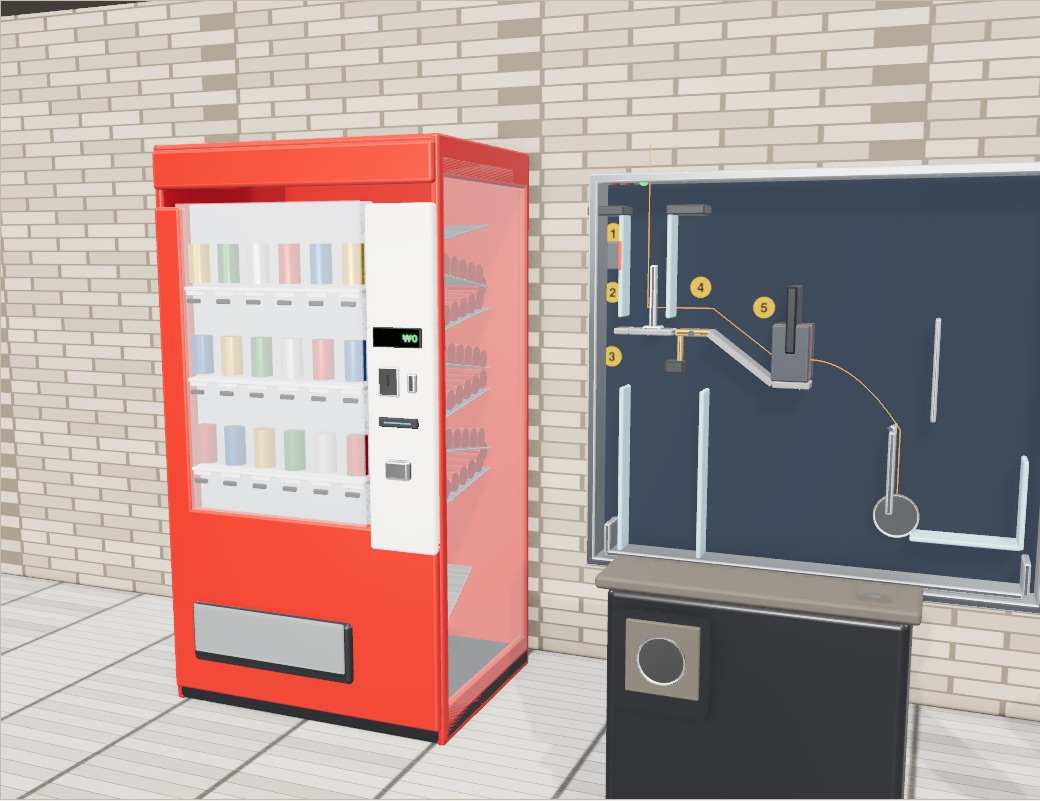
1 / 14 A coin rolls through five gates Two 500 won coins drop into a coin selector shown 3.5 times life size, and the can machine on the left gives a can. Then a steel washer comes. The mannequin is your height.
Drag to turn. Scroll or pinch to zoom.
Guide Parts Controls
01 A coin rolls through five gates Two 500 won coins drop into a coin selector shown 3.5 times life size, and the can machine on the left gives a can. Then a steel washer comes. The mannequin is your height.
02 Too wide for the slot The slot is only half a millimetre wider than the biggest coin the machine takes. A 30 mm brass medal rests on top and is handed back.
03 Iron sticks to the first magnet A steel washer is pulled against the small magnet beside the chute and stays there. The return lever swings the selector open and wipes it off.
04 The gauge reads the diameter Each coin the machine takes has its own track. A Japanese 100 yen, 22.6 mm, matches none of the Korean tracks, so the trapdoor drops it.
05 The cradle weighs the coin A counterweighted cradle tips only for a coin within 4 % of the right weight. A 24 mm aluminium disc weighs 2.2 g and is pushed back.
06 The magnet slows the coin The 100 won is not attracted to the magnet, but moving past it the coin carries eddy currents that push back. It leaves the ledge a little slower.
07 Too conductive: copper drops short A copper disc of the same size and weight brakes so hard under the magnet that it drops straight off the ledge, short of the anvil.
08 A token that nearly passes Nickel silver conducts almost as poorly as cupronickel. At the factory setting the token lands inside the window; raise the magnet to 130 % and it falls short.
09 Cans in a serpentine column Through the clear side, cans lie on ramps that slope one way and then the other. A star wheel at the bottom lets one can go and holds the next.
10 Two coils, two frequencies The US quarter and the 100 won differ by 0.26 mm. The 200 kHz coil sees the copper-nickel skin; the 1 kHz coil sees the copper core of the quarter and rejects it.
11 A copied note has no magnetic ink Rollers pull the note past a length gate, an infrared beam, a magnetic head and UV light. The colour copy passes the first three and stops at the head.
12 Heron's coin vessel A coin of five drachms falls on the plate of a lever. The lever lifts a lid and water runs from the spout until the coin slides off.
13 A penny for a postcard In the 1880s a penny tipped a balance that freed the drawer for one pull. Weight was the only test.
14 Back on the street The coin selector, the can machine and the validators work together in one machine. The panels below the stage show the numbers, the cases and the tasks.
Coin slot Only as wide as the largest coin the set takes, plus half a millimetre. Iron magnet A small permanent magnet beside the chute. Iron and steel stick to it. Size gauge Reads the diameter and sends the coin to its track; the trapdoor drops coins with no track. Weighing cradle A rail on a pivot with a counterweight. It tips only within the weight window. Ramp The coin rolls down from rest; its speed at the bottom depends only on the height. Eddy-current magnet Two pole blocks either side of the runway. Eddy currents in the passing coin slow it. Anvil A knife edge 40 mm below the ledge. Coins landing short of it are rejected. Coin box Accepted coins land here and count as credit. Reject chute Coins stopped at the gauge or the cradle fall down here. Return cup Every rejected coin ends up here, back to the customer. Serpentine column Ramps sloping each way in turn hold cans lying on their sides. Star wheel At the foot of each column: turns once to let one can go and stop the next. Delivery bin The can drops here behind a flap. Coin mechanism The real-size selector and the change tubes behind the money panel. Credit display Shows the money put in so far. Coin entry The slot plate on the front of the door. Bill entry The mouth of the bill validator. Light gate An LED and a photodiode: how long the beam is blocked gives the diameter. 1 kHz coil Low frequency: the eddy currents run through the whole thickness. 200 kHz coil High frequency: the eddy currents stay near the surface. Accept flap Opens for an accepted coin; otherwise the coin falls to reject. Signal screen The three signals as the coin passes. Width guides Korean notes are all 68 mm wide; a wider note does not go in. Rollers Rubber rollers pull the note in and push a rejected note back out. Length sensor Times the note to find its length, 136 to 154 mm. Infrared sensor Reads how infrared light passes through the note. Magnetic head Reads the magnetic ink printed on genuine notes. UV lamp Ordinary paper glows under UV; note paper hardly does. One-way gate Lets the note pass toward the stacker and stops it being pulled back. Stacker Accepted notes pile up here. Chest Hero calls it a treasure chest; it holds the water and the coins. Lever O P Turns on a vertical rod; plate at one end, lid at the other. Plate R The coin falls on it and slides off when it tilts enough. Lid S Hangs from the lever over the outlet box L. Pipe L M Carries water from the box out of the chest to the spout. Postcards A stack of plain cards behind glass. Drawer Freed by the catch for one pull. Balance and catch The coin tips the arm; if heavy enough the catch frees the drawer.