Loading the model
This device cannot show the 3D model. You can read the guide steps below as text.
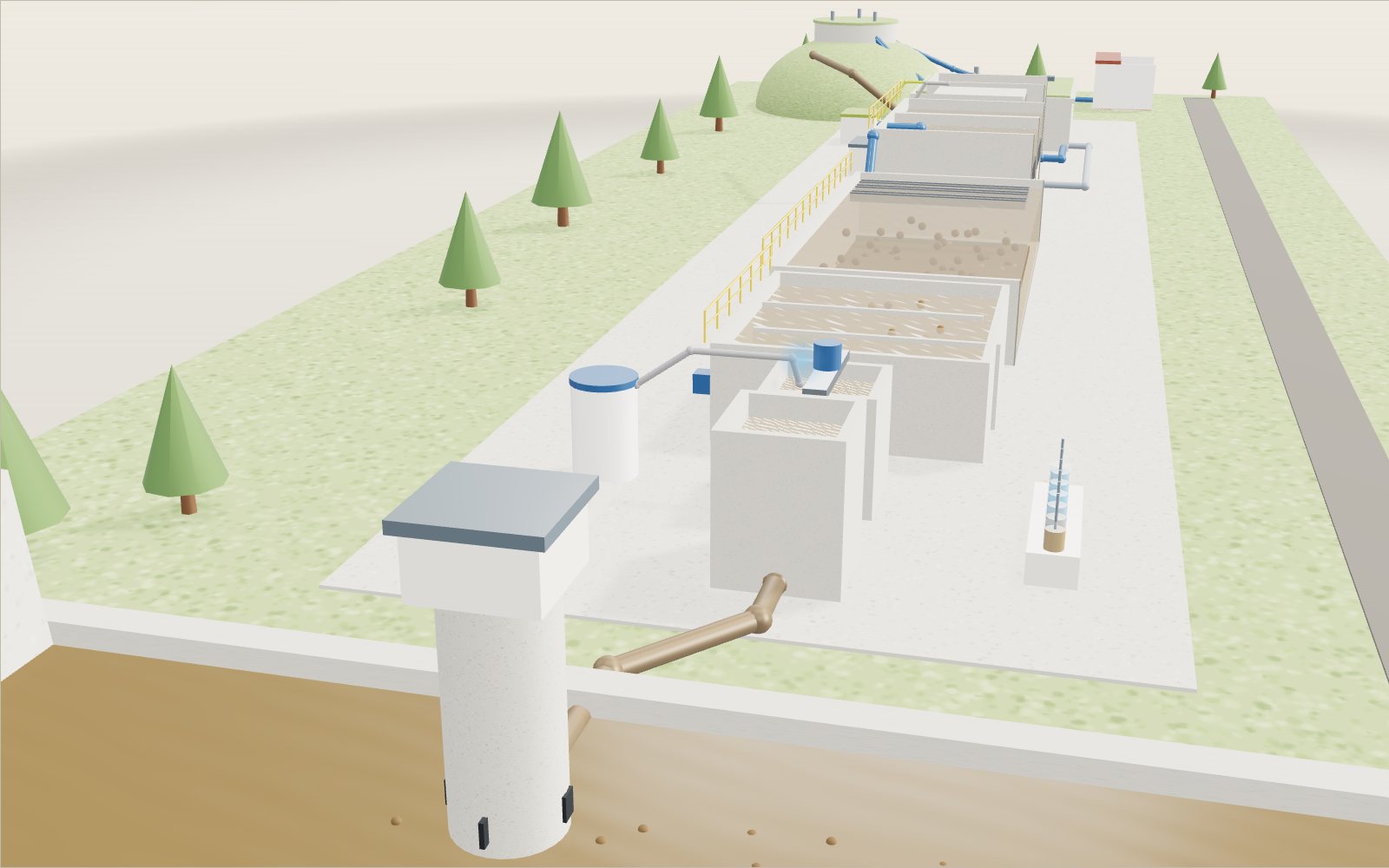
1 / 11 You are the drop You start as one drop in a muddy river behind the dam and get pulled into the intake tower. Use the bar on the stage to go inside each stage of the plant, or click a building. The readout follows turbidity and bacteria from river to tap; the numbers are model values and the limits drawn are the Korean ones.
Drag to turn. Scroll or pinch to zoom.
Guide Parts Controls
01 You are the drop You start as one drop in a muddy river behind the dam and get pulled into the intake tower. Use the bar on the stage to go inside each stage of the plant, or click a building. The readout follows turbidity and bacteria from river to tap; the numbers are model values and the limits drawn are the Korean ones.
02 Into the intake River water at 10 NTU carries silt, leaves and about 1,000 bacteria per millilitre in this model. The screen stops leaves and fish; the fine silt goes straight through into the intake, which is why the rest of the plant exists. Try the river turbidity slider: at 300 NTU the water is thick with silt.
03 Coagulant goes in at the rapid mix Clay grains carry a negative charge and push each other away, so they stay apart for days. The coagulant (polyaluminium chloride here) neutralises that charge in about a minute of hard mixing, and grains that touch now stay together. Watch the white puff each time you change the dose.
04 Flocs grow, and pH decides how well In slow stirring the grains collide and build flocs. At 25 mg/L and pH 7 almost every grain ends up in a floc about 120 micrometres across. This step starts at pH 6, where the coagulant works less well and many grains stay single. Move the pH back to 7, or try 0 and 60 mg/L.
05 Stokes's law decides what settles A particle sinks at a speed that grows with the square of its size. A 2 µm clay grain falls 1.3 cm an hour, so it would take eleven days to settle. A 120 µm floc falls 1.76 m an hour, faster than the basin's 1.5 m/h overflow rate, so the flocs reach the floor and the fine grains drift out over the weir.
06 Filters catch what the basin missed The settled water passes down through anthracite and sand. Particles stick to the grains near the top of the bed, and turbidity drops from about 1 NTU to 0.05. The bed slowly fills: the Filter load row counts it. A backwash pushes air and water up through the bed, lifts it and carries the dirt to the trough. It is running now.
07 Ozone and activated carbon After the filters, ozone bubbles break down taste and odour compounds and the black bed of activated carbon catches what is left. In the model ozone also adds a 1-log kill of bacteria and 2 logs of viruses.
08 Chlorine needs time as well as strength Disinfection is judged by CT, the chlorine left times the contact time: 0.7 mg/L for 30 minutes gives 21 mg·min/L. Bacteria and viruses fade from colour to grey as they die. The green dots are HOCl, the strong form; at higher pH more chlorine turns into pale blue OCl⁻, which works far more slowly. The big orange Cryptosporidium oocysts barely notice.
09 UV for what chlorine misses With ozone off and UV on, light at 40 mJ/cm² (a model value) leaves the oocysts unable to multiply: about 4 logs. UV leaves nothing behind in the pipes, so the chlorine stays.
10 Down from the hill to the tap Pumps lift the water to a service reservoir on the hill, and gravity carries it to the house. On the way the chlorine slowly fades. With 1.0 mg/L dosed, about 0.27 mg/L is left at the tap, above the 0.1 mg/L minimum. Turn the chlorine up past 2.9 mg/L and the smell lines appear over the glass.
11 Monsoon: 300 NTU Rain has brought the river to 300 NTU while the coagulant is still at 25 mg/L. Flocs are too few, the basin lets far more through and the filter fills fast. In the model the best dose rises to about 115 mg/L: raise it, slow the filter if needed, and backwash before the bed is full.
Dam and intake tower A dam holds back a reservoir upstream. The tower in the river draws water through screened ports and sends it to the plant. Receiving well A deep concrete box where the raw water arrives. It steadies the flow and the level so the rest of the plant gets an even supply. Rapid mix and coagulant tank Coagulant (polyaluminium chloride here) is dosed from the white tank and whipped into the water by a fast turbine in about a minute. Flocculation basin Three bays with paddles that turn slower in each bay, so the young flocs keep bumping together without being torn apart. Settling basin A long, quiet tank, cut open at the front. Flocs sink to the floor while the water crawls across; launders at the far end skim off the clear top layer. Rapid filters Two cells, cut open: anthracite over sand over gravel, on an underdrain. Switch on Backwash to see the right-hand cell washed from below. Ozone contactor Part of advanced treatment. Ozone gas bubbles up through the water and breaks down taste and odour compounds. The building behind makes the ozone. Activated carbon filter A deep bed of granular activated carbon that adsorbs what the ozone left behind, including the earthy-smelling compounds from algae. Clearwell and chlorine Chlorine goes in at the inlet. Baffle walls make the water snake through so every part of it stays in contact long enough. Switch on See inside. Service reservoir A covered tank on a hill. Pumps fill it, and gravity then pushes the water down through the mains to the town. Kitchen tap The end of the trip. Korean rules want at least 0.1 mg/L of free chlorine still in the water here, and no more than 0.5 NTU of turbidity.