Loading the model
This device cannot show the 3D model. You can read the guide steps below as text.
1 / 13 A clear winter night A clear mid-January evening far from town lights. The opening switches the lights off and every star down to magnitude 6.0 in the Yale catalogue appears. Drag to look around the sky.
Drag to turn. Scroll or pinch to zoom.
Guide Parts Controls
01 A clear winter night A clear mid-January evening far from town lights. The opening switches the lights off and every star down to magnitude 6.0 in the Yale catalogue appears. Drag to look around the sky.
02 The same sky in a city In a class 8 city sky only stars brighter than about magnitude 4.5 survive. Orion’s shoulders, knees and belt are still there; most of the rest has gone.
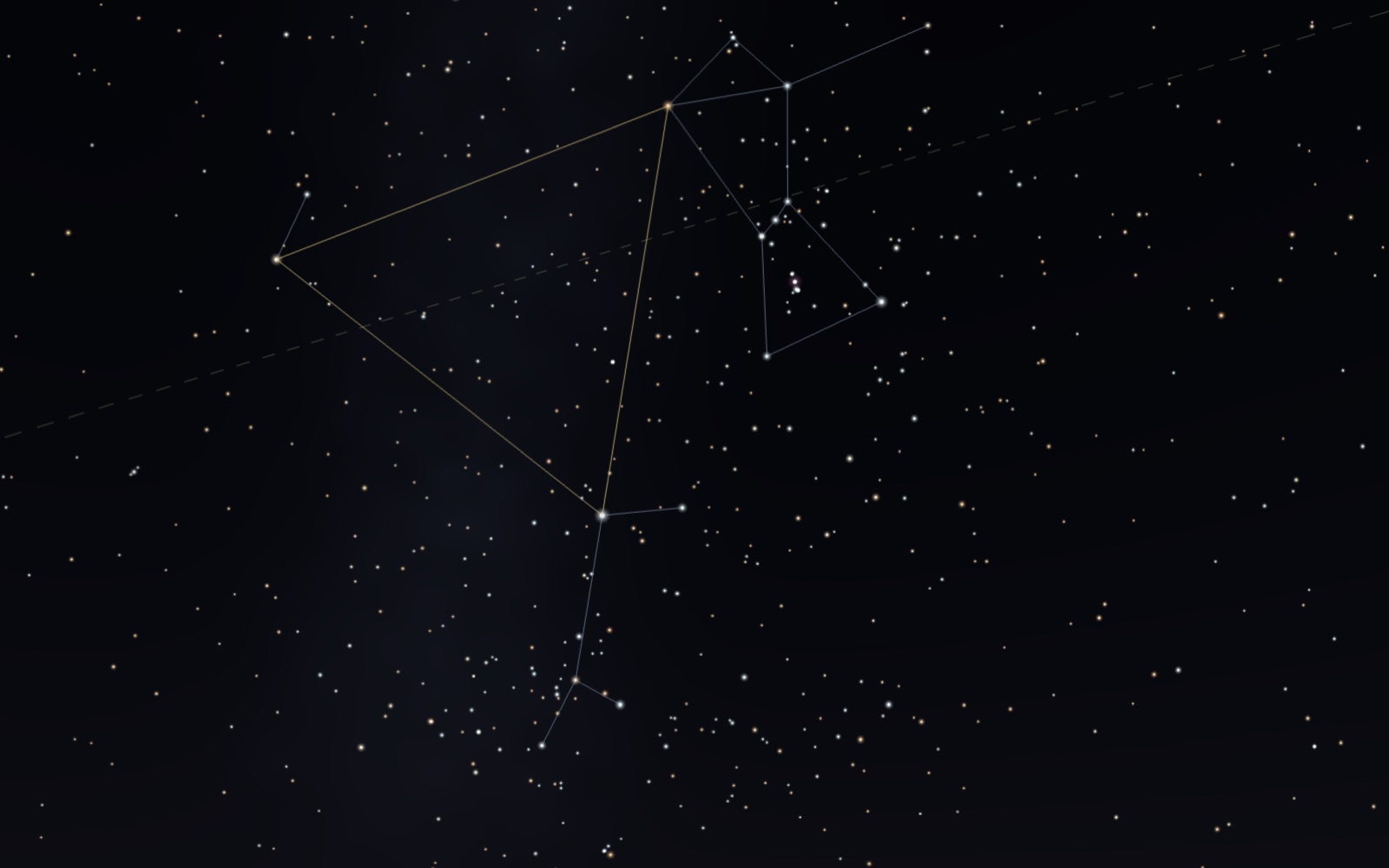
03 Orion Back in a rural sky. Betelgeuse is the red shoulder, Rigel the blue-white foot. The three belt stars point down to Sirius and up towards Aldebaran.
04 The belt and the sword Below the belt hangs the sword. Its middle star is not a star but the Orion Nebula, a cloud where stars are forming, about 1,300 to 1,400 light-years away.
05 The Winter Triangle Betelgeuse, Sirius and Procyon make a nearly equal-sided triangle. Each comes from a different constellation.
06 The Winter Hexagon Rigel, Aldebaran, Capella, Pollux, Procyon and Sirius ring Orion. The hexagon is so big that you need to turn your head to see it all.
07 The night goes on Early in the evening Orion climbs out of the east, lying on its side. Play the clock: the whole sky turns about the pole, 15° an hour.
08 From Sydney South of the equator the same stars stand in the north, and Orion is upside down: the belt is above Rigel and Betelgeuse is at the bottom.
09 Seen from the side Turn on real distances. Each named star moves out along its own line of sight to the distance from its parallax. Drag to look at the triangle from the side.
10 The belt is not a row Mintaka, Alnilam and Alnitak are hundreds of light-years apart. The yellow bars show ± one standard error: Alnilam’s small parallax gives the widest bar.
11 Where is Betelgeuse? Three studies, three distances: Hipparcos 2007, a radio solution (Harper 2017) and stellar models (Joyce 2020). The coloured dots show all three.
12 The Great Dimming Between October 2019 and February 2020 Betelgeuse lost about a magnitude and became as faint as Bellatrix. Images showed a dust cloud over its southern half. The light curve in the panel lists the published values.
13 Light pollution In an inner-city sky (class 9) only stars brighter than magnitude 4.0 show. Lower the class to bring the stars back.
Orion The hunter of the winter sky: two bright shoulders, two bright knees and three stars in a row for the belt. The stick figure is drawn by this exhibit; the IAU fixes only the boundary of each constellation. Orion’s Belt Alnitak, Alnilam and Mintaka, about 3° long in total. They look like neighbours, but their parallaxes put them hundreds of light-years apart. Orion Nebula The fuzzy middle star of Orion’s sword is a cloud of gas lit by young stars. Radio parallaxes put it at 414 ± 7 pc (Menten 2007) or 388 ± 5 pc (Kounkel 2017). Betelgeuse A red supergiant on Orion’s shoulder. In February 2020 it fell to V 1.614, the faintest in its measured record, and in autumn 2026 it faded again. Rigel The blue-white supergiant at Orion’s foot, V 0.12. Hipparcos puts it at a parallax of 3.78 ± 0.34 mas. Sirius The brightest star of the night sky, V −1.46, and one of the nearest: parallax 379.21 mas, about 8.6 light-years. Procyon The Little Dog’s bright star, V 0.38, also close: parallax 284.56 mas. Winter Triangle Betelgeuse, Sirius and Procyon, three stars from three constellations. The shape exists only from where we stand. Winter Hexagon Rigel, Aldebaran, Capella, Pollux, Procyon and Sirius, a ring of six bright stars around Orion, also called the Winter Circle. Pleiades The star cluster in Taurus. Its distance was argued over for years: 120.2 pc from Hipparcos against 136.2 pc from radio parallax (Melis 2014). Horizon Hills and town lights. Below the horizon the ground hides the stars; switch the ground to see-through to look under it.