FIG. 126Senses
Winter constellations: Orion, the Winter Triangle and Hexagon
The three stars of Orion’s Belt look side by side, yet by their Hipparcos parallaxes Alnilam is nearly three times as far away as Mintaka.
This device cannot show the 3D model. You can read the guide steps below as text.
1 / 13 A clear winter nightA clear mid-January evening far from town lights. The opening switches the lights off and every star down to magnitude 6.0 in the Yale catalogue appears. Drag to look around the sky.
Drag to turn. Scroll or pinch to zoom.
What the sky shows
On a clear winter evening the brightest part of the whole night sky stands in the south. Orion, with its three belt stars in a row, is the easiest pattern to find; around it shine Sirius, Procyon, Aldebaran, Capella, Pollux and Rigel, seven of the brightest stars you can see from anywhere. This exhibit puts you at the centre of that sky. Pick a date between 1 November 2026 and 13 March 2027, a clock time and one of eight cities, and every star of magnitude 6.0 or brighter in the Yale Bright Star Catalogue appears where it really stands at that moment. Then turn on real distances and the sky comes apart: the named stars slide out along their lines of sight to the distance worked out from their measured parallax, and the shapes you just found turn out to be made of stars that have nothing to do with each other.
The numbers on the stage and in the panel are published values (catalogue positions, magnitudes, parallaxes, measured brightness of Betelgeuse, the Bortle limits), or are worked out from them, in which case the page says "calculated". Nothing is filled in by guesswork.
How to find Orion
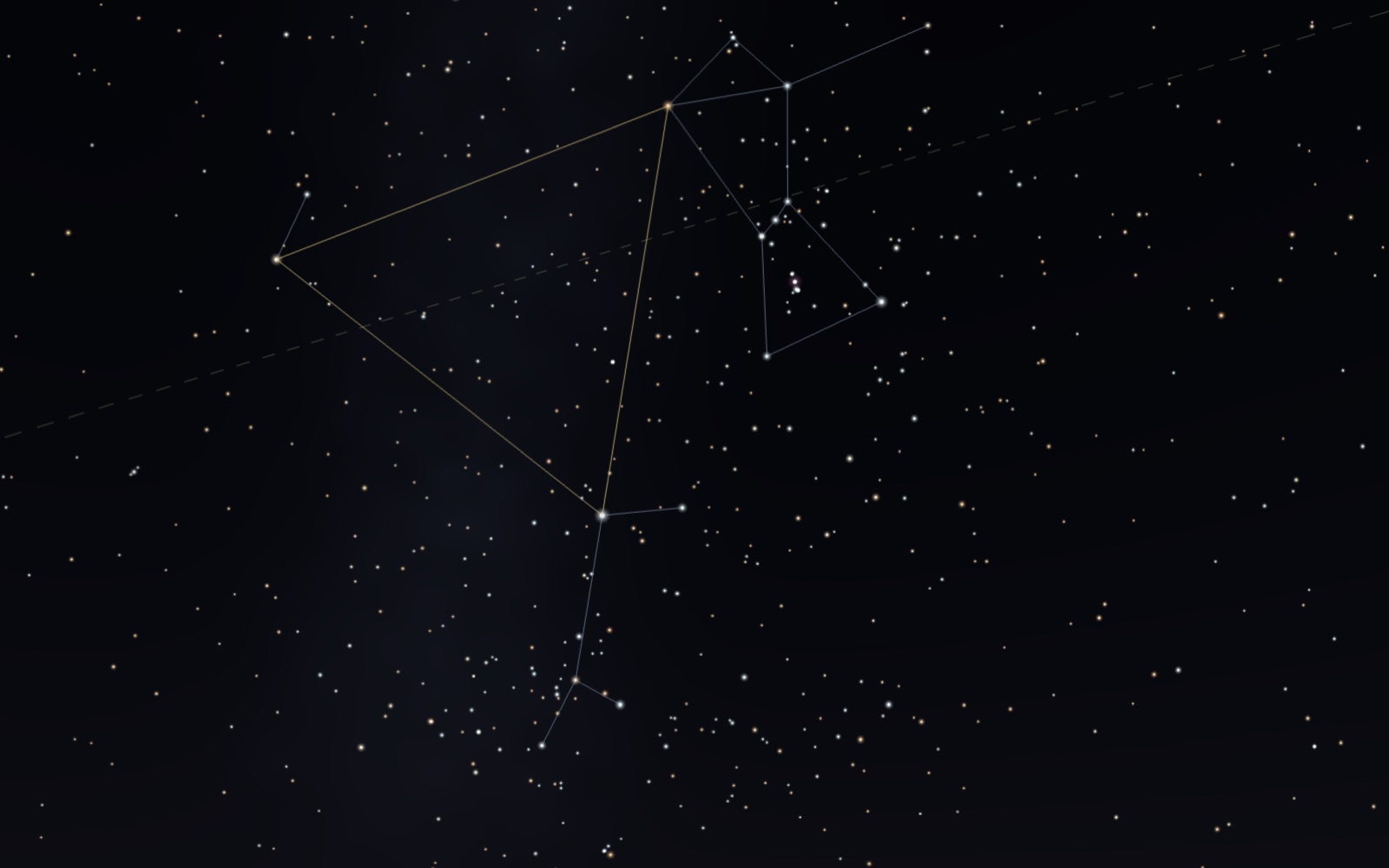
Look for three stars of about the same brightness in a short, straight row. That is Orion's Belt, and it is about 3° long, roughly the width of two fingers held at arm's length. Above the belt and to the left (from the northern hemisphere) is a reddish star, Betelgeuse, the hunter's shoulder. Below and to the right is a blue-white star, Rigel, his knee or foot. The other shoulder is Bellatrix and the other knee is Saiph. Together the four corners and the belt make the hourglass shape that most people recognise.
The colours are real. Betelgeuse has a colour index B−V of 1.85 in the catalogue, which means it gives out much more red light than blue; Rigel's B−V is −0.03, a blue-white star. On the stage each star is tinted from its catalogue B−V, so you can see the difference even on a screen.
From mid-northern latitudes Orion is high in the south around 10 pm in mid-January and around 8 pm in mid-February. In early November it rises late in the evening and is best seen after midnight. Because the belt lies almost on the celestial equator, it rises close to due east and sets close to due west from every place on Earth.
Orion's Belt and the sword
The three belt stars are, from east to west, Alnitak, Alnilam and Mintaka. Alnilam, in the middle, is the brightest of the three in the catalogue, at magnitude 1.70; Alnitak is 2.05 and Mintaka 2.23. All three are hot, massive stars of spectral types O and B.
Hanging below the belt is a shorter, fainter row: Orion's sword. Its middle "star" looks slightly fuzzy even to the naked eye from a dark site. It is the Orion Nebula, catalogued as M42, a cloud of gas and dust lit from inside by a small cluster of very young, hot stars called the Trapezium. On the stage it is drawn as a soft pink glow; the glow is a picture, not a measured brightness.
The belt also works as a pointer. Follow it down and to the left (from the north) and you reach Sirius, the brightest star of the night. Follow it up and to the right and you reach Aldebaran, the orange eye of Taurus, and beyond it the small cluster of the Pleiades.
The Winter Triangle
Draw a line from Betelgeuse to Sirius, from Sirius to Procyon and back to Betelgeuse, and you have the Winter Triangle. It is a large, nearly equal-sided triangle, and each corner belongs to a different constellation: Betelgeuse to Orion, Sirius to Canis Major, the Great Dog, and Procyon to Canis Minor, the Little Dog. NASA's Night Sky Network lists the three stars as Procyon, Sirius and Betelgeuse.
The triangle shows how a shape in the sky depends on where you stand. Sirius is about 8.6 light-years from us and Procyon about 11.5, two of our nearest bright neighbours. Betelgeuse is roughly 500 light-years away by the Hipparcos parallax, and other studies put it farther still. Seen from the side, as the distance view shows, the triangle is a long, thin spike with two corners almost at our feet and one far away.
The Winter Hexagon
Around Orion lies a much larger ring of six bright stars: Rigel, Aldebaran, Capella, Pollux, Procyon and Sirius. This ring is called the Winter Hexagon or the Winter Circle. NASA's Night Sky Network (January 2024) names those six stars. NASA's Astronomy Picture of the Day has used Castor for the Gemini corner instead, mentioning Pollux alongside it; the two Gemini stars sit next to each other, so either way the ring looks the same.
The hexagon is big. From Rigel to Capella it spans more than 50° of sky, so you have to turn your head to take it in. Turn on the hexagon on the stage and press the hexagon in the parts list to swing the view to its centre. It contains six of the brightest stars visible from mid-northern latitudes in winter, which is why it still stands out from a city.
The other winter constellations
Orion has five bright neighbours, and the stage draws a simple figure for each when the constellation lines are on. All the magnitudes below are V magnitudes from the catalogue, and the distances are calculated from Hipparcos parallaxes.
Taurus, the Bull, lies up and to the right of Orion. Its brightest star, orange Aldebaran, is magnitude 0.85 and about 67 light-years away. Around it a loose V of fainter stars marks the bull's face, and farther along the same line the Pleiades sit like a tiny dipper. Elnath, magnitude 1.65, marks the tip of one horn and is shared in the stick figures of Taurus and Auriga.
Auriga, the Charioteer, is a large pentagon high overhead from northern cities in January. Capella, magnitude 0.08, is the sixth brightest star of the night sky and about 43 light-years away; Menkalinan, magnitude 1.90, is about 81.
Gemini, the Twins, has two bright heads side by side. Pollux (1.14) is the brighter of the two, although its Bayer letter is β; Castor (1.98, with α) is the fainter. Pollux is about 34 light-years away and Castor about 51.
Canis Major, the Great Dog, holds Sirius and several bright stars in its body and legs: Adhara (1.50), Wezen (1.84) and Mirzam (1.98). Wezen looks like a modest star but by its parallax is about 1,610 light-years away; it is a yellow supergiant far brighter than Sirius in reality. From its magnitude and that distance it gives out about 1,600 times as much visible light as Sirius (roughly 1,000 to 2,000 times within the parallax error). Canis Minor, the Little Dog, is just two stars that you will notice: Procyon (0.38) and Gomeisa (2.90).
Use the atlas in the panel to compare them: sort by distance and the order bears no relation to the order by brightness.
When and where to look
The sky turns once about the celestial pole in a sidereal day, 23 hours 56 minutes. Each night the same star rises, crosses the meridian and sets about 4 minutes earlier by the clock, which adds up to about 2 hours a month. That is why Orion is an after-midnight sight in November, a late-evening one in January and an early-evening one by March.
The table gives the time when Orion's Belt (Alnilam) crosses the meridian, worked out with this exhibit's sky arithmetic, for three dates in local clock time. These are calculated values.
| City | 15 December | 15 January | 15 February | Highest altitude |
|---|---|---|---|---|
| Seoul | 00:31 | 22:29 | 20:27 | 51° |
| New York | 23:53 | 21:51 | 19:49 | 48° |
| London | 23:58 | 21:56 | 19:54 | 37° |
| Reykjavík | 01:25 | 23:23 | 21:21 | 25° |
| Singapore | 01:03 | 23:02 | 20:00 | 87° |
| Sydney | 00:54 | 22:53 | 20:51 | 57° |
Seoul crosses later than Tokyo even though both keep UTC+9, because Seoul lies farther west within that time zone. Reykjavík keeps UTC+0 although it lies far west of Greenwich, so its stars cross the meridian well after midnight in December.
Latitude decides how high Orion climbs. The highest altitude of a star is 90° minus your latitude plus the star's declination. Betelgeuse has a declination of +7.4°, so from Seoul (37.6° N) it reaches about 59.8°, from London about 46°, and from Reykjavík about 33°. From Singapore, almost on the equator, the belt passes nearly overhead.
Upside down in the south
South of the equator the same winter stars are summer stars, and they stand in the northern half of the sky. Because you are facing north instead of south, everything is turned around: from Sydney, Orion appears upside down, with Rigel at the top and Betelgeuse at the bottom. The sword, which hangs below the belt from the north, points up from the south, and Sirius is above Orion instead of below.
Pick Sydney on the stage and look north to see it. The stars are exactly the same; only your position on Earth has changed. Canopus, the second brightest star of the night sky, is also high from Sydney. From Seoul it stays just below the horizon even at its highest (about −0.3° by the formula above, before refraction), and from London it never comes close.
How the stage places the stars
The stage uses the standard method from Jean Meeus's Astronomical Algorithms. First the date and clock time are turned into a Julian day number in Universal Time. From that comes the mean sidereal time at Greenwich (Meeus equation 12.4), then the local sidereal time by adding the city's longitude. The hour angle of each star is the local sidereal time minus its right ascension, and two lines of spherical trigonometry turn hour angle, declination and latitude into altitude and azimuth.
The exhibit's calculations reproduce Meeus's worked examples: the sidereal time 13h 10m 46.3668s at 0h UT on 10 April 1987, the 128.7378734° at 19:21 UT the same day, and the altitude 15.1249° and azimuth of Venus seen from Washington in example 13.b. Betelgeuse's highest altitude over Seoul also comes out at 90 − 37.57 + 7.407 = 59.84°. The Sun's position, which sets the twilight colour, uses Meeus's low-accuracy method (chapter 25), checked against example 25.a.
Two effects are left out. The catalogue positions are for the year 2000, and precession has moved the sky by about 0.4° since then, too little to see on the stage. Refraction, which lifts stars near the horizon by about half a degree, is also ignored.
The star list
The stars come from the Yale Bright Star Catalogue, fifth revised edition (Hoffleit and Warren, 1991). It lists 9,110 objects, essentially every star of magnitude 6.5 or brighter, and is the classic list for naked-eye stars. The version used here is the one distributed by the Harvard-Smithsonian Center for Astrophysics. The stage takes every entry of V magnitude 6.0 or brighter, 5,080 stars, with their J2000 positions, V magnitude and B−V colour index.
At any moment about half of them are above the horizon. The readout counts how many: on 15 January at 9 pm from Seoul, about 2,540. That count is calculated from the list, not observed, and it is the upper limit for a perfect sky with this list. Real observers at very dark sites see stars fainter than 6.0, and Bortle's scale goes down to magnitude 8.0, but this list stops at 6.0, so darker settings than class 5 add no stars on the stage.
Magnitudes and colour
Star brightness is given in magnitudes, a scale where a larger number means a fainter star. Five magnitudes are a factor of 100 in brightness, so one magnitude is a factor of about 2.512. Sirius at −1.46 is the brightest star in the night sky; the faintest stars on the stage are at 6.0, about 960 times fainter than Sirius.
The V in "V magnitude" means the brightness was measured through a standard yellow-green filter close to the eye's sensitivity. B−V is the difference between the blue and the V magnitude. Hot stars give out more blue light and have a small or negative B−V; cool stars have a large one. Rigel (−0.03) is a hot blue supergiant, while Aldebaran (1.54) and Betelgeuse (1.85) are cool red giants and supergiants. On the stage each star's tint comes from its B−V through a standard temperature formula; the tint is a picture of the colour, not a measurement of it.
Measuring distance: parallax
As Earth goes round the Sun, a nearby star seems to shift a little against far-off stars, and back again six months later. The size of that wobble is the star's parallax. A star with a parallax of one arcsecond is at a distance of one parsec, about 3.26 light-years; half the parallax means twice the distance.
For bright stars the best set of parallaxes is still the one from the European Space Agency's Hipparcos satellite, which measured positions from 1989 to 1993. Floor van Leeuwen reprocessed the raw data and published a new reduction in 2007. The exhibit takes the parallaxes and their standard errors from that new reduction, served by NASA's HEASARC archive, for the 28 named stars in the atlas. Distances on the page are 1,000 divided by the parallax in milliarcseconds, in parsecs, times 3.26 for light-years, and are marked as calculated.
How far are the stars of Orion?
| Star | Parallax (mas) | Distance (light-years, calculated) | Range at ± 1σ |
|---|---|---|---|
| Bellatrix | 12.92 ± 0.52 | 250 | 240 to 260 |
| Betelgeuse | 6.55 ± 0.83 | 500 | 440 to 570 |
| Saiph | 5.04 ± 0.22 | 650 | 620 to 680 |
| Mintaka | 4.71 ± 0.58 | 690 | 620 to 790 |
| Alnitak | 4.43 ± 0.64 | 740 | 640 to 860 |
| Rigel | 3.78 ± 0.34 | 860 | 790 to 950 |
| Alnilam | 1.65 ± 0.45 | 1,980 | 1,550 to 2,720 |
The two shoulders, which look like a matched pair, are not: Bellatrix is about twice as close as Betelgeuse. The belt, the neatest row in the sky, has Mintaka and Alnitak at around 700 light-years and Alnilam nearly three times as far by its parallax. That is the point of the distance view: the stars of a constellation are usually just stars that happen to lie in nearly the same direction.
Press any name in the distance table in the panel to fly to that star in the distance view and see its bar.
Why some distances are so uncertain
A parallax is a tiny angle. Alnilam's is 1.65 milliarcseconds, about the width of a coin seen from more than 2,000 kilometres, and its standard error is 0.45. The error is more than a quarter of the value, and because distance is one over parallax, the range of distance is lopsided: from about 1,550 light-years at the near end to about 2,720 at the far end. Bellatrix's parallax is about eight times larger with a similar error, so its distance is known to a few per cent.
On the stage the yellow bars show this range for every named star. Turn on real distances and look at Alnilam, Hatysa or Aludra: their bars are hundreds of light-years long. Sirius and Procyon have bars too short to see.
Red supergiants are especially hard. Betelgeuse's own disc is large on the sky and its surface is uneven, so bright patches that come and go shift the centre of its light, which is exactly what a parallax measurement has to follow.
Betelgeuse: one star, several distances
Betelgeuse is the clearest case. The Hipparcos new reduction gives a parallax of 6.55 ± 0.83 mas, about 153 parsecs. In 2017 Graham Harper and colleagues combined the Hipparcos measurements with radio positions from the VLA, e-MERLIN and ALMA and found 4.51 ± 0.80 mas, 222 (+48, −34) parsecs, about 720 light-years. In 2020 Meridith Joyce and colleagues took another route: they modelled the star's evolution and pulsations, derived its radius and from that a distance of 168 (+27, −15) parsecs, about 550 light-years.
The distance view shows all three as coloured dots along Betelgeuse's line of sight. They do not agree within their errors, and the difference matters: the star's true size and brightness, and so its stage of life, depend on how far away it is. Harper's team noted that Betelgeuse's angular diameter, about 44 milliarcseconds, is several times larger than its parallax, which is one reason the measurement is so hard.
The Great Dimming of 2019 and 2020
Betelgeuse is a variable star; it normally drifts between about magnitude 0.1 and 1.0 over months and years. In late 2019 it began to fade much further. Edward Guinan and Richard Wasatonic of Villanova University, who had measured it for 25 years, reported V = 1.12 on 7 December 2019 in The Astronomer's Telegram, then 1.273 to 1.294 between 19 and 22 December, 1.494 and 1.506 on 17 and 18 January 2020, and 1.614 ± 0.012 on 30 January.
The bottom came in February. Over 7 to 13 February 2020 the mean was V = 1.614 ± 0.008, about a magnitude fainter than in September 2019 and as faint as Bellatrix. Between 17 and 22 February measurements by Guinan's group, Thomas Calderwood of the AAVSO and Donald Carona of Texas A&M University gave V from 1.522 to 1.589: the dimming had stopped. Costantino Sigismondi reported visual estimates of 1.08 on 23 March and 0.93 on 31 March as the star recovered.
The light curve in the panel plots these published values. Press any point to read its date, magnitude, method and the telegram it comes from. Values that a report gives only approximately, with a "~", are drawn hollow.
What caused the dimming
Images taken with the European Southern Observatory's Very Large Telescope in late 2019 and early 2020 showed that the star's southern half had gone dark. Miguel Montargès and colleagues, writing in Nature in 2021, concluded that a cloud of dust had formed in front of that part of the star. As ESO describes it, the star had thrown out a large bubble of gas; when a patch of the surface below it cooled, the gas condensed into solid dust that blocked part of the light. The team found the southern hemisphere about ten times darker than usual.
The dimming was not a sign that Betelgeuse was about to explode. It is expected to end as a supernova, but on the timescale of a star's life, not of a human one.
Betelgeuse fades again in 2026
The story did not end in 2020. Sigismondi and colleagues reported a second, smaller minimum near V = 1.0 in August 2020 and a recovery to 0.7 by 27 August. Guinan's group had already noted a long period of about 5.9 years in the star's brightness besides its main pulsation. In 2025 a team led by Steve Howell of NASA's Ames Research Center reported a probable direct image of a faint companion star close to Betelgeuse, made with the Gemini North telescope; such a companion had been proposed as the cause of that long period.
In October 2026 Daniel Jadlovsky and colleagues reported in The Astronomer's Telegram that Betelgeuse had been fading again, from about V 0.5 to about V 0.95 between August and October 2026, with motions in its atmosphere like those before the Great Dimming. Soon after, Sigismondi and colleagues reported that the fall seemed to have stopped near magnitude 1.0 by mid-October. The second panel of the light curve shows those approximate values. If you look at Orion this winter, compare Betelgeuse with Aldebaran (0.85) and Pollux (1.14) to judge its brightness yourself.
The Orion Nebula
The Orion Nebula is one of the nearest places where stars are being born. Its distance has been measured precisely with radio telescopes that track young stars inside the cluster. Karl Menten and colleagues used the Very Long Baseline Array and published 414 ± 7 parsecs in 2007, about 1,350 light-years. Marina Kounkel and colleagues, with a larger sample of stars in the Gould's Belt Distances Survey, found 388 ± 5 parsecs for the Orion Nebula Cluster in 2017, about 1,270 light-years. The two values differ by more than their errors, a reminder that "the distance" of an extended cloud depends on which stars are measured.
On the stage the nebula sits at its Menten distance in the distance view, beyond most of Orion's bright stars. So when you look at the sword, the fuzzy patch is farther away than Betelgeuse, Rigel and the belt stars Mintaka and Alnitak, and less far than Alnilam's parallax suggests for that star.
The Pleiades distance argument
The Pleiades, the small dipper-shaped cluster in Taurus, show how even a careful mission can be off. The Hipparcos results put the cluster at 120.2 ± 1.5 parsecs, while other methods gave about 133.5. The disagreement lasted for years. In 2014 Carl Melis and colleagues measured the parallax of cluster stars with a worldwide radio network and found 136.2 ± 1.2 parsecs, about 440 light-years, settling the question in favour of the larger value.
The atlas lists both values. It is a useful caution for the Hipparcos numbers used for the single stars on this page: they are the best available for these bright stars, but a parallax is a measurement with an error, and sometimes with a hidden bias.
Sirius and Procyon, the near neighbours
Sirius has a Hipparcos parallax of 379.21 ± 1.58 mas, which puts it at about 8.6 light-years, one of the nearest stars to the Sun. Procyon, at 284.56 ± 1.26 mas, is about 11.5 light-years away. Their errors are tiny compared with the parallax, so their distances are known to well under one per cent.
Turn on real distances and the two corners of the Winter Triangle collapse onto the Earth marker while Betelgeuse moves far out. Aldebaran (about 67 light-years), Capella (about 43) and Pollux (about 34) are also near; Rigel is the only distant star of the hexagon.
Light pollution and the Bortle scale
In 2001 the amateur astronomer John Bortle published a nine-class scale for judging how dark a sky is, in Sky & Telescope. Each class describes what you can see, and gives the naked-eye limiting magnitude, the faintest star an observer can make out.
| Class | Name | Faintest star |
|---|---|---|
| 1 | Excellent dark-sky site | 7.6 to 8.0 |
| 2 | Typical truly dark site | 7.1 to 7.5 |
| 3 | Rural sky | 6.6 to 7.0 |
| 4 | Rural and suburban transition | 6.1 to 6.5 |
| 5 | Suburban sky | 5.6 to 6.0 |
| 6 | Bright suburban sky | about 5.5 |
| 7 | Suburban and urban transition | 5.0 |
| 8 | City sky | 4.5 at best |
| 9 | Inner-city sky | 4.0 or less |
The light pollution control sets the class, and the stage hides every star fainter than the faint end of that class's range. On 15 January at 9 pm from Seoul, a class 8 sky leaves about 430 of the list's stars above the horizon and class 9 about 240, against about 2,540 for a perfect sky down to 6.0 (calculated). Orion's shoulders, knees and belt are all brighter than 2.3 and survive. Bortle notes that in a city sky some stars of familiar constellation figures go missing; you can watch that happen to the fainter stars of Taurus and Gemini.
How common are such skies? The world atlas of artificial night sky brightness (Falchi and colleagues, 2016) found that more than 80% of the world's people and more than 99% of people in the United States and Europe live under light-polluted skies, and that the Milky Way is hidden from more than one-third of humanity. Using naked-eye star counts sent in by volunteers of the Globe at Night project, Christopher Kyba and colleagues found in 2023 that the sky those observers saw grew brighter by about 9.6% a year from 2011 to 2022.
Twilight and the Moon
Even far from any town the sky is not dark until the Sun is well below the horizon. The U.S. Naval Observatory defines astronomical twilight as ending when the Sun is 18° below the horizon; before that, the faintest stars are washed out. The stage computes the Sun's altitude and brightens the sky towards the Sun as twilight comes on; the brightening is a picture, not a measured sky brightness. Set the clock to 18:00 in November and the western sky still glows.
The Moon is not drawn. A bright Moon washes out faint stars much as light pollution does, so for the darkest views pick a night near new Moon.
Orion in other sky traditions
Many cultures have their own picture for this part of the sky. In the traditional astronomy of Korea and China, the sky was divided into three enclosures and 28 lunar lodges, and Orion's main stars form the lodge called Sam (參宿, samsu). The National Folk Museum of Korea notes that the shape of this lodge is almost the same as the western Orion, which is why it is easy to find on old star charts.
The Korea Heritage Service describes the Cheonsang Yeolcha Bunyajido, a star chart carved in stone in 1395 at the start of the Joseon dynasty and now kept at the National Palace Museum of Korea. It groups the lodges into four directions; Sam is among the seven western lodges of the White Tiger. The stone shows 1,467 stars, each carved larger or smaller according to its brightness.
Constellations and asterisms
The International Astronomical Union recognises 88 constellations, which are areas of the sky with fixed boundaries, so that every point in the sky belongs to exactly one. The stick figures that join their stars are not official; each atlas draws its own. The lines on this stage are drawn by the exhibit.
Patterns that are not one of the 88, such as the Winter Triangle, the Winter Hexagon and Orion's Belt, are called asterisms. NASA's Night Sky Network describes all three as asterisms. They can cross constellation boundaries, as the triangle and hexagon do.
What the model simplifies
- Positions are J2000 catalogue positions without precession, proper motion, nutation, aberration or refraction. Over the dates shown, the largest of these shifts is under half a degree.
- Twilight, the Milky Way and town lights are pictures, not measured sky brightness. The Moon and planets are not shown.
- Star sizes on the screen grow with brightness so that magnitudes can be compared at a glance; seen by eye, a star is a point of light.
- The star list stops at magnitude 6.0. Very dark skies show more.
- Distances in the distance view are calculated from Hipparcos parallaxes and drawn to scale along each line of sight, 1 stage unit to 10 light-years. The Orion Nebula and the Pleiades use the radio parallaxes named above.
- Each city's clock is its standard time (Sydney's daylight saving time) between 1 November 2026 and 13 March 2027.
Questions
What are the winter constellations?
The constellations high in the evening sky in northern winter: Orion, Taurus, Gemini, Auriga, Canis Major and Canis Minor, with fainter ones such as Lepus, Monoceros and Eridanus. Their bright stars make the Winter Triangle and the Winter Hexagon.
How do I find the Orion constellation?
Look south on a winter evening for three equally bright stars in a short row, the belt. A red star above it (Betelgeuse) and a blue-white star below it (Rigel) complete the figure.
What stars make the Winter Triangle?
Betelgeuse in Orion, Sirius in Canis Major and Procyon in Canis Minor.
What stars make the Winter Hexagon?
Rigel, Aldebaran, Capella, Pollux, Procyon and Sirius, as listed by NASA's Night Sky Network. Some charts use Castor instead of Pollux.
What time is Orion visible?
From mid-northern latitudes it crosses the south around 10 pm in mid-January and about 2 hours earlier each month. In November it rises in the evening and is best after midnight; by March it is in the west after dusk.
Why does Orion look upside down in Australia?
Because observers in the southern hemisphere face north to see it, the figure is turned around. The stars are the same.
How far away is Betelgeuse?
The Hipparcos new reduction gives about 500 light-years. Harper and colleagues (2017) found about 720, and Joyce and colleagues (2020) about 550. The value is still uncertain.
Is Betelgeuse going to explode?
It is expected to end as a supernova, but no one can say when, and nothing measured so far suggests it is close. The 2019 to 2020 dimming was caused by dust, not by the star collapsing.
What happened to Betelgeuse in 2026?
It faded from about magnitude 0.5 in August to near 1.0 by mid-October 2026, according to reports in The Astronomer's Telegram, and the fading seemed to stop there.
Are the stars of Orion's Belt at the same distance?
No. By their Hipparcos parallaxes Mintaka and Alnitak are about 700 light-years away and Alnilam nearly three times as far, though Alnilam's distance is very uncertain.
How far is the Orion Nebula?
About 1,350 light-years (414 ± 7 parsecs, Menten and colleagues 2007) or about 1,270 light-years (388 ± 5 parsecs, Kounkel and colleagues 2017).
How many stars can I see in a city?
Under a class 8 city sky only stars brighter than about magnitude 4.5 show. With this list that leaves about 430 stars above the horizon from Seoul on a mid-January evening, against about 2,540 for a perfect sky down to magnitude 6.0.
What is the brightest star in the winter sky?
Sirius, in Canis Major, is the brightest star in Earth's night sky. It is therefore the brightest star in the winter-evening pattern shown here. This means apparent brightness as seen from Earth, not the greatest intrinsic luminosity. NASA's Night Sky Network explains that its closeness helps it look so bright. Select the Sirius label in the model to identify the Dog Star. NASA Night Sky Network.
Why does Sirius change colors?
Earth's turbulent atmosphere bends different colours of starlight by different amounts. Moving air can make Sirius appear to flash red, green or blue, especially near the horizon where its light travels through more atmosphere. This is atmospheric scintillation, not the star's surface rapidly changing colour. The B−V colour index used in this model describes the star's underlying colour, rather than those momentary flashes. NASA Chandra.
Terms
- Magnitude: a brightness scale where a larger number is a fainter star; 5 magnitudes are a factor of 100.
- B−V: colour index, the blue magnitude minus the V magnitude; larger means redder.
- Parallax: the small yearly shift of a nearby star against distant ones, used to measure its distance.
- Parsec: the distance at which a star has a parallax of one arcsecond, about 3.26 light-years.
- Altitude and azimuth: height above the horizon, and direction measured from north through east.
- Sidereal time: time measured by the turning of the sky; one sidereal day is about 4 minutes shorter than a solar day.
- Asterism: a recognisable pattern of stars that is not one of the 88 constellations.
- Bortle scale: a nine-class scale of night sky darkness.
Sources
D. Hoffleit, W. H. Warren Jr., The Bright Star Catalogue, 5th revised edition (1991), file ybsc5 distributed by the Harvard-Smithsonian Center for Astrophysics. http://tdc-www.harvard.edu/catalogs/bsc5.html (checked 2026-10-29)
NASA HEASARC, BSC5P: Bright Star Catalog, 5th Revised Ed. https://heasarc.gsfc.nasa.gov/W3Browse/star-catalog/bsc5p.html (checked 2026-10-29)
F. van Leeuwen, Validation of the new Hipparcos reduction, Astronomy & Astrophysics 474, 653 to 664 (2007); table hipnewcat at NASA HEASARC. https://heasarc.gsfc.nasa.gov/w3browse/all/hipnewcat.html (checked 2026-10-29)
European Space Agency, Hipparcos catalogues. https://www.cosmos.esa.int/web/hipparcos/catalogues (checked 2026-10-29)
J. Meeus, Astronomical Algorithms, 2nd edition, Willmann-Bell (1998), chapters 7, 12, 13 and 25.
G. M. Harper and others, An Updated 2017 Astrometric Solution for Betelgeuse, The Astronomical Journal 154, 11 (2017). https://arxiv.org/abs/1706.06020 (checked 2026-10-29)
M. Joyce and others, Standing on the Shoulders of Giants: New Mass and Distance Estimates for Betelgeuse, The Astrophysical Journal 902, 63 (2020). https://arxiv.org/abs/2006.09837 (checked 2026-10-29)
E. F. Guinan, R. J. Wasatonic, T. J. Calderwood, The Fainting of the Nearby Red Supergiant Betelgeuse, ATel #13341 (2019). https://www.astronomerstelegram.org/?read=13341 (checked 2026-10-29)
E. F. Guinan, R. J. Wasatonic, T. J. Calderwood, Updates on the "Fainting" of Betelgeuse, ATel #13365 (2019). https://www.astronomerstelegram.org/?read=13365 (checked 2026-10-29)
E. F. Guinan, R. J. Wasatonic, The Continued Unprecedented Fading of Betelgeuse, ATel #13410 (2020). https://www.astronomerstelegram.org/?read=13410 (checked 2026-10-29)
E. F. Guinan, R. J. Wasatonic, Betelgeuse Updates, ATel #13439 (2020). https://www.astronomerstelegram.org/?read=13439 (checked 2026-10-29)
E. F. Guinan, R. J. Wasatonic, T. J. Calderwood, D. Carona, The Fall and Rise in Brightness of Betelgeuse, ATel #13512 (2020). https://www.astronomerstelegram.org/?read=13512 (checked 2026-10-29)
C. Sigismondi, Rapid rising of Betelgeuse's luminosity, ATel #13601 (2020). https://www.astronomerstelegram.org/?read=13601 (checked 2026-10-29)
C. Sigismondi and others, Second dust cloud on Betelgeuse, ATel #13982 (2020). https://www.astronomerstelegram.org/?read=13982 (checked 2026-10-29)
D. Jadlovsky and others, Extreme Velocity Gradients in the Atmosphere of Betelgeuse: Is Another Dimming Event Imminent?, ATel #18097 (2026). https://www.astronomerstelegram.org/?read=18097 (checked 2026-10-29)
C. Sigismondi and others, Betelgeuse 2026 dimming is stopping at magnitude 1.0 at mid October, ATel #18114 (2026). https://www.astronomerstelegram.org/?read=18114 (checked 2026-10-29)
M. Montargès and others, A dusty veil shading Betelgeuse during its Great Dimming, Nature 594, 365 to 368 (2021). https://doi.org/10.1038/s41586-021-03546-8 (checked 2026-10-29)
European Southern Observatory, Mystery of Betelgeuse's dip in brightness solved, eso2109 (2021). https://www.eso.org/public/news/eso2109/ (checked 2026-10-29)
European Southern Observatory, eso2003 (2020), VLT/SPHERE images of Betelgeuse before and during the dimming. https://www.eso.org/public/news/eso2003/ (checked 2026-10-29)
S. B. Howell and others, Probable Direct Imaging Discovery of the Stellar Companion to Betelgeuse, The Astrophysical Journal Letters (2025). https://doi.org/10.3847/2041-8213/adeaaf (checked 2026-10-29)
NASA, NASA Scientist Finds Predicted Companion Star to Betelgeuse (23 July 2025). https://www.nasa.gov/science-research/astrophysics/nasa-scientist-finds-predicted-companion-star-to-betelgeuse/ (checked 2026-10-29)
J. A. Goldberg and others, The Astrophysical Journal 977, 35 (2024), binarity as the origin of Betelgeuse's long secondary period. https://doi.org/10.3847/1538-4357/ad87f4 (checked 2026-10-29)
K. M. Menten, M. J. Reid, J. Forbrich, A. Brunthaler, The distance to the Orion Nebula, Astronomy & Astrophysics 474, 515 to 520 (2007). https://arxiv.org/abs/0709.0485 (checked 2026-10-29)
M. Kounkel and others, The Gould's Belt Distances Survey (GOBELINS) II. Distances and structure towards the Orion Molecular Clouds, The Astrophysical Journal 834, 142 (2017). https://arxiv.org/abs/1609.04041 (checked 2026-10-29)
C. Melis and others, A VLBI resolution of the Pleiades distance controversy, Science 345, 1029 to 1032 (2014). https://arxiv.org/abs/1408.6544 (checked 2026-10-29)
NASA Night Sky Network, January's Night Sky Notes: Connecting the 'Dots' with Asterisms (2024). https://science.nasa.gov/solar-system/skywatching/night-sky-network/connecting-the-dots-with-asterisms/ (checked 2026-10-29)
NASA Science, What Are Asterisms? https://science.nasa.gov/solar-system/what-are-asterisms/ (checked 2026-10-29)
NASA, Astronomy Picture of the Day: The Winter Hexagon (6 November 2002). https://science.nasa.gov/image-article/apod-2002-november-6-the-winter-hexagon/ (checked 2026-10-29)
NASA Night Sky Network, A Flame in the Sky: The Orion Nebula. https://science.nasa.gov/solar-system/skywatching/night-sky-network/a-flame-in-the-sky-the-orion-nebula/ (checked 2026-10-29)
J. E. Bortle, Light Pollution and Astronomy: The Bortle Dark-Sky Scale, Sky & Telescope (February 2001). https://skyandtelescope.org/astronomy-resources/light-pollution-and-astronomy-the-bortle-dark-sky-scale/ (checked 2026-10-29)
F. Falchi and others, The new world atlas of artificial night sky brightness, Science Advances 2, e1600377 (2016). https://doi.org/10.1126/sciadv.1600377
C. C. M. Kyba and others, Citizen scientists report global rapid reductions in the visibility of stars from 2011 to 2022, Science 379, 265 to 268 (2023). https://doi.org/10.1126/science.abq7781
NOIRLab, Citizen Scientists Reveal a Severe and Rapid Loss of Visibility of the Stars, noirlab2304 (2023). https://noirlab.edu/public/news/noirlab2304/ (checked 2026-10-29)
U.S. Naval Observatory, Rise, Set, and Twilight Definitions. https://aa.usno.navy.mil/faq/RST_defs (checked 2026-10-29)
National Folk Museum of Korea webzine, 하늘을 궁리하다 (25 January 2017). https://webzine.nfm.go.kr/2017/01/25/%ED%95%98%EB%8A%98%EC%9D%84-%EA%B6%81%EB%A6%AC%ED%95%98%EB%8B%A4 (checked 2026-10-29)
Korea Heritage Service, 조선 개국과 천상열차분야지도 (2014). https://www.khs.go.kr/cop/bbs/selectBoardArticle.do?nttId=16513&bbsId=BBSMSTR_1008&mn=NS_01_09_01 (checked 2026-10-29)
NASA Night Sky Network, Taking the Dog Stars for a Springtime Walk: Sirius and Procyon. https://nightsky.jpl.nasa.gov/news/428
NASA Chandra X-ray Center, General Astronomy Q&A: why Sirius changes colour. https://chandra.harvard.edu/resources/faq/astrophysics/astrophysics-27.html
Text and simulation: CC BY-NC-SA 4.0, except where noted.
More exhibits
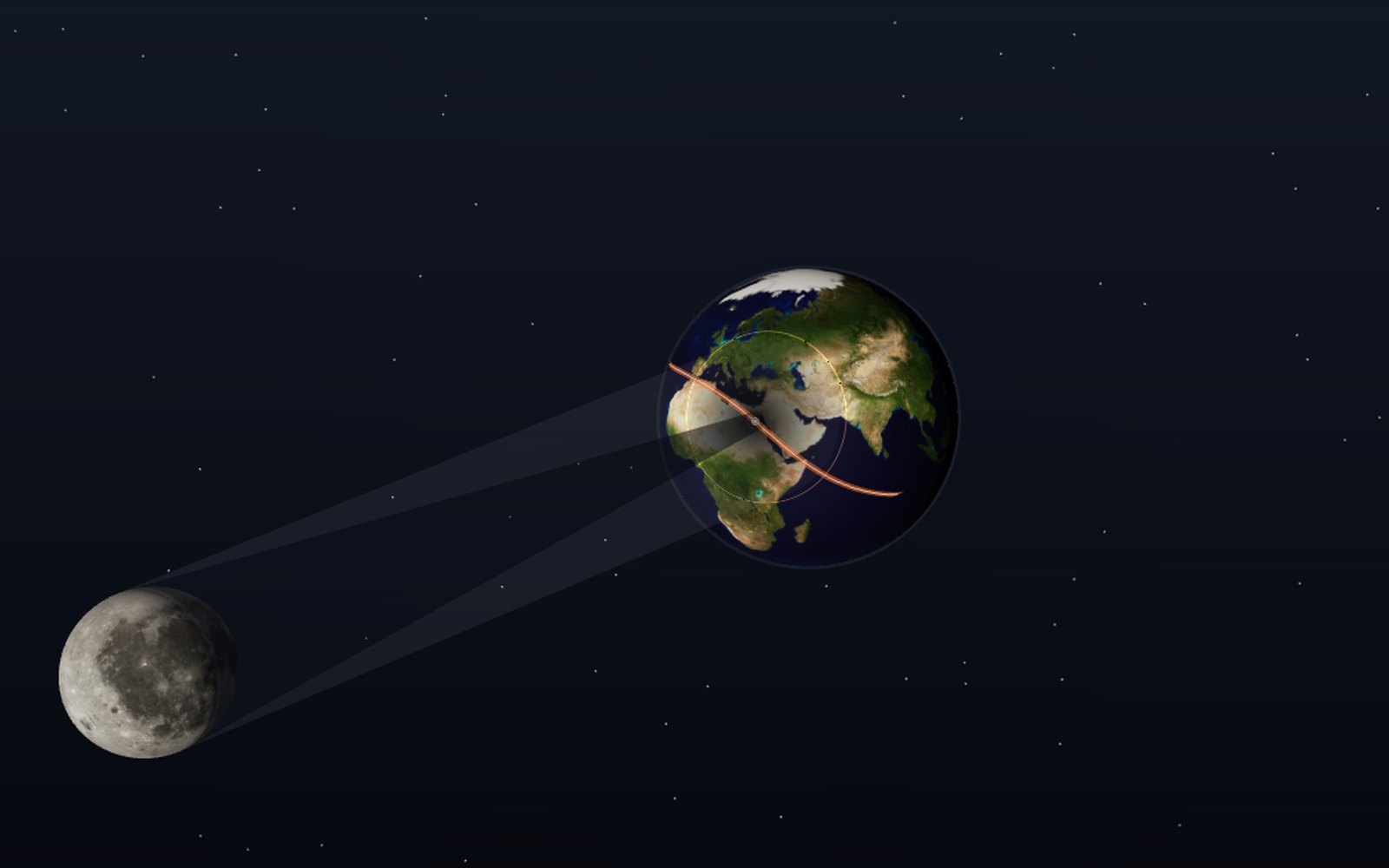
Total solar eclipse: the 2027 path and the next total eclipses
On 2 August 2027 the Moon's shadow crosses Spain, North Africa and Egypt, and near Luxor the Sun stays hidden for about 6 min 23 s.
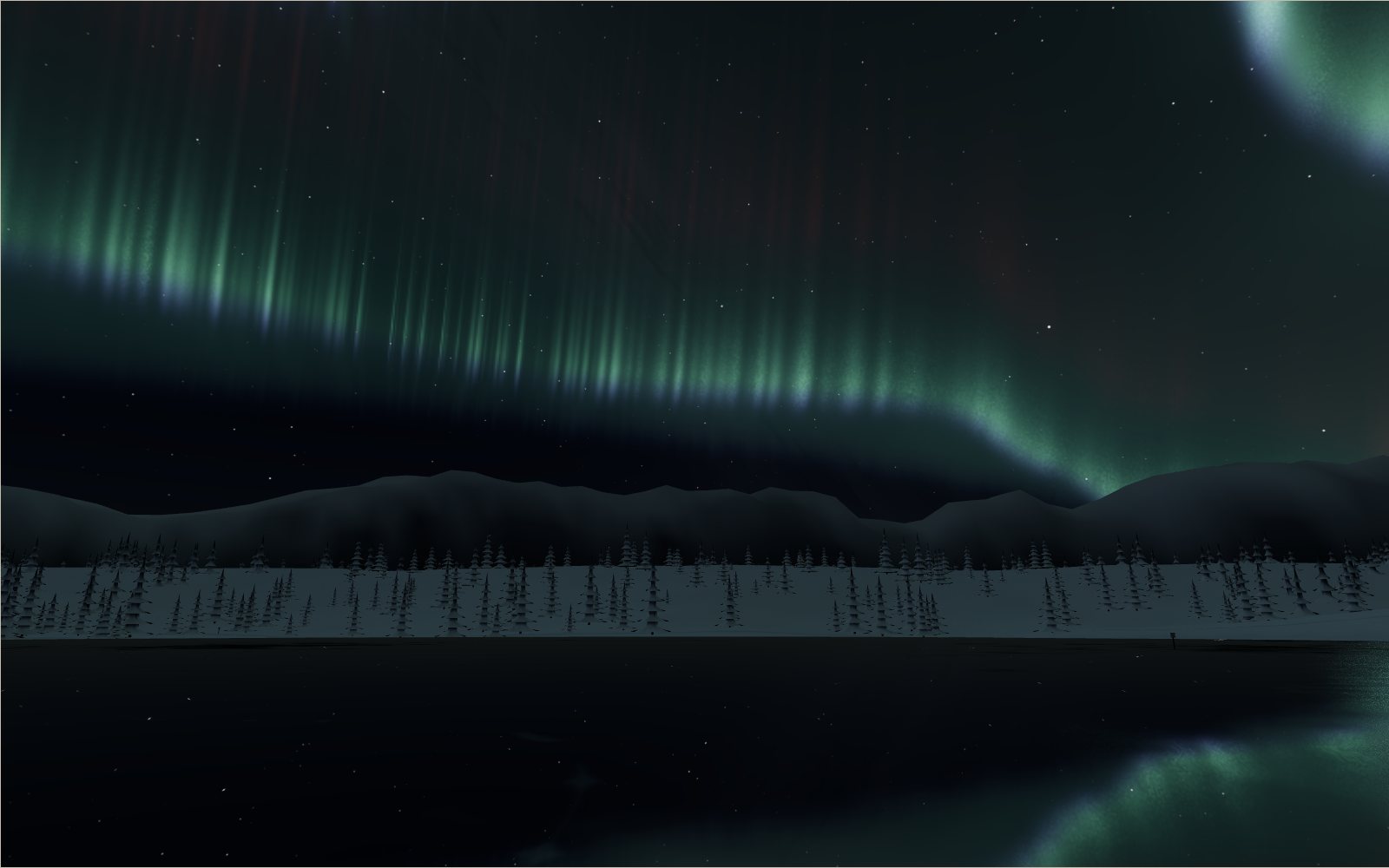
Northern lights over an Arctic village
The green of the northern lights comes from oxygen about 100 km up, and in the biggest storms the red glow above it can be seen as far south as Korea.
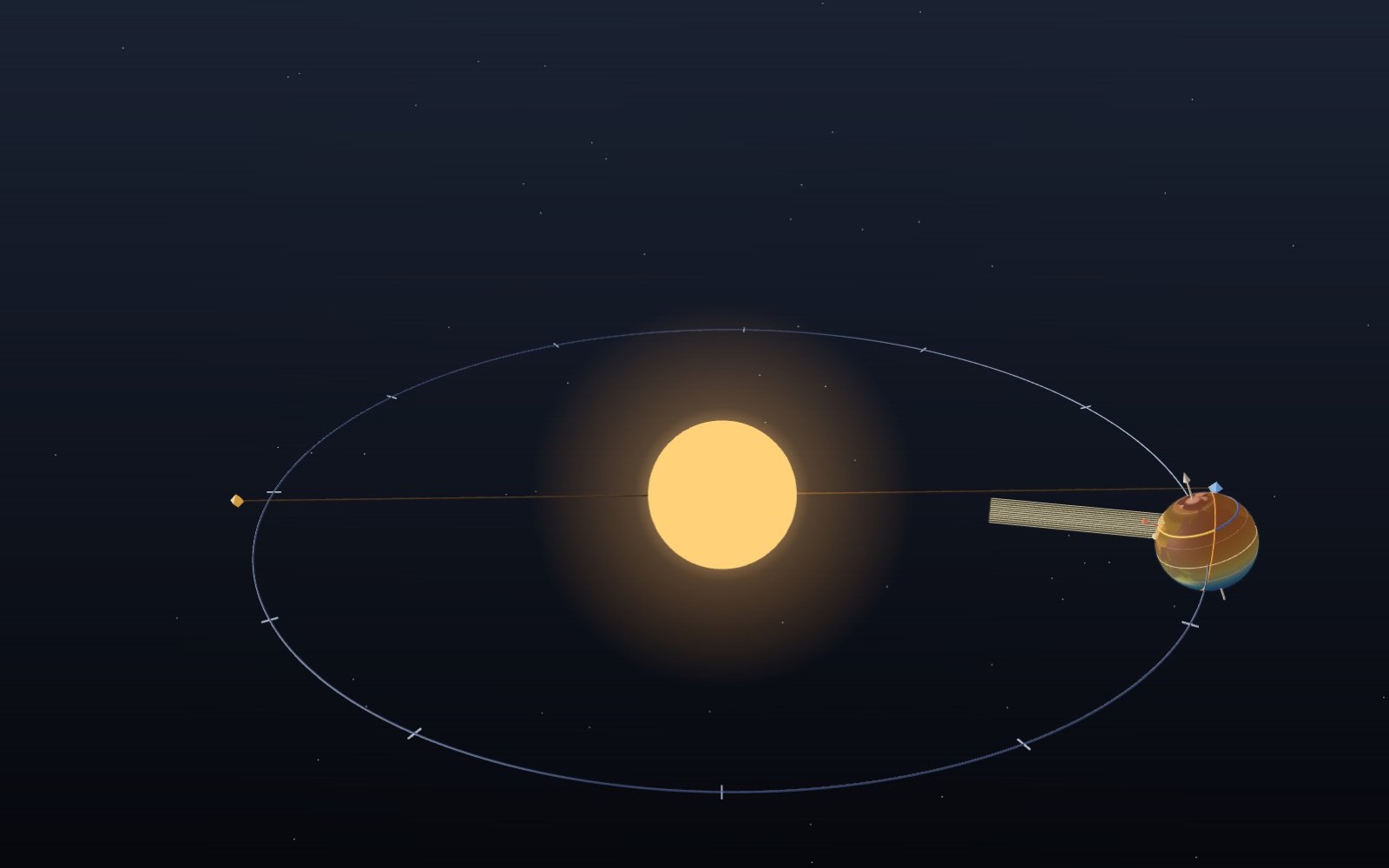
Why we have seasons: tilted Earth, changing daylight
The Earth is closest to the Sun in the first week of January, in the middle of the northern winter.
Moon phases: why a crescent is not Earth’s shadow
The Moon passes between the Earth and the Sun every 29.5 days, so why is there no solar eclipse every month?
What you would see falling into a black hole
From 40 times the horizon radius a black hole's shadow is only 7.4° wide, yet starlight from directly behind it already forms a ring 28° across.
Asteroid impact crater size simulator: how craters form in 3D
The 1.2 km wide Meteor Crater in Arizona was dug by an iron asteroid only a few tens of metres across.