FIG. 123How It Works
Total solar eclipse: the 2027 path and the next total eclipses
On 2 August 2027 the Moon's shadow crosses Spain, North Africa and Egypt, and near Luxor the Sun stays hidden for about 6 min 23 s.
This device cannot show the 3D model. You can read the guide steps below as text.
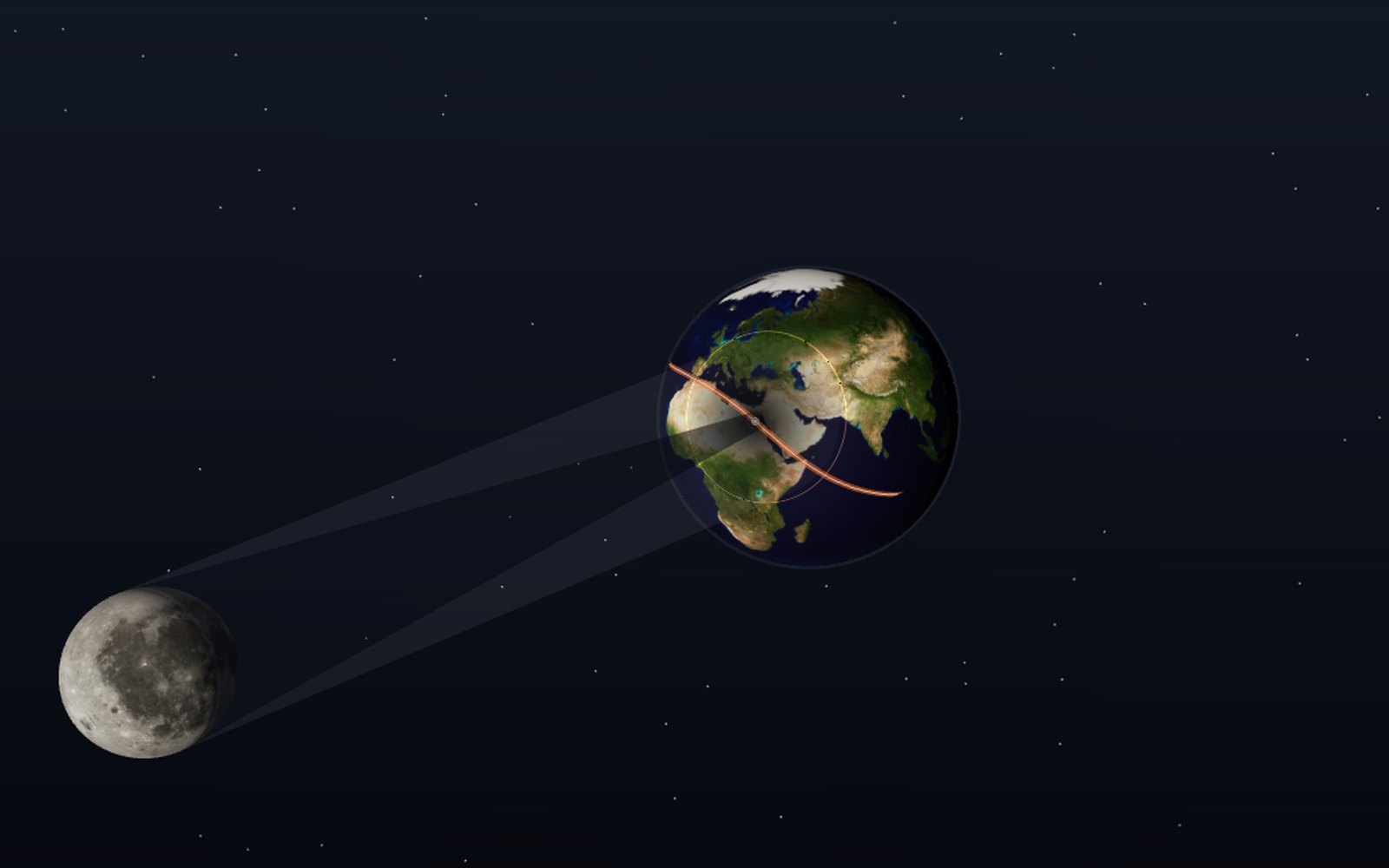
1 / 13 The Moon's shadow on the Earth2 August 2027, 40 minutes before greatest eclipse. The Moon passes exactly between the Sun and the Earth and its shadow falls on North Africa. Drag to turn the view.
Drag to turn. Scroll or pinch to zoom.
What the model shows
A total solar eclipse happens when the Moon passes exactly between the Sun and the Earth and its dark inner shadow, the umbra, touches the ground. Only people inside that narrow track, usually 100 to 250 km wide, see the Sun fully covered. The next one on land is on 2 August 2027: the path crosses southern Spain, Morocco, Algeria, Libya, Egypt, Saudi Arabia, Yemen and Somalia, and near Luxor the Sun stays hidden for about 6 minutes 23 seconds, the longest totality in this exhibit's catalogue of eclipses from 2026 to 2060.
The stage has two views. In the space view the Earth, the Moon and both shadow cones are drawn in the same frame NASA uses to predict eclipses, and the Earth turns to the exact hour of the eclipse you pick. The dark patch on the day side is the shadow worked out for every point of the surface, and the orange band is the path of totality. In the sky view you stand in one city and look up: the Moon slides over the Sun, the last light breaks into beads, the corona appears and the sky goes dark. Every time and duration on this page comes from NASA's published eclipse elements, and the program that turns them into city times was checked against NASA's own tables (more on that further down).
One thing comes before anything else. Never look at the Sun with bare eyes, through ordinary sunglasses or through a camera, binoculars or a telescope without a proper solar filter. Eclipse glasses must meet the international standard ISO 12312-2. The only safe moment to take them off is during totality itself, and they go back on as soon as the first bright bead returns.
Two shadows, two kinds of eclipse
The Moon, lit from one side by the Sun, throws a shadow into space like any other object. Because the Sun is not a point but a disk about half a degree wide, that shadow has two parts.
The penumbra is the region where the Moon hides part of the Sun but not all of it. It spreads out behind the Moon like a widening cone, and by the time it reaches the Earth it is roughly 6,800 km across. Anyone inside it sees a partial eclipse: a bite taken out of the Sun.
The umbra is the region where the Moon hides the whole Sun. It is a cone that narrows behind the Moon and comes to a point about 374,000 km away. The average distance from the Moon to the nearest point of the Earth's surface is about 378,000 km, so at an average distance the tip of the umbra falls a few thousand kilometres short of the ground. When that happens, people under the axis of the shadow see a ring of sunlight around the Moon: an annular eclipse. Only when the Moon is near the close point of its orbit does the umbra reach the Earth, and then the eclipse is total along a narrow track.
A hybrid eclipse is a rare mix of the two. The Earth's surface is curved, so the middle of the track is about one Earth radius closer to the Moon than its two ends. If the umbra's tip lies between those distances, the eclipse is annular near sunrise and sunset and total in the middle. Between 2001 and 2100 NASA's catalogue lists 224 solar eclipses: 77 partial, 72 annular, 68 total and 7 hybrid.
Switch on True distance to see these lengths without the shrinking the stage normally uses. The Moon moves out to about 56 Earth radii from the plane through the Earth's centre, and the dark cone that looked so long in the compressed view barely reaches the ground.
Why the Moon can cover the Sun at all
The Sun's mean radius is 695,700 km and the Moon's is 1,737.4 km, a ratio of about 400. The Sun's mean distance is 149.6 million km and the Moon's is 384,400 km, a ratio of about 389. The two ratios are nearly the same, so the two disks look almost the same size in our sky: about half a degree each.
"Almost" is the reason for all the variety. The Moon's distance changes during every orbit, from about 363,300 km at an average perigee to 405,500 km at an average apogee, and the Earth's distance from the Sun changes by about 3% over a year. When the Moon looks larger than the Sun, the eclipse can be total; when it looks smaller, the best you get is annular. NASA's magnitude at greatest eclipse expresses this: for 2 August 2027 it is 1.079, so the Moon looks almost 8% wider than the Sun, which is why that totality is so long.
Why there is no eclipse every month
The Moon passes between the Earth and the Sun at every new moon, about every 29.5 days. Most months nothing happens, because the Moon's orbit is tilted by 5.145° to the plane of the Earth's orbit. At most new moons the Moon passes a little above or below the Sun in our sky and its shadow misses the Earth altogether.
An eclipse needs the new moon to fall close to one of the two nodes, the points where the Moon's orbit crosses the Earth's orbital plane. The Sun lines up with the nodes twice a year, so solar eclipses come in "eclipse seasons" roughly six months apart. That is why the catalogue shows dates such as February and August 2026, February and August 2027, then January and July 2028: the seasons slide about 19 days earlier each year as the nodes turn.
Each season brings at least one solar eclipse somewhere on Earth, but most of them are partial or annular, and a total eclipse covers only a sliver of the planet. NASA's measure of how centrally the shadow hits is gamma, the distance of the shadow axis from the Earth's centre in Earth radii at the moment of greatest eclipse. Gamma near 0 means the shadow strikes the middle of the day side; near ±1 it grazes the edge. The 2027 eclipse has gamma 0.1421, a near-central hit. The 2033 eclipse over Alaska has gamma 0.9778, which is why its path lies so far north and is 781 km wide: the shadow meets the Earth at a slant and spreads out.
The path of totality
If the Earth did not turn, the umbra would sweep across it at about 3,500 km/h (NASA's elements for 2027 move the axis 0.545 Earth radii per hour). The Earth's rotation carries the ground in the same direction, west to east, so the shadow's speed over the ground is lower. On the stage the Shadow speed readout gives it moment by moment: near Luxor on 2 August 2027 it is about 2,400 km/h, while near the start and end of the track, where the shadow strikes the curved Earth at a glancing angle, it moves many times faster.
The width of the track depends on how far away the Moon is and how steeply the shadow meets the ground. NASA gives 258 km at greatest eclipse in 2027 and 116 km in 2035. The stage computes the edges of the track from the same elements every 30 seconds: at each instant it finds where the shadow axis meets the Earth, works out the direction the shadow moves relative to the turning ground, and steps the umbra's radius to each side. The result is the orange band. Its edges are the limits: just inside them totality lasts a few seconds, on the centre line it lasts longest.
Why is the band curved on the map? The shadow moves in a nearly straight line through space, but the Earth is a turning ball tilted towards or away from the Sun, so the track bends across the globe. In August the north is tilted towards the Sun, and the 2027 path arcs from the Atlantic over Gibraltar, across the Sahara to the Red Sea and on to the Horn of Africa.
What you see from the ground
Switch to the Sky view, pick a city and move the time. The phases come in a fixed order, named after the four contacts between the edges of the two disks.
First contact (C1). The Moon's edge touches the Sun's. For a while nothing looks different, because even a Sun 30% covered is still too bright to notice the loss. The partial phase usually lasts more than an hour. Through a filter you can watch the bite grow.
The light changes. With 80 to 90% of the Sun covered, daylight turns pale and shadows sharpen, because the light now comes from a thin crescent. The Sunlight left readout gives the share of the Sun's disk still visible; at 99% covered there is still 1% left, and that 1% is far too bright to look at.
Baily's beads. The Moon's edge is not smooth. Valleys a few kilometres deep let the last sunlight through in separate points for a few seconds. The sky view draws a lunar edge with valleys about that deep, so the beads appear at about the right time, though their glows are drawn larger than life so you can see them. They are named after Francis Baily, who described them at the annular eclipse of 1836.
The diamond ring. When a single bead is left, it flashes next to the faint glow of the corona like a stone on a ring. Then the last bead goes out and totality begins (second contact, C2).
Totality. The bright disk is gone. The chromosphere, a thin pink layer, shows for a moment at the edge, with pink tongues of gas called prominences. Around the black Moon spreads the corona, the Sun's outer atmosphere, hot (over a million degrees) but far too faint to see while any of the bright disk is showing. The sky turns a deep twilight blue and the horizon glows all the way around, because the light there comes from places outside the shadow where the eclipse is only partial. Bright planets and stars can appear.
Third contact (C3) ends totality with another diamond ring and more beads on the other side of the Moon, then the partial phase runs in reverse until fourth contact (C4).
The stage buttons First contact, Totality starts, Maximum, Totality ends and Last contact jump to each moment for the city you chose. The readouts show the local time, the Sun's altitude, the share covered and a countdown to the start or end of totality.
Eye safety
The NASA eclipse safety page, the American Astronomical Society (AAS) and the Korea Astronomy and Space Science Institute (KASI) give the same rules.
- Except during totality, the only safe way to look at the Sun is through a solar filter: eclipse glasses or a handheld viewer that meets ISO 12312-2, or a filter made for the front of a telescope or camera.
- Ordinary sunglasses, even very dark ones, are not safe. Neither is smoked glass, exposed film or a stack of sunglasses.
- Never look through a camera, binoculars or a telescope at the uncovered Sun, even while wearing eclipse glasses: the optics concentrate the light and burn through the glasses' filter and into the eye.
- During totality, and only then, take the filter off to see the corona. Put it back as soon as the diamond ring or the first bead returns.
- An annular eclipse never becomes safe. The bright ring is part of the Sun's surface.
- If you are outside the path of totality, there is no safe moment without a filter at all, even at 99% covered.
AAS keeps a list of checked suppliers of eclipse glasses, because counterfeit glasses printed with the ISO number have been sold before major eclipses. KASI's eclipse notices also warn against using a telescope, camera or sunglasses without a solar filter, and advise against looking for more than 3 minutes at a time even through a filter.
The sky view follows these rules. Its banner stays red with the warning during every partial phase and switches to a green note only while the Sun is fully covered. The Solar filter control shows what a filtered view looks like: an orange disk on a black sky, with no corona.
The next total eclipses
The table lists the total eclipses of the coming years, with NASA's maximum duration (on the centre line at greatest eclipse) and the countries in the path. The catalogue in the Controls tab has 43 eclipses, including historical ones, with search, filters and a sort by duration.
| Date | Maximum totality | Path of totality |
|---|---|---|
| 12 August 2026 | 2 min 18 s | Arctic, Greenland, Iceland, Spain |
| 2 August 2027 | 6 min 23 s | Morocco, Spain, Algeria, Libya, Egypt, Saudi Arabia, Yemen, Somalia |
| 22 July 2028 | 5 min 10 s | Australia, New Zealand |
| 25 November 2030 | 3 min 44 s | Botswana, South Africa, Australia |
| 30 March 2033 | 2 min 37 s | eastern Russia, Alaska |
| 20 March 2034 | 4 min 09 s | Nigeria, Cameroon, Chad, Sudan, Egypt, Saudi Arabia, Iran, Afghanistan, Pakistan, India, China |
| 2 September 2035 | 2 min 54 s | China, Korea, Japan, Pacific |
| 23 August 2044 | 2 min 04 s | Greenland, northern Canada, Montana, North Dakota |
| 12 August 2045 | 6 min 06 s | southern United States, Haiti, Dominican Republic, Venezuela, Guyana, Suriname, French Guiana, Brazil |
2 August 2027: Spain, North Africa and Luxor
This is the eclipse most people will travel for. The shadow reaches land at the Strait of Gibraltar at about 08:45 UT. Computed for city centres: Cádiz gets 2 min 53 s of totality and Málaga 1 min 50 s, while Seville, just north of the track, stays at 98.3% covered and never goes dark. Across the Mediterranean the path covers northern Morocco and Algeria and runs along the Libyan coast. Tunis is outside it at 97.1% and Cairo at 94.8%. Luxor is close to the point of greatest eclipse: totality lasts 6 min 20 s at the city centre and the Sun is 82° high, almost overhead. Jeddah in Saudi Arabia gets 6 min 0 s.
30 March 2033: Alaska
The shadow comes in over the Bering Strait and crosses western and northern Alaska before leaving over the Arctic Ocean. In Nome totality lasts 2 min 30 s with the Sun only 8° above the horizon at about 09:47 local time; in Utqiagvik it lasts 2 min 36 s. Anchorage is outside the path at 96.7%. Low Sun, snow and spring weather are the planning points here. Try the sky view for Nome with Sun size turned down, so the horizon and the twilight glow come into view.
23 August 2044 and 12 August 2045: the United States
The 2044 eclipse ends at sunset over Montana and North Dakota; in Great Falls, near the southern edge, totality lasts only 22 s with the Sun 5° high. A year later, on 12 August 2045, the centre line crosses the whole country: northern California, Nevada, Utah, Colorado, Kansas, Oklahoma, Arkansas, Mississippi, Alabama and Florida. Orlando gets 5 min 47 s with the Sun 76° high, while Dallas is outside the path at 92.8%. The maximum, 6 min 6 s, falls over the Caribbean.
In between, on 22 July 2028, totality crosses Australia and New Zealand: Sydney gets 3 min 49 s and Dunedin 2 min 51 s.
2 September 2035: northern Korea and Japan
The 2035 track runs from northern China (Beijing: 1 min 33 s) across the north of the Korean peninsula, where Pyongyang gets 1 min 48 s and Wonsan 2 min 8 s, and on over central Japan (Toyama: 1 min 15 s, Mito: 2 min 32 s). Seoul lies south of the path and sees 96.5% covered, Tokyo 99.4%.
12 August 2026, already passed
The eclipse of 12 August 2026 crossed Greenland, western Iceland (Reykjavik: 1 min 1 s) and northern Spain in the evening. In Valencia totality came with the Sun only 4° above the horizon.
Your city: the next eclipse
The Eclipses from your city section in the Controls tab works out, for each of 35 cities, every solar eclipse from today to 2100 in which the Sun is above the horizon at some point between first and last contact. For each one it shows the date, how much of the Sun's area is covered (the obscuration) and whether the city is inside a path of totality or annularity. It also picks out the next total eclipse and the deepest one before 2100.
A few results show how rare totality is for one place. New York's next total eclipse is on 1 May 2079. Paris and Istanbul wait for 3 September 2081. Seoul, Tokyo, Madrid, London and Perth have none at all before 2100, though Sydney gets 3 min 49 s on 22 July 2028. For Seoul the deepest eclipse of the century is the 96.5% of 2035.
Eclipses that changed science
28 July 1851. Julius Berkowski, working at the Königsberg observatory in Prussia, made a daguerreotype that is the first successful photograph of a total solar eclipse.
18 August 1868. The path crossed India. Observing at Guntur, Jules Janssen saw a bright yellow line in the spectrum of the prominences that did not match any known element. Norman Lockyer later attributed it to a new element, helium.
29 May 1919. Expeditions to the island of Príncipe (Arthur Eddington) and to Sobral in Brazil (Andrew Crommelin) photographed stars near the eclipsed Sun. Their positions were shifted by about the amount Einstein's general relativity predicted for light bending in the Sun's gravity, as Dyson, Eddington and Davidson reported in 1920.
30 June 1973. The prototype Concorde 001 flew under the shadow over North Africa at Mach 2.05. Its seven observers stayed in totality for 74 minutes, far longer than any ground site allows, and used the time for infrared and chromosphere measurements.
21 August 2017 and 8 April 2024 crossed the United States (and in 2024 Mexico and Canada) and were the first total eclipses many people saw with eclipse glasses in hand.
How the times are calculated
NASA does not publish a separate list for every town. It publishes Besselian elements: a few numbers per eclipse, written as short polynomials in time, that describe the Moon's shadow on a plane through the Earth's centre at right angles to the shadow axis (the fundamental plane). For each eclipse they give:
- x and y: where the shadow axis crosses that plane, in Earth radii;
- d and μ: the direction of the axis (its declination) and its hour angle, which together say how the Earth is turned under the shadow;
- l₁ and l₂: the radii of the penumbra and umbra on the plane;
- tan f₁ and tan f₂: how fast those radii change along the axis.
For an observer at latitude φ and longitude λ, the program first works out where the observer is in the same frame (ξ, η, ζ), taking the Earth's flattening into account. Then, at any instant:
- the shadow radii at the observer's height are L₁′ = l₁ − ζ tan f₁ and L₂′ = l₂ − ζ tan f₂;
- the observer's distance from the axis is Δ = √((x − ξ)² + (y − η)²);
- the eclipse magnitude is (L₁′ − Δ) / (L₁′ + L₂′);
- the eclipse is total when Δ < −L₂′ and annular when Δ < L₂′.
Maximum eclipse is the instant when Δ is smallest. The contacts are the instants when Δ equals L₁′ (C1 and C4) or |L₂′| (C2 and C3); each is found by a few rounds of Newton's method. The covered share of the Sun's area follows from the two apparent radii and their separation, using the area where two circles overlap. These are the standard equations of the Explanatory Supplement to the Astronomical Almanac and of Jean Meeus's Elements of Solar Eclipses.
The elements for all 169 eclipses from 2026 to 2100 and for the historical eclipses come from NASA's Solar Eclipse Search Engine (Fred Espenak), which lists the polynomial elements behind the Five Millennium Canon of Solar Eclipses. The program has been compared against three NASA sources:
- NASA's online calculator. For 35 cities and 169 eclipses, 2,259 pairs in which the penumbra reaches the city, the eclipse type agrees every time, magnitudes agree to 0.00001, the covered share to 0.005 percentage points, and every contact time to better than 0.1 s.
- NASA's path tables. At 266 points on the centre lines of 12 eclipses (1919 to 2045), the computed duration of totality agrees with NASA's tabulated value to within 0.21 s.
- NASA's catalogue. For all 43 eclipses in the catalogue, the time of greatest eclipse agrees within 1.2 s and the central duration within 0.5 s (NASA rounds to whole seconds).
What the model simplifies
- Distances along the shadow are shrunk about 9 times so that the Moon, the Earth and the cones fit on one stage; widths across the shadow are true. True distance undoes the shrinking. The Sun is drawn far too close and too small.
- The Earth is drawn as a sphere. The calculations use the flattened Earth, but every city is taken at sea level, and refraction near the horizon is ignored, so a Sun just below the horizon is counted as set.
- The Earth's rotation depends on ΔT, the difference between uniform time and the Earth's actual rotation. NASA's elements use a predicted ΔT (76 s for 2027). The future value cannot be known exactly; an error of a few seconds moves the track east or west by a kilometre or two.
- The Moon's edge is drawn with made-up valleys a few kilometres deep. Real beads follow the measured lunar profile, which shifts contact times by a second or two and is not modelled here; NASA's tables also use a smooth Moon.
- The corona is drawn, not photographed. Its shape changes with the solar cycle; the stage uses a generic shape with long streamers near the Sun's equator.
- Sky brightness in the sky view follows the visible share of the Sun; the totality sky and the horizon glow are drawn to look like photographs of totality, not measured.
Questions
When is the next total solar eclipse?
After 12 August 2026, the next total solar eclipse is on 2 August 2027. Its path crosses southern Spain, North Africa, Egypt, Saudi Arabia, Yemen and Somalia, and the longest totality, 6 min 23 s, is near Luxor.
Where can I see the 2027 eclipse from?
Totality is visible inside a band about 250 km wide from the Strait of Gibraltar across northern Morocco, Algeria, Libya, Egypt, Saudi Arabia and Yemen to Somalia. A partial eclipse is visible over most of Europe, Africa, the Middle East and western and southern Asia. Use the city calculator to check a specific city.
How long does totality last?
Never more than about 7 min 30 s. Most eclipses give 1 to 4 minutes on the centre line. The longest of the 21st century was on 22 July 2009 (6 min 39 s); the longest of the 20th was on 20 June 1955 (7 min 8 s). Near the edge of the path totality lasts only seconds.
Why can't I look at a partial eclipse without glasses?
Even a thin crescent of the Sun is a piece of the Sun's surface at full brightness. Looking at it can damage the retina without pain, and the damage can be permanent. Use eclipse glasses that meet ISO 12312-2.
Is it safe to look at totality without a filter?
Yes, during totality only. When the Sun is completely covered you can take the glasses off to see the corona. Put them back on the moment the diamond ring appears at the end. If you are outside the path, that moment never comes.
Are sunglasses enough?
No. Ordinary sunglasses let through thousands of times too much sunlight. Even several pairs stacked are not safe.
What is the difference between a total and an annular eclipse?
In a total eclipse the Moon looks larger than the Sun and covers it completely. In an annular eclipse the Moon is farther away and looks smaller, so a bright ring of Sun stays visible around it. An annular eclipse always needs a filter.
Why doesn't a solar eclipse happen every month?
The Moon's orbit is tilted 5.145° to the Earth's orbit, so at most new moons the Moon passes above or below the Sun in our sky. Eclipses only happen when a new moon falls near a node of the Moon's orbit, which happens in two seasons each year.
What are Baily's beads?
Points of sunlight shining through valleys along the Moon's edge in the few seconds before and after totality. The diamond ring is the moment when only one bead is left.
What is the corona?
The Sun's outer atmosphere. It is very hot but far fainter than the Sun's surface, so we normally only see it during totality or with special instruments called coronagraphs.
How accurate are the city times on this page?
They match NASA's calculator to better than a second for the same coordinates. Real contacts can differ by a second or two because the Moon's edge is not smooth, and your position in a city matters: a few kilometres can change the duration a lot near the edge of the path.
Will Korea see a total solar eclipse?
Yes, on 2 September 2035, but only in the north of the peninsula: Pyongyang is in the path (1 min 48 s). Seoul lies just outside and sees 96.5% of the Sun covered.
Why do some eclipses happen at sunrise or sunset?
The shadow first touches the Earth where the Sun is rising and leaves where it is setting. Cities near those ends, such as Valencia in 2026 or Great Falls in 2044, see the eclipse with the Sun low on the horizon.
Terms
- Umbra: the part of the Moon's shadow where the whole Sun is hidden.
- Penumbra: the part where only some of the Sun is hidden.
- Magnitude: the fraction of the Sun's diameter covered by the Moon. Above 1 means total.
- Obscuration: the fraction of the Sun's area covered.
- Gamma: how far the shadow axis passes from the Earth's centre, in Earth radii.
- Contacts: C1 and C4 begin and end the partial eclipse; C2 and C3 begin and end totality.
- Besselian elements: NASA's numbers that describe the shadow on the fundamental plane.
- Saros: a cycle of 18 years 11 days after which similar eclipses repeat.
- ΔT: the difference between uniform time and the Earth's rotation.
Sources
- NASA Goddard Space Flight Center, Eclipse Web Site (F. Espenak). https://eclipse.gsfc.nasa.gov/eclipse.html (checked 2026-10-27)
- NASA, Five Millennium Catalog of Solar Eclipses: 2001 to 2100 (F. Espenak, J. Meeus). https://eclipse.gsfc.nasa.gov/SEcat5/SE2001-2100.html (checked 2026-10-27)
- NASA, Solar Eclipses: 2021 to 2030. https://eclipse.gsfc.nasa.gov/SEdecade/SEdecade2021.html (checked 2026-10-27)
- NASA, Solar Eclipses: 2031 to 2040. https://eclipse.gsfc.nasa.gov/SEdecade/SEdecade2031.html (checked 2026-10-27)
- NASA, Solar Eclipses: 2041 to 2050. https://eclipse.gsfc.nasa.gov/SEdecade/SEdecade2041.html (checked 2026-10-27)
- NASA, Path of the Total Solar Eclipse of 2027 Aug 02. https://eclipse.gsfc.nasa.gov/SEpath/SEpath2001/SE2027Aug02Tpath.html (checked 2026-10-27)
- NASA, Path of the Total Solar Eclipse of 2033 Mar 30. https://eclipse.gsfc.nasa.gov/SEpath/SEpath2001/SE2033Mar30Tpath.html (checked 2026-10-27)
- NASA, Path of the Total Solar Eclipse of 2035 Sep 02. https://eclipse.gsfc.nasa.gov/SEpath/SEpath2001/SE2035Sep02Tpath.html (checked 2026-10-27)
- NASA, Path of the Total Solar Eclipse of 2045 Aug 12. https://eclipse.gsfc.nasa.gov/SEpath/SEpath2001/SE2045Aug12Tpath.html (checked 2026-10-27)
- NASA, Solar Eclipse Search Engine, Besselian Elements (example: 2027 Aug 02). https://eclipse.gsfc.nasa.gov/SEsearch/SEdata.php?Ecl=20270802 (checked 2026-10-27)
- NASA, Besselian Elements (explanation). https://eclipse.gsfc.nasa.gov/SEcat5/beselm.html (checked 2026-10-27)
- NASA, Polynomial Expressions for Delta T. https://eclipse.gsfc.nasa.gov/SEcat5/deltatpoly.html (checked 2026-10-27)
- NASA Science, Eclipse Safety. https://science.nasa.gov/eclipses/safety/ (checked 2026-10-27)
- American Astronomical Society, Solar Eclipse Eye Safety. https://eclipse.aas.org/eye-safety (checked 2026-10-27)
- American Astronomical Society, Solar Filters and Viewers. https://eclipse.aas.org/eye-safety/viewers-filters (checked 2026-10-27)
- Korea Astronomy and Space Science Institute, partial eclipse notice of 15 June 2020 (observing safety). https://www.kasi.re.kr/kor/publication/post/newsMaterial/28484 (checked 2026-10-27)
- NASA Space Science Data Coordinated Archive, Moon Fact Sheet. https://nssdc.gsfc.nasa.gov/planetary/factsheet/moonfact.html (checked 2026-10-27)
- NASA Space Science Data Coordinated Archive, Sun Fact Sheet. https://nssdc.gsfc.nasa.gov/planetary/factsheet/sunfact.html (checked 2026-10-27)
- F. W. Dyson, A. S. Eddington, C. Davidson, A determination of the deflection of light by the Sun's gravitational field, Philosophical Transactions of the Royal Society A 220 (1920). https://doi.org/10.1098/rsta.1920.0009 (checked 2026-10-27)
- J. Beckman et al., Eclipse Flight of Concorde 001, Nature 246, 72 to 74 (1973). https://www.nature.com/articles/246072a0 (checked 2026-10-27)
- American Physical Society, August 18 and October 20, 1868: Discovery of Helium. https://www.aps.org/apsnews/2014/08/discovery-of-helium-1868 (checked 2026-10-27)
- Linda Hall Library, Scientist of the Day: Julius Berkowski. https://www.lindahall.org/about/news/scientist-of-the-day/julius-berkowski (checked 2026-10-27)
- P. K. Seidelmann (ed.), Explanatory Supplement to the Astronomical Almanac, University Science Books (1992), chapter 8.
- J. Meeus, Elements of Solar Eclipses 1951 to 2200, Willmann-Bell (1989).
Text and simulation: CC BY-NC-SA 4.0, except where noted.
More exhibits
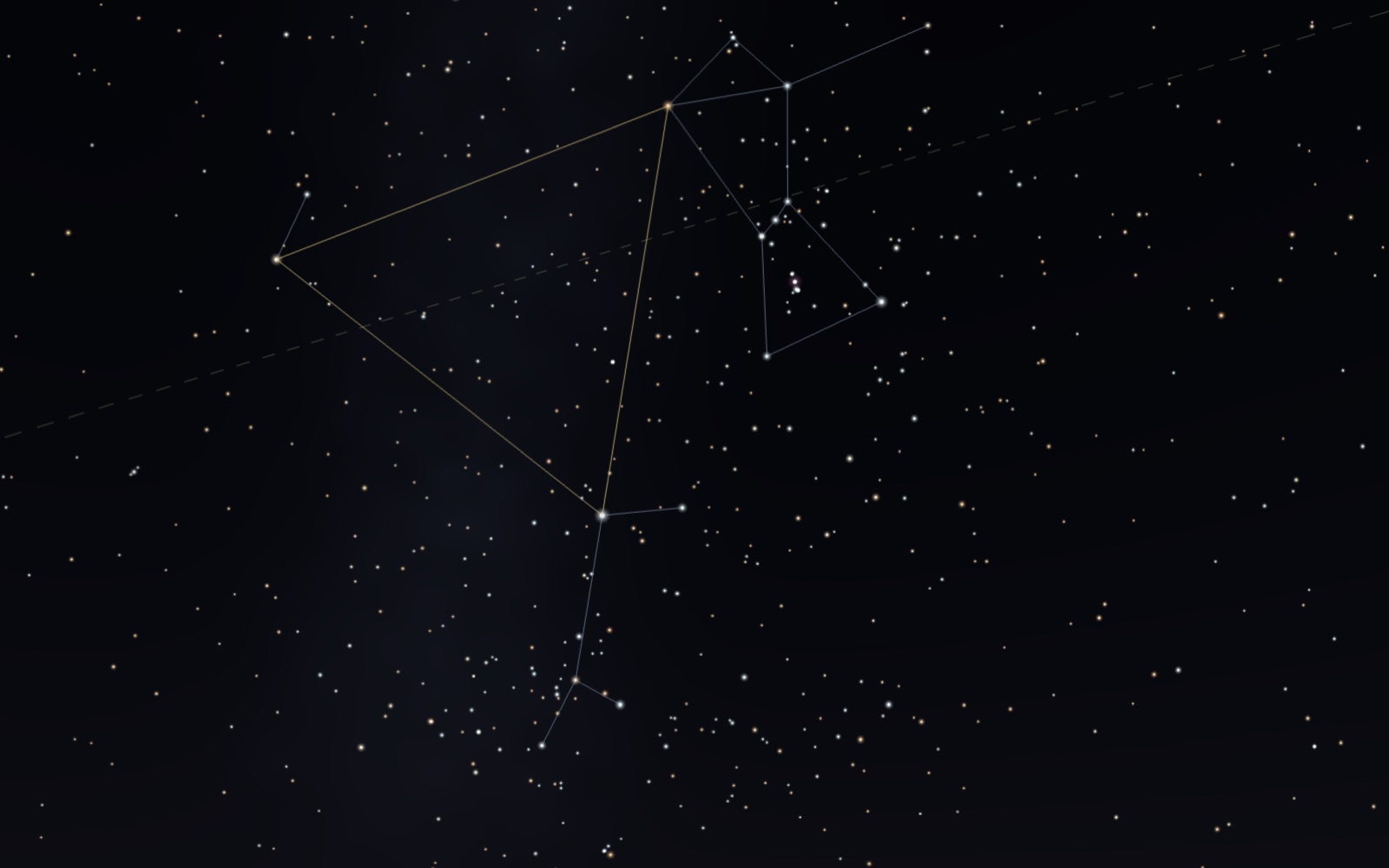
Winter constellations: Orion, the Winter Triangle and Hexagon
The three stars of Orion’s Belt look side by side, yet by their Hipparcos parallaxes Alnilam is nearly three times as far away as Mintaka.
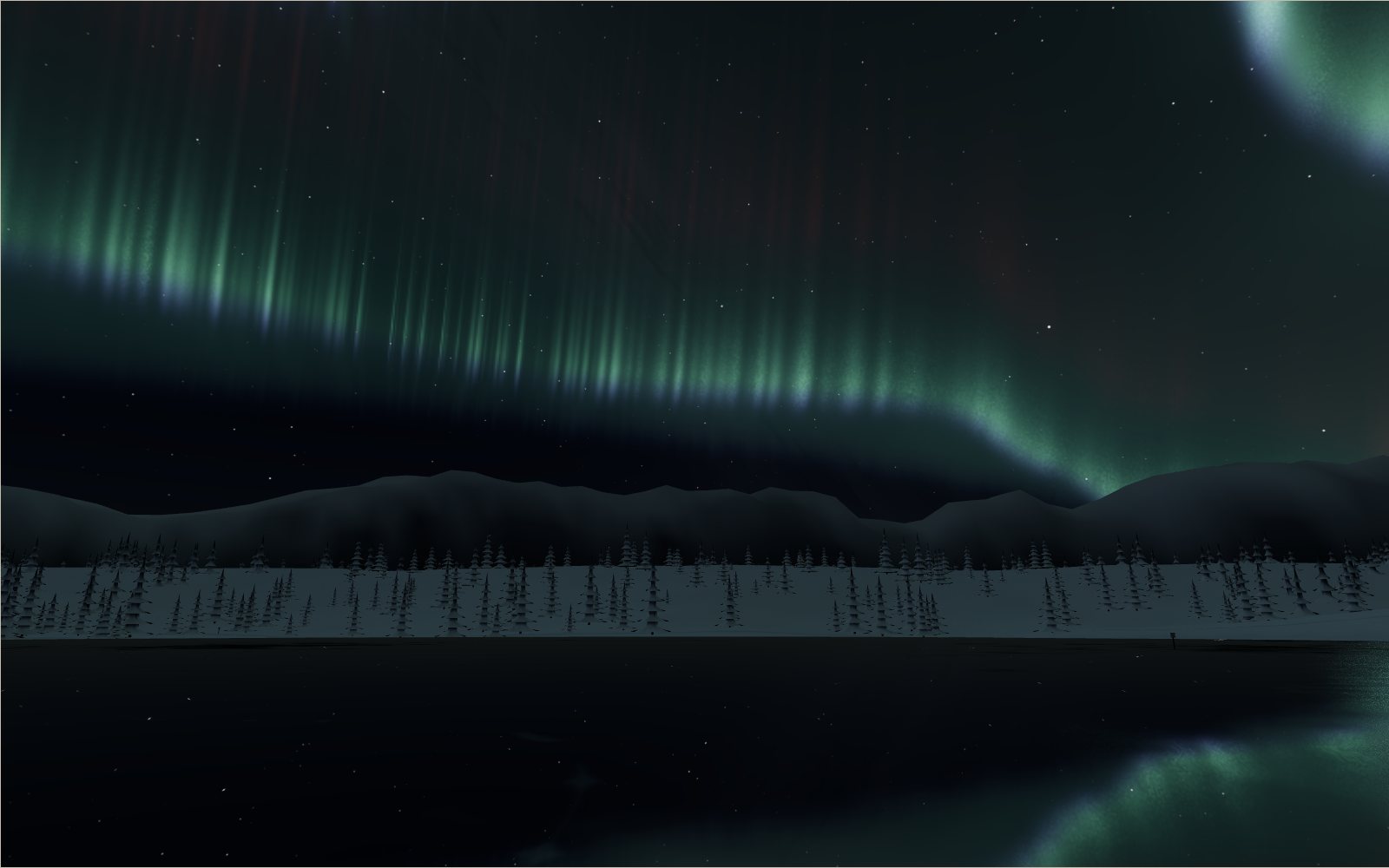
Northern lights over an Arctic village
The green of the northern lights comes from oxygen about 100 km up, and in the biggest storms the red glow above it can be seen as far south as Korea.
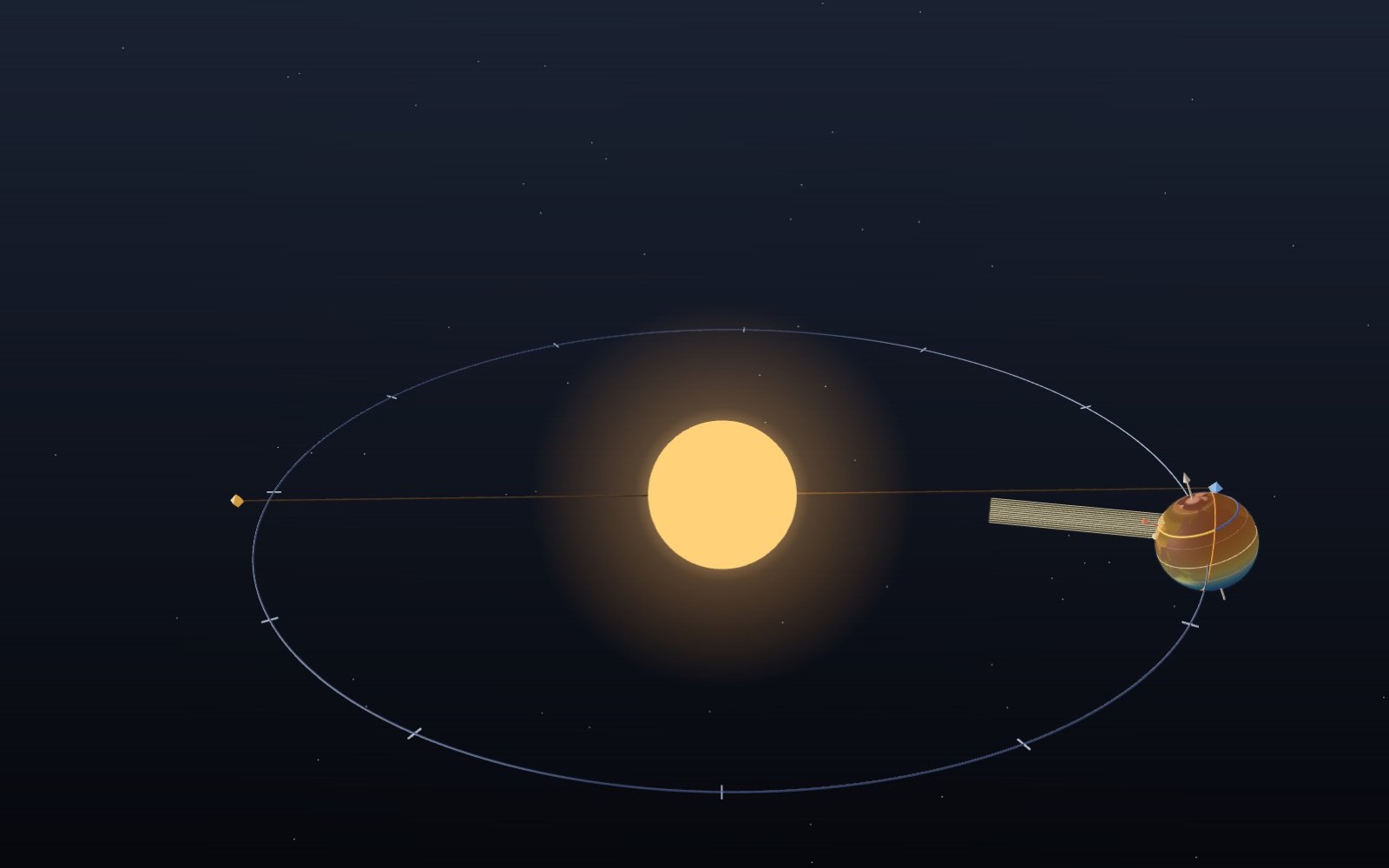
Why we have seasons: tilted Earth, changing daylight
The Earth is closest to the Sun in the first week of January, in the middle of the northern winter.
Moon phases: why a crescent is not Earth’s shadow
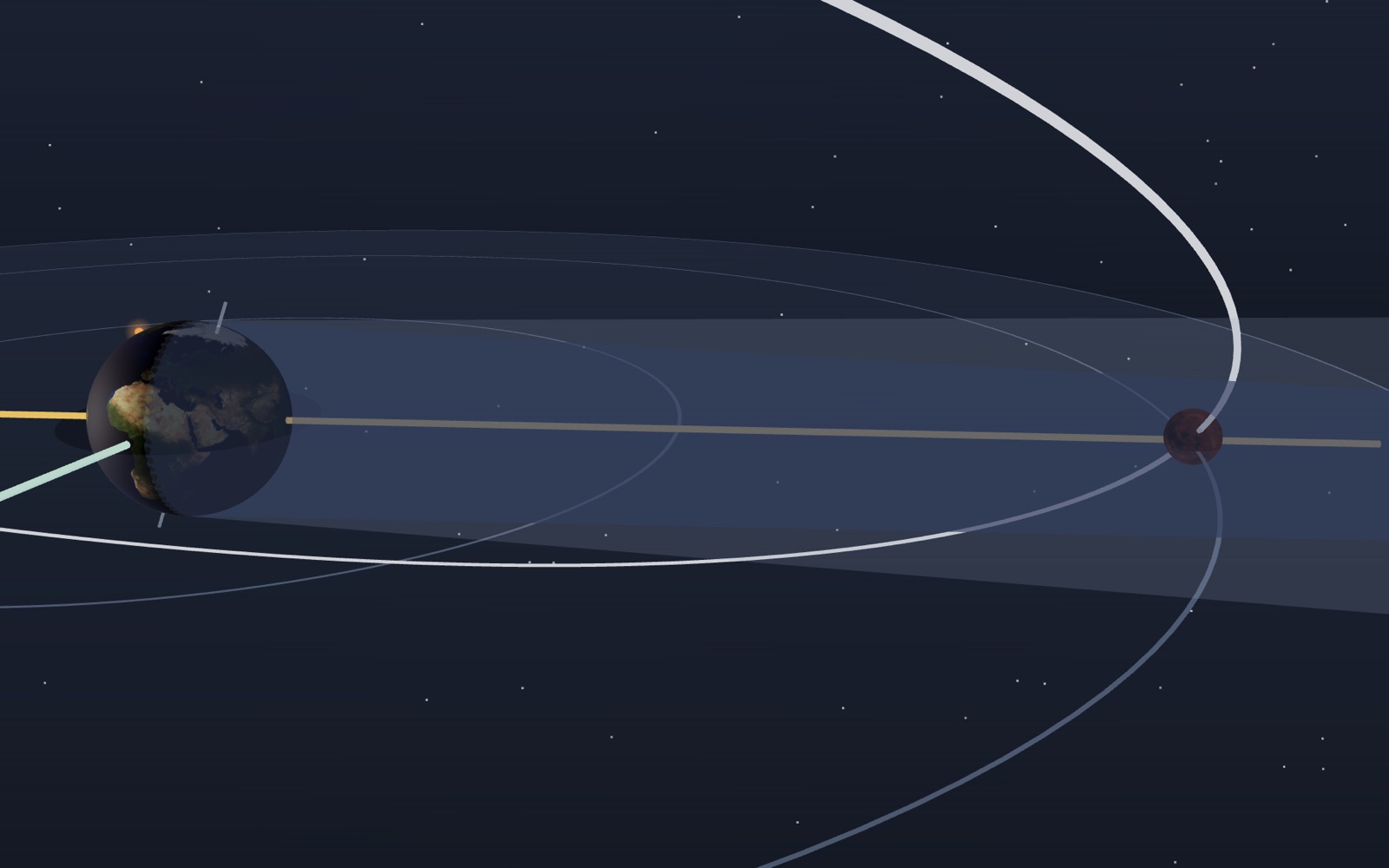
The Moon passes between the Earth and the Sun every 29.5 days, so why is there no solar eclipse every month?
What you would see falling into a black hole
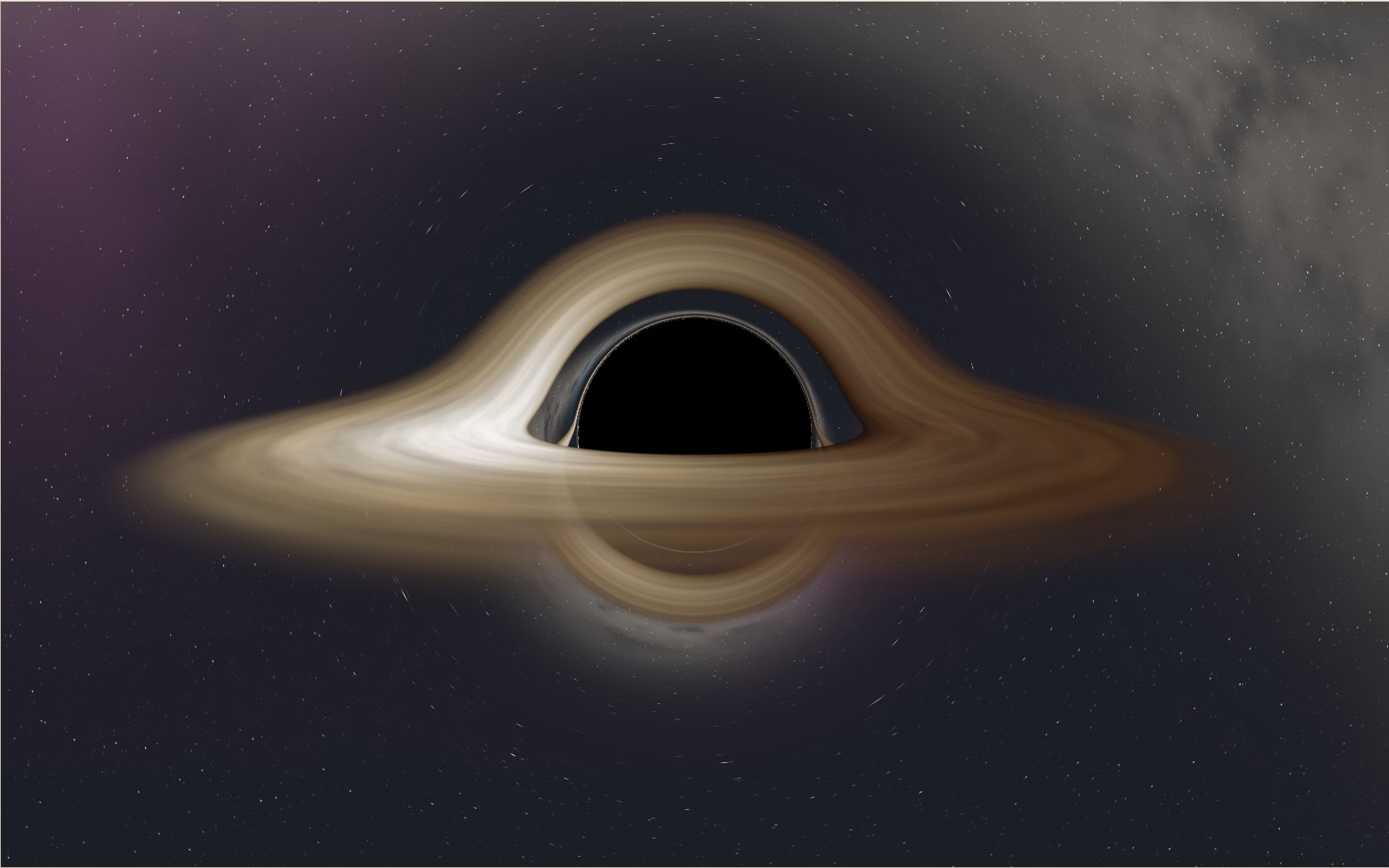
From 40 times the horizon radius a black hole's shadow is only 7.4° wide, yet starlight from directly behind it already forms a ring 28° across.
Asteroid impact crater size simulator: how craters form in 3D
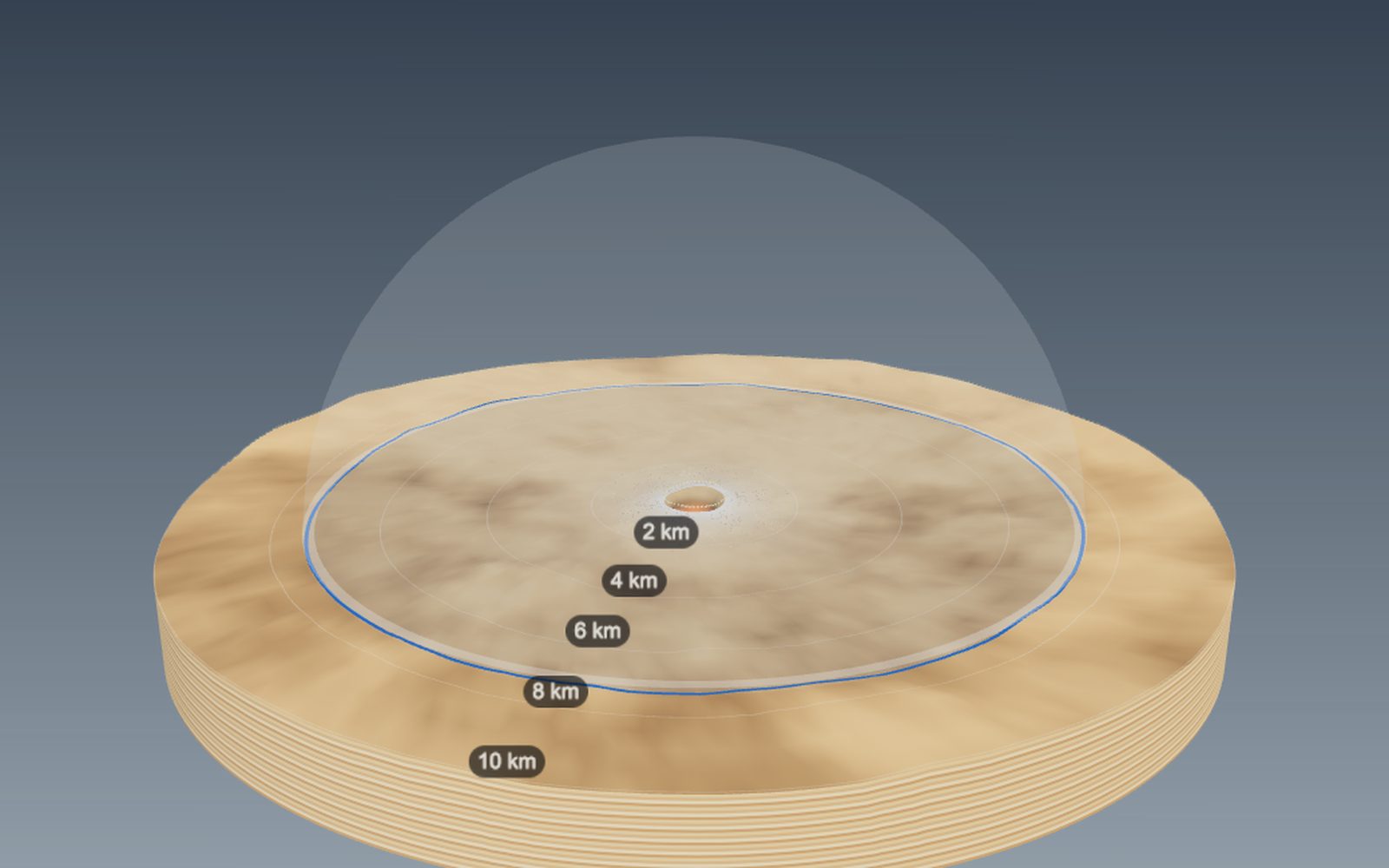
The 1.2 km wide Meteor Crater in Arizona was dug by an iron asteroid only a few tens of metres across.