Loading the model
This device cannot show the 3D model. You can read the guide steps below as text.
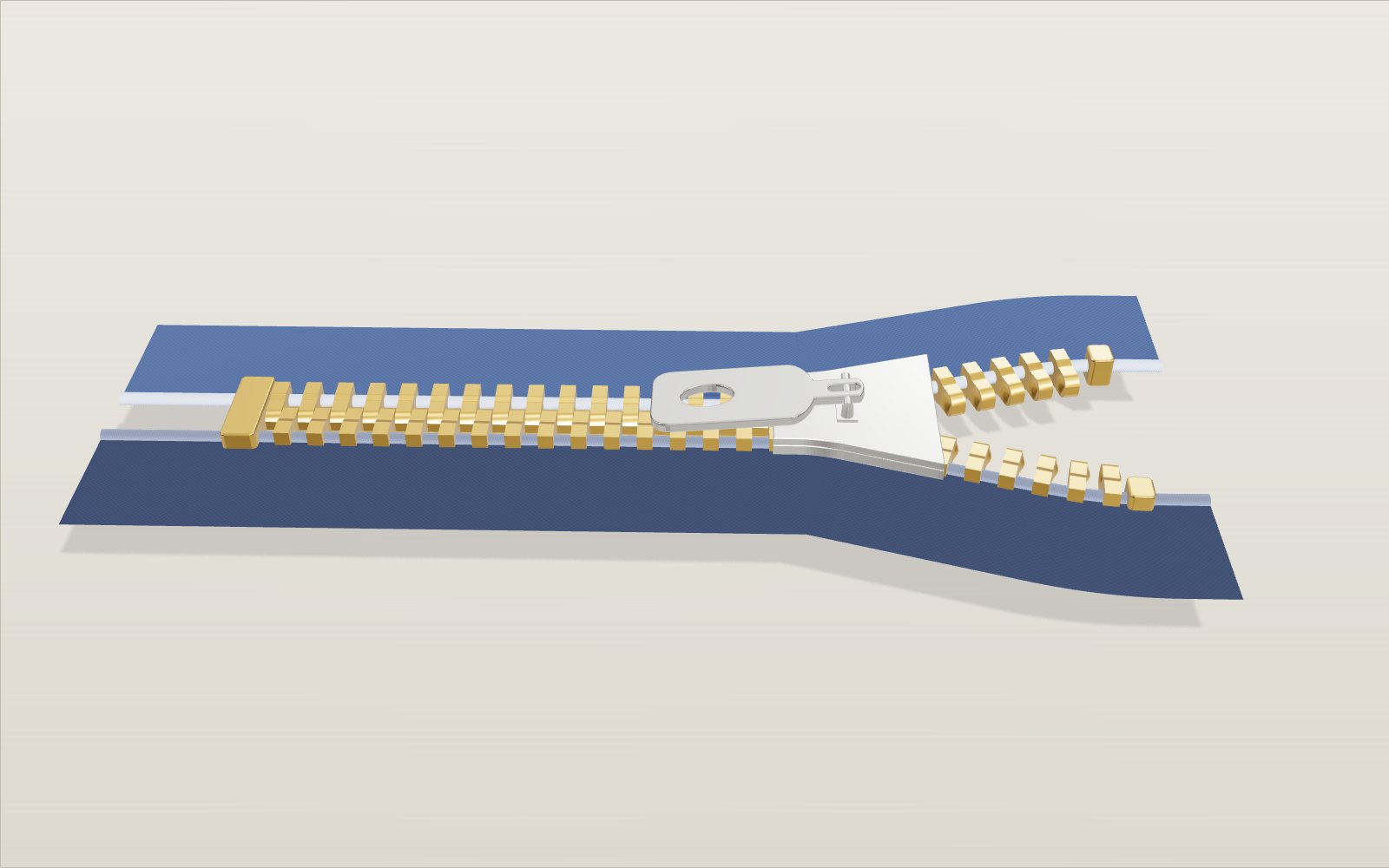
1 / 22 The whole zipper A metal zipper enlarged ten times, so a millimetre becomes a centimetre. The demonstration closes and opens it. Drag the slider yourself, or pick one of seven zippers, a size, a fault or a place it is sewn into from the controls and the lab below them.
Drag to turn. Scroll or pinch to zoom.
Guide Parts Controls
01 The whole zipper A metal zipper enlarged ten times, so a millimetre becomes a centimetre. The demonstration closes and opens it. Drag the slider yourself, or pick one of seven zippers, a size, a fault or a place it is sewn into from the controls and the lab below them.
02 Two rows of cups Below the slider the heads alternate left and right along the middle. Every bump sits in the hollow of the next head, so the column holds itself together.
03 The Y channel closes it Seen through the slider at low speed: each row bends as it runs from its arm into the stem, the gaps between heads open, and a head from the other side slips in. The readout counts the locked teeth.
04 The wedge opens it Going the other way, the arms pull the rows apart and bend them again, which lifts each bump out of its hollow. The wedge sits in the widening gap and keeps the heads from meeting.
05 Cut through the slider Here the slider is cut level with the teeth, so you can look straight down into the Y channel. The two arms, the stem and the wedge between the arms are all one piece; nothing inside moves.
06 One tooth, slow motion Above the chain, three teeth a little over twice as large again. As the rows bend, the gap between two left heads opens and the right head slides in at an angle. When the row straightens, its bump is seated in the hollow next to it.
07 Top stops At the top every tooth is locked. The two small clamps above the last teeth run into the arms of the slider, and it can go no further.
08 Bottom stop At the bottom one clamp holds both tapes together. The last two teeth stay locked, so the readout never drops below 2 of 52.
09 The pull tab and the lock pin The tab hangs from the bridge and swings round to point the way it is pulled. Under the bridge is a lock pin: with the tab lying flat it drops between the teeth, and pulling the tab lifts it.
10 No lock, sides pulled apart Now the lock is off and the cloth pulls the two sides apart. The pull on the rows pushes the slider down, and the zipper creeps open. Turn the lock back on and it stops.
11 A worn slider Here the narrow end of the slider is a fraction of a millimetre too wide. The rows leave it side by side without being pressed into each other, and the zipper stays open behind the slider.
12 Pulled at an angle The pull tab is drawn 22° to the side. The slider twists, the rows leave it without being pressed together, and the readout reports teeth coming out unlocked. YKK warns of the same failure on concealed zippers.
13 A missing tooth Left tooth 14 has been removed and the sides are pulled apart. While the gap is below the slider the chain opens there: the teeth next to the gap have nothing to hold.
14 Coil zipper One plastic thread wound into a spiral along each tape edge. Each turn is a tooth, and the same slider closes it. The model uses the same chain layout as the metal zipper.
15 Moulded plastic Teeth injected onto the tape: a taller block over the cord, a broad head with a shallow cup. YKK sells these as VISLON, made of polyacetal.
16 Concealed zipper The tape is folded back over a coil, so from the front only the two folded edges show. Turn on See inside to see the teeth.
17 Waterproof zipper A coil turned teeth-in with a polyurethane film over the tape. The two film edges meet in the middle and keep rain off the stitches.
18 Two sliders The upper slider stays at the top. The lower one, turned round, runs up from the bottom and opens the zipper below itself; between the two sliders the chain stays closed.
19 Box and pin A separating zipper has no bottom stop. The slider rests on the retainer box, and the insert pin on the other tape goes through the slider into the box. Only then will the slider start.
20 The size number Sizes are classed by chain width. This is No. 10, 8.5 to 12.0 mm wide in the JIS classes; the No. 5 model is 6.6 mm.
21 In a spacesuit The zipper sewn into white suit cloth. Apollo suits closed with a pressure-sealing zipper that lasted about 50 openings, under a second slide fastener that took the loads.
22 In a jacket A separating zipper in a quilted jacket front. The slider starts on the box, closes to the top, and the lock pin holds it there.
Left teeth 26 brass teeth clamped on the left tape, one every 2.54 mm. Each head has a bump on one face and a hollow on the other. Right teeth The same tooth, set half a pitch further along. That offset is what lets the heads alternate down the middle. Tapes Woven strips that the teeth are clamped to and that get sewn into the garment. With its teeth, each one is called a stringer. Corded edges The thick inner edge of each tape. The jaw of every tooth is squeezed around it, so the teeth cannot slide along. Slider body Two plates joined by side walls, with a Y-shaped channel between them: two arms at the wide end and one stem at the narrow end. Wedge The post with a rounded point between the arms of the Y, often called the diamond. When the zipper opens it keeps the two rows of heads apart. Bridge The lug on top of the slider. It carries the pin the pull tab swings on. Pull tab The part you hold. It swings round to point the way you pull and drops back when you let go. Top stops One small clamp on each tape above the last tooth. They run into the arms of the slider and stop it at the top. Bottom stop A single clamp that joins both tapes below the first teeth, so the zipper cannot open past it. Lock pin A small pin under the bridge. With the pull tab lying flat it drops between the teeth and the slider cannot move; pulling the tab lifts it. Lower slider The second slider of a two-slider zipper, turned round so its wide end faces down. It opens the zipper from the bottom. Retainer box On a separating zipper, the box at the bottom of the left tape. The slider rests on it and the insert pin goes into it. Insert pin The stiff end of the right tape. Pushed through the slider into the box, it lines the two rows up so the slider can start. Cover On the concealed zipper the tape folded over the teeth; on the waterproof zipper a polyurethane film. The two edges meet in the middle. Cloth The cloth the tapes are sewn into: jacket, bag, tent door, pressure suit or jeans, at the model scale. Tooth close-up Three teeth a little over twice the model size, moving as they do in the slider: one head goes into the gap between two others.