FIG. 27How It Works
How a zipper works: how the slider locks the teeth
Nothing inside a zipper slider moves, yet the same Y-shaped channel locks the teeth on the way up and unlocks them on the way down.
This device cannot show the 3D model. You can read the guide steps below as text.
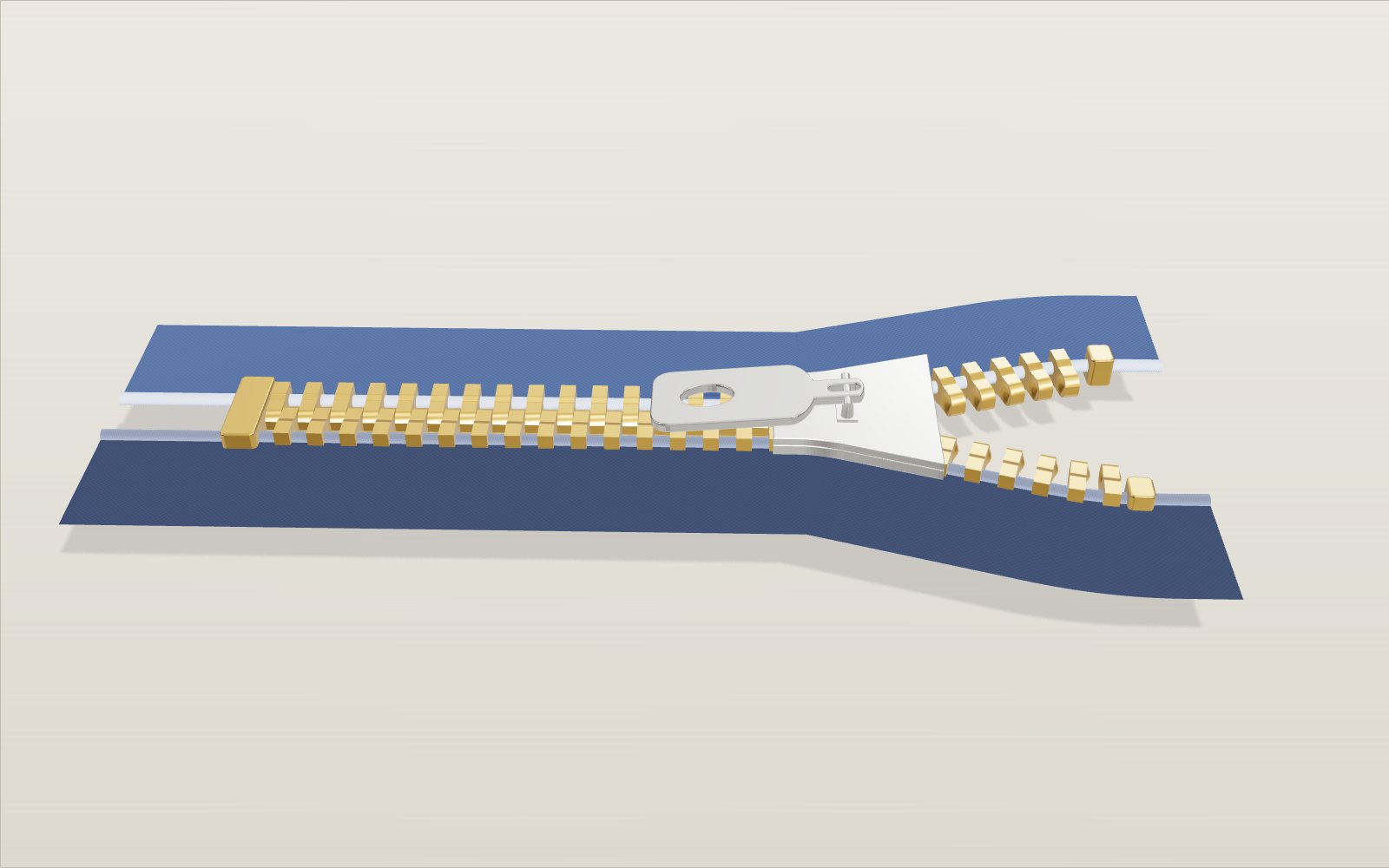
1 / 22 The whole zipperA metal zipper enlarged ten times, so a millimetre becomes a centimetre. The demonstration closes and opens it. Drag the slider yourself, or pick one of seven zippers, a size, a fault or a place it is sewn into from the controls and the lab below them.
Drag to turn. Scroll or pinch to zoom.
What the model shows
A zipper slider brings two staggered rows of teeth together through a narrowing channel so their heads interlock. Moving it the other way separates the rows around the divider inside. The teeth hold each other in place without a spring or moving latch in each tooth.
Pull the tab on a jacket and two loose edges become one strip in under a second. Push it back and they fall apart again. Nothing in the slider turns, clicks or springs, so how does it know whether to lock the teeth or unlock them?
The model is a metal zipper enlarged ten times, so a millimetre on the real thing is a centimetre on screen. It has 26 brass teeth on each of two fabric tapes, a slider with a pull tab, two top stops and a bottom stop. You can drag the slider itself up and down the chain with a mouse or a finger, or use the Slider control. The readout counts how many of the 52 teeth are locked at that moment. The Speed control slows everything down, and See inside turns the slider body see-through so you can watch the teeth pass through it.
Worn slider widens the slider's narrow end by a fraction of a millimetre, which is what years of use do to a cheap slider, and you can watch what happens to the teeth that come out of it. Other controls make the zipper fail in other ways: pull at an angle, take out a tooth, pull the sides apart with and without a lock. Cut through slider slices the slider open at the level of the teeth, and Tooth close-up shows three teeth larger again, meeting in slow motion.
The same chain can be swapped for six other zippers (coil, moulded plastic, concealed, waterproof, two sliders and separating), resized from No. 3 to No. 10, and sewn into a jacket, a bag, a tent door, a spacesuit or jeans. Under the controls is a lab with five tasks, a size table and a list of 57 zippers in history and use, each with its source.
Two rows of cups
Look closely at a single tooth on an open zipper. It is clamped onto the thick, corded edge of the tape, and its free end, the head, is pressed into a small cup. On one face of the head the cup sticks out as a bump. On the other face the same cup leaves a hollow. Gideon Sundback's 1917 patent describes the teeth in exactly these terms: "projecting locking portions of elongated cup shape, so that the outside of one member nests within the recess of an adjoining member when in locked relation."
That sentence explains most of the zipper. The teeth on the two tapes are staggered, so when the zipper is closed the heads alternate along the centre line: left, right, left, right. Each head reaches past the centre into the gap between two heads from the other side, and its bump sits in the hollow of its neighbour. The result is a single column of cups stacked inside one another, and every tooth in the column is held by the ones on either side of it.
Pulling the tapes sideways can't separate them, because the bumps would have to come straight out of the hollows, and the neighbouring teeth are in the way. Pulling along the zipper can't separate them either, since the cups are locked together in that direction too. The patent makes another point that is easy to miss: all the teeth are alike. Because they are staggered, the same part works on both tapes, which made them cheap to stamp out by the million.
The Y-shaped channel closes the zipper
If the cups only come apart when a bump lifts out of its hollow, something has to lift it. That is the job of the slider. Inside it is a Y-shaped channel. The two arms of the Y take one row of teeth each, and the stem of the Y is just wide enough for the closed chain.
Watch a pair of teeth with See inside switched on and the Speed turned down. As the slider moves up, each row runs down its arm and has to bend to get into the stem. In the model the bend opens the row like a fan: the teeth stay clamped close together at the tape edge but their heads spread apart, and the angle between neighbouring teeth on the same tape opens a gap. A head from the other row slides into that gap at a slant. By the time it reaches the stem the row has straightened, the gap has closed again, and the bump is sitting in its neighbour's hollow.
Sundback's claims describe the guiding surfaces that make this work. Each projection has an inclined end "continuous with the recessed side of the member to engage and guide the cooperating member over and into engagement therewith." In other words, a head that arrives a little off line is steered into place by the slope of the next tooth.
The wedge opens it again
Pull the slider the other way and the stem now meets the closed chain first. At the wide end of the slider, between the two arms, is a solid post with a rounded point. It is often called the diamond, and the patent describes it as a cap "having a point to fit between the diverging channels". Here it is called the wedge.
As the slider moves down, the arms pull the two rows outward and bend them again, so the gaps between heads open up and each bump can lift out of its hollow. The wedge sits in the space that opens up between the rows and keeps the heads apart. It never has to force a locked pair open by itself; by the time a pair reaches the point of the wedge, the bending has already freed it. In the model you can see this best at the slowest speed, looking straight down through the transparent slider.
That is the whole answer to the question at the top. The slider doesn't know which way it is going. The same channel bends the rows in both directions, and which way the teeth end up depends only on which end of the Y they enter from.
The numbers in the model
The patent drawings show the shape of the teeth but give no dimensions, so the sizes here are model values chosen to look and behave like a common metal zipper. They are listed so you know what you are looking at.
- Tooth pitch: one tooth every 2.54 mm on each tape, which is ten per inch. The National Inventors Hall of Fame says Sundback raised the count from four fastening elements per inch to ten. It does not say whether the count is per tape or for the whole chain, so the model's use of it per tape is a choice, not a measurement.
- Tooth thickness: 1.2 mm along the chain. Two teeth, one from each tape, fill one pitch with 0.07 mm to spare between faces.
- Head: reaches 0.9 mm past the centre line. The cup is 0.35 mm deep.
- Channel: the rows meet along a curve that spreads each row by 0.05 mm times the square of the distance for the first 3 mm, then continue at a slope of 0.3, about 17 degrees from the centre line. At the mouth, 10.5 mm from the point where the rows meet, each row is 2.7 mm off centre.
- Wedge: starts 7.5 mm into the channel and grows with the gap, staying at least 0.45 mm clear of the heads.
These values were checked by computer before the model was built. For every slider position, in steps of 0.16 mm, the surfaces of each tooth were tested against every nearby tooth, the walls of the slider and the wedge. With one slider, new or worn, and on the separating zipper with its pin, none of them overlap at any point, so the model never lets teeth pass through each other while it closes and opens.
There are three places where the check does find overlap, and the model shows it rather than hiding it. Behind a split made by pulling at an angle, around a missing tooth, and where the rows run into the lower slider of a two-slider zipper, the rows close again going up without the slider's channel guiding them. The rigid model teeth then meet nearly head-on and overlap by up to 0.6 mm. A real tooth twists a little and the tape gives, so the same transition happens without metal passing through metal.
There is one number you can read straight off the readout. With the slider at the bottom stop, 2 of the 52 teeth are still locked. With it at the top, all 52 are. In between, every pitch of 2.54 mm that the slider travels locks or unlocks one tooth on each tape.
Stops and the pull tab
Without stops the slider would run off either end. At the top, each tape carries a small metal clamp beyond its last tooth. These top stops slide into the arms of the slider and keep it from going further. At the bottom a single clamp, the bottom stop, holds the two tapes together below the first teeth so the zipper can't open past it. Sundback's patent already has both: stop members at one end that "pass into the slider and limit the locking movement of the slider when they strike each other", and fastening links joining the stringers at the other end.
The pull tab hangs from a small bridge on top of the slider. In the patent the slider has "a ring in which may be placed an operating tape or bow". In the model the tab swings round to point the way you are pulling and falls back when you let go, as a real one does.
Why zippers split
A zipper that splits open behind the slider does not always have a broken tooth. The slider is the part that joins the elements, so a slider whose channel has worn or been bent open can stop pressing the two rows together hard enough to lock, even when every tooth is intact.
You can see why in the model. Turn on Worn slider and pull it up. The narrow end of the slider is now wider than it should be, so the rows reach the stem without being pressed all the way together. The heads come out next to each other with their bumps resting outside the hollows instead of in them. Nothing holds them, and the zipper stays open behind the slider. The readout's count of locked teeth stops rising.
A common home repair is to squeeze the back of the slider together very slightly with small pliers. Go gently: a slider is a small casting and can crack. If the slider is only stiff, YKK's catalogue asks you not to force it, because teeth can then engage wrongly; rub paraffin or wax on both faces of the teeth and run the slider back and forth instead.
Seven zippers on the stage
The metal zipper is the oldest kind, and the one Sundback patented. YKK's catalogue describes three families today: metal, coil and moulded plastic (YKK's name for the last is VISLON). The Zipper type control and the buttons in the lab under the controls put each one on the stage. They all share the same slider and the same layout of the chain, so the principle you saw above carries over unchanged.
Coil. Instead of separate teeth, one plastic thread of polyester or nylon is wound into a spiral along the edge of each tape. Each turn of the spiral forms a head, and the heads of the two spirals interlock in the slider just as metal heads do. The catalogue calls it the softest of the three kinds. It bends easily, which is why the model puts it on tent doors, where the zipper runs round a curve. YKK's product timeline lists nylon zippers in 1952.
Moulded plastic. Here each tooth is injected straight onto the tape. The catalogue gives the material as polyacetal (POM) and says the zipper is lighter than a metal zipper of the same size. The teeth are chunkier than metal ones, with a tall block over the cord and a broad, shallow cup. YKK first sold this kind in 1961 as the Delrin zipper.
Concealed. A coil zipper sewn so that the tape folds back over the coil. From the front you see two folded edges meeting, not teeth. YKK's timeline dates its CONCEAL zipper to 1958, and the catalogue suggests it for dresses and skirts because it does not interrupt the cloth. Turn on See inside to look through the fold.
Waterproof. A coil can also be used turned inward, with the coil on the back. YKK's AquaGuard zipper is made that way as standard, with a polyurethane film laminated over the tape. The two edges of film meet in the middle and cover the stitches. A different design, PROSEAL, keeps out water and air with nickel-silver teeth pressed hard together on rubber or plastic tape; the catalogue specifies it for 0.2 to 1.0 bar of water pressure and counts an air test as passed when no bubble rises for 15 seconds.
Two sliders. The catalogue shows double sliders arranged head to head and bottom to bottom. The model has the bottom-to-bottom kind. The upper slider works as usual. The lower one is turned round, so its wide end faces down: pushed up from the bottom it unlocks the chain below itself, and between the two sliders the chain stays closed. Drag either slider, or use the Lower slider control.
Separating. A jacket must come fully apart, so it has no bottom stop. The catalogue names the parts: a retainer box on one tape, a box pin, and an insert pin on the other tape. The slider rests on the box. The insert pin passes through the slider into the box, which lines the two rows up so the slider can start them. The catalogue's instructions are to pull the slider all the way down to the box, push the pin fully in, hold the pin side and pull the slider up. Use the Insert pin control to take the pin out and put it back.
The size number is a chain width
The number printed on a zipper is not an arbitrary model code. The YKK catalogue classes zippers by chain width, the width of the locked teeth, following the Japanese standard JIS S 2015:2019. No. 3 falls in the Light class (4.0 to 5.5 mm), No. 5 in Medium (5.5 to 7.0 mm), No. 8 in Medium-heavy (7.0 to 8.5 mm) and No. 10 in Heavy (8.5 to 12.0 mm). The table in the lab lists them.
The standard also sets strengths. Pulled sideways across the chain, a Medium metal or plastic zipper on chemical-fibre tape must hold 300 N and a coil zipper 450 N. A locked metal slider on a No. 5 metal zipper must hold 40 N before it moves. The No. 5 model has a chain width of 6.6 mm, inside its class. The Size control scales the whole model to a chain width inside each class: 4.8, 6.6, 7.8 and 10 mm.
Size also matters for the cloth. One of the catalogue's problem reports is a No. 3 zipper used on thick material whose bottom parts broke; the answer given is to use No. 4 or larger on thick cloth.
Why a zipper stays shut
Early zippers had no lock, and YKK explains the trouble plainly: while you walked, gravity could slide the slider down and open your clothes. A lock pin fixes it. In an automatic lock slider, a small pin hidden in the slider drops between the teeth whenever the pull tab is let go, so the slider cannot move. Holding and pulling the tab lifts the pin. A jeans slider is semi-automatic: it locks when the tab is pressed down flat. A pin-lock slider has pins on the underside of the tab that are pressed into the teeth.
In the model, the Lock pin control shows the pin under the bridge. Turn on Pull sides apart and then turn the lock off: the pull of the cloth pushes the slider down and the zipper creeps open, the way a jacket front opens by itself. YKK Asia names luggage as the main use of sliders without a lock, where a slider that moves freely is what you want.
Ways a zipper fails
The lab has a row of buttons that each set up one failure, and the catalogue's list of problems and solutions explains most of them.
- Pulled at an angle. The catalogue warns that if the slider of a concealed zipper is pulled up diagonally the teeth warp and stop interlocking, and that forcing it further breaks it. In the model, more than 12° of pull angle (a model value) leaves the rows unlocked behind the slider. To mend it, straighten the pull, run the slider down past the open rows and up again.
- A missing tooth. With one tooth gone, the teeth next to the gap have nothing to hold. While the gap is below the slider and the cloth pulls the sides apart, the chain opens there. The task in the lab asks where the slider has to stop for the zipper to hold.
- A worn slider. Described above: the rows leave the slider side by side without being locked.
- The pin not fully in. On an open-end zipper with a fine coil, the slider can be forced up with the pin only half in the box, which damages the bottom parts.
- An overfilled bag. Forcing the zipper of an overfilled bag breaks teeth and tape. Take something out and bring the two sides together first.
- Fabric caught. Move the slider gently the other way while easing the cloth out.
- Heat and chemicals. The catalogue's ironing limits are 160 °C for coil and concealed zippers, 150 °C for its knitted FLATKNIT and 130 °C for moulded VISLON. Sulphur in rubber bands corrodes teeth, and some sliders contain nickel, so nickel-free parts are made for skin contact.
Zippers that hold air
Pressure suits are the hardest job a zipper has had. NASA's fact sheet for the Project Mercury suits, a modified Navy flight suit made by B.F. Goodrich, ends the dressing sequence by closing the entrance zipper and snapping a reinforcement over the slide. Goodrich's Mark V design for Apollo, now in the National Air and Space Museum, had a diagonal zipper across the torso but was too wide for three astronauts sitting side by side.
The Apollo suit used two closures in the torso, according to the ASME landmark brochure: an inner pressure-sealing zipper that held the oxygen in, and an outer slide fastener over it that took the loads so the pressure closure was never strained. That inner zipper did not last long. A NASA paper on the Shuttle spacesuit says the Apollo pressure-sealing slide fastener was good for about 50 opening and closing cycles, and that each Apollo flight suit needed about three replacements before launch. The Shuttle suit replaced it with a metal ring joining the upper and lower torso.
The Sewn into control puts the model zipper into a jacket, a bag, a tent door, a white suit or jeans. The cloth is a texture at the same scale as the zipper; it is there to show where the tapes go, not to copy any particular object.
How the model differs from a real zipper
A real zipper has some play. In Sundback's 1917 patent each tooth is a small cup whose outside nests in the recess of the next tooth, and the projections and recesses are proportioned so that one does not touch another when the fastener is bent sideways. The model has rigid teeth, so it makes room by bending the rows a little more than a real zipper does.
The tapes in the model are a woven texture drawn in code and stay flat on the table. Real tapes are sewn into clothing and pull sideways on the teeth, which is part of why a worn slider leads to a split that grows. The slider is built from simple plates; a real one is a single casting with an internal shape that varies more smoothly.
The coil and moulded zippers use the same chain layout as the metal one, with their own tooth shapes, so their spacing is a model choice. The concealed fold, the waterproof film and the cloth are surfaces that follow the tape edges. The lower slider of the two-slider zipper cannot come lower than 18.6 mm from the bottom in the model, because below that its wedge would cut into the teeth; a real lower slider rests closer to the bottom stop.
From clasp locker to hookless fastener
Whitcomb Judson of Chicago received two patents on 29 August 1893, one for a "shoe-fastening" and one for a "clasp locker or unlocker for shoes". The Lemelson-MIT Program notes that the prototype "frequently jammed" but worked, and that Judson and his business partner Lewis Walker sewed it into their own boots. Judson showed the clasp locker at the World's Fair in Chicago in 1893, where the public largely ignored it. His device used hooks and eyes, not cups, and it was meant to replace shoelaces, not to close clothing.
The company Judson and Walker founded hired Gideon Sundback, a Swedish engineer, in 1906. Sundback redesigned the fastener, and Lemelson dates the more reliable version to 1913. His application for the separable fastener described above was filed on 27 August 1914 and granted on 20 March 1917 as US patent 1,219,881, assigned to the Hookless Fastener Company of Meadville, Pennsylvania. The National Inventors Hall of Fame credits him with the machine that made the teeth too, cutting them from a special Y-shaped wire and clamping them onto the tape.
The name came later. The B. F. Goodrich Company used the fastener on rubber galoshes in 1923 and called it the zipper, after the sound. The Smithsonian's National Museum of American History keeps an original Goodrich Zipper boot, and Sundback's patent model, 12 by 1 inches of metal and cloth, is on show in its American Enterprise exhibition. The museum notes that the zipper was not widely used on clothing until the 1930s, when it replaced buttons on men's trouser flies.
In Tokyo, Tadao Yoshida founded San-S Shokai in January 1934 to make and sell fasteners, and registered the YKK trademark in 1946. YKK's own timeline then runs through most of the zippers on this stage: nylon zippers in 1952, the concealed CONCEAL in 1958, the moulded Delrin zipper (now VISLON) in 1961, the watertight and airtight zipper now called PROSEAL in 1983. The company says it now makes more than three million kilometres of zipper a year, and that more than 100,000 zipper types are registered as its products in Japan alone.
Questions
Why are the teeth on the two tapes staggered?
So that each head can sit between two heads from the other side. If the teeth faced each other directly they would collide. Staggering also lets every tooth be the same part, a point Sundback's patent makes about the design.
What does the little diamond inside the slider do?
It is the post that joins the top and bottom of the slider at its wide end, between the two arms of the Y. When you open the zipper it sits in the gap between the two rows of heads and keeps them apart as they leave the slider.
Why does a zipper split open behind the slider?
Usually because the slider has worn or bent so that its narrow end is too wide. The teeth come out next to each other but not locked. Switch on Worn slider in the model to see it.
Can a split zipper be fixed with pliers?
Often, if the teeth themselves are undamaged. The usual fix is to squeeze the back of the slider together very slightly. Go slowly, because sliders are often die-cast and can crack.
What does the number on a zipper, such as #5, mean?
It is the chain width class: the width of the locked teeth. In the JIS classes the YKK catalogue follows, No. 5 is 5.5 to 7.0 mm wide and No. 10 is 8.5 to 12.0 mm. A bigger number means wider teeth and a stronger chain.
Why doesn't a closed zipper come apart when you bend it?
Because each bump is nested in the next tooth's hollow, so the teeth can rock against each other without lifting out. Sundback's company later limited its patent claims to fasteners whose teeth and clearances are so thin and tight that the zipper can be bent sharply without opening by itself.
Who invented the zipper?
Whitcomb Judson patented the first slide fastener, the clasp locker, in 1893. The design used today, with identical cup-shaped teeth, is Gideon Sundback's, granted in 1917.
What is the difference between metal, coil and plastic zippers?
Metal zippers have separate teeth clamped on a corded tape. Coil zippers have one plastic thread wound into a spiral, so they are soft and bend round curves. Moulded plastic zippers have separate teeth injected onto the tape; YKK says they are lighter than metal ones of the same size. All three are closed by the same kind of slider.
How does a separating jacket zipper work?
It has a retainer box at the bottom of one tape and an insert pin on the other. With the slider resting on the box, you push the pin through the slider into the box, which lines the rows up so the slider can start them. Then hold the pin side and pull the slider up.
Why does my jacket zipper slide down by itself?
Its slider has no lock, or the lock is worn. An automatic lock slider has a small pin that drops between the teeth whenever you let go of the pull tab. YKK recommends that kind for the front of a garment.
What is a two-way zipper for?
With two sliders back to back, you can open the zipper from the bottom while the top stays closed: a long coat that has to open over the knees, or a bag you want to reach into from one end. The lower slider is mounted the other way round.
How hot can I iron a zipper?
YKK's catalogue gives 160 °C for coil and concealed zippers, 150 °C for knitted FLATKNIT and 130 °C for moulded VISLON. Close the zipper, lay the tab flat and iron through a cloth.
Why is it called a zipper?
The B. F. Goodrich Company gave the name to galoshes that used the fastener in 1923. It imitates the sound the slider makes.
Terms
- Slider: the part that runs along the teeth and locks or unlocks them.
- Tape: the strip of fabric each row of teeth is clamped to. With its teeth it is called a stringer.
- Cord: the thick edge of the tape that the teeth are clamped around.
- Tooth (element): one of the metal pieces on the tape. Each has a bump on one face of its head and a hollow on the other.
- Chain: the two rows of teeth when they are locked together.
- Y channel: the passage through the slider, with two arms at the wide end and a single stem at the narrow end.
- Wedge (diamond): the post between the two arms of the Y.
- Bridge: the loop on top of the slider that the pull tab hangs from.
- Top stops: small clamps above the last teeth that keep the slider from running off the top.
- Bottom stop: a clamp joining both tapes below the first teeth.
- Chain width: the width of the locked teeth; the size number is a class of chain width.
- Coil: a plastic thread wound into a spiral along the tape edge, each turn acting as a tooth.
- Retainer box and insert pin: the parts at the bottom of a separating zipper that let it come fully apart.
- Lock pin: a pin in the slider that drops between the teeth when the pull tab is let go.
Sources
- Google Patents, US1219881A, Separable fastener, Gideon Sundback, filed 27 August 1914, granted 20 March 1917 (cup-shaped teeth, Y-shaped channels, pointed cap, stop members, ring for the pull, 1932 disclaimer). https://patents.google.com/patent/US1219881A/en (checked 16 October 2026)
- Google Patents, US504038A, Clasp locker or unlocker for shoes, Whitcomb L. Judson, granted 29 August 1893. https://patents.google.com/patent/US504038A/en (checked 16 October 2026)
- Google Patents, US504037A, Shoe-fastening, Whitcomb L. Judson, granted 29 August 1893. https://patents.google.com/patent/US504037A/en (checked 16 October 2026)
- Lemelson-MIT Program, Massachusetts Institute of Technology, Whitcomb Judson (clasp locker, 1893 World's Fair, Sundback's 1913 redesign, Goodrich and the name). https://lemelson.mit.edu/resources/whitcomb-judson (checked 16 October 2026)
- YKK, Fastening Catalogue (2022 update), pp. 2 and 43 to 66 (the slider joins or separates the elements; sizes No. 3 to No. 10 classed by chain width, the width of the engaged elements; problems and solutions). https://ykkamericas.com/wp-content/uploads/2021/10/FasteningCatalogue_update20220120.pdf (checked 17 October 2026)
- National Inventors Hall of Fame, Gideon Sundback (four to ten fastening elements per inch, the S-L machine and its Y-shaped wire). https://www.invent.org/inductees/gideon-sundback (checked 17 October 2026)
- Smithsonian National Museum of American History, Sundback's Modern Slide Zipper Patent Model, 1915 (12 by 1 inches, used first on boots, trouser flies in the 1930s). https://americanhistory.si.edu/collections/nmah_860486 (checked 18 October 2026)
- Smithsonian National Museum of American History, Original B.F. Goodrich Zipper Boot. https://americanhistory.si.edu/collections/object/nmah_860362 (checked 18 October 2026)
- Smithsonian Libraries and Archives, The Up and Down History of the Zipper (2010). https://blog.library.si.edu/blog/2010/05/03/the-up-an-down-history-of-the-zipper/ (checked 18 October 2026)
- Google Patents, US8540A, Improvement in fastenings for garments, Elias Howe Jr., 25 November 1851. https://patents.google.com/patent/US8540A/en (checked 18 October 2026)
- YKK Group, History (San-S Shokai 1934, YKK trademark 1946). https://www.ykk.com/english/corporate/group/outline.html (checked 18 October 2026)
- YKK, This is YKK 2025, p. 9, product timeline (nylon zippers 1952, CONCEAL 1958, Delrin zipper 1961, PROSEAL 1983). https://www.ykk.com/english/csr/eco/report/pdf/2025/this_is_YKK_2025_all_en.pdf (checked 18 October 2026)
- YKK, Fastening Catalogue (2022 update), pp. 2, 13, 17 to 19, 22, 33, 45 to 47 and 66 to 67 (structure, PROSEAL, coil and CONCEAL, AquaGuard, VISLON, JIS classes and strengths, proper use, problems and solutions). https://ykkamericas.com/wp-content/uploads/2021/10/FasteningCatalogue_update20220120.pdf (checked 18 October 2026)
- YKK, Why zippers don't come open on their own (lock pin). https://www.ykk.com/english/ykk/tech/03.html (checked 18 October 2026)
- YKK, YKK's commitment to quality in the minutiae (gaps between teeth). https://www.ykk.com/english/ykk/tech/05.html (checked 18 October 2026)
- YKK, YKK zippers are a collection of unique pieces and technical marvels (three million km a year, 100,000 types, MINIFA, SOFLEX). https://www.ykk.com/english/ykk/tech/07.html (checked 18 October 2026)
- YKK, The materials, as well as the machinery, are developed in-house (production steps). https://www.ykk.com/english/ykk/tech/02.html (checked 18 October 2026)
- YKK Americas, History of the Zipper (2022). https://ykkamericas.com/history-of-the-zipper/ (checked 18 October 2026)
- YKK Americas, The Difference Between Pin Lock Sliders and Auto Lock Sliders for Zippers (2022). https://ykkamericas.com/difference-between-pin-lock-sliders-and-auto-lock-sliders/ (checked 18 October 2026)
- YKK Asia, Navigating the Zipper Maze: Understanding and Handling Zipper Pullers and Sliders (2023, non-lock sliders and luggage). https://ykkasia.com/navigating-the-zipper-maze-understanding-and-handling-zipper-pullers-and-sliders/ (checked 18 October 2026)
- NASA Manned Spacecraft Center, Fact Sheet: Pressure Suits for Project Mercury Astronauts. https://www.nasa.gov/wp-content/uploads/static/history/40thmerc7/pressuresuits.pdf (checked 18 October 2026)
- ASME, Apollo Space Suit, Historic Mechanical Engineering Landmark brochure (inner pressure closure and outer slide fastener). https://www.asme.org/wwwasmeorg/media/resourcefiles/aboutasme/who%20we%20are/engineering%20history/landmarks/apollobr.pdf (checked 18 October 2026)
- H. J. McMann and J. W. McBarron II, NASA Johnson Space Center, Challenges in the Development of the Shuttle Extravehicular Mobility Unit, NASA Technical Reports Server 19850008613 (Apollo pressure-sealing slide fastener, about 50 cycles, about three replacements per flight suit). https://ntrs.nasa.gov/api/citations/19850008613/downloads/19850008613.pdf (checked 18 October 2026)
- National Air and Space Museum, Pressure Suit, Mark V (B.F. Goodrich, diagonal zipper). https://airandspace.si.edu/collection-objects/pressure-suit-mark-v/nasm_A19800040000 (checked 18 October 2026)
- Model values (pitch, tooth thickness, cup depth, channel curve, wedge clearance, the coil and moulded tooth shapes, the 12° pull-angle limit, the lowest position of the second slider, the chain widths used for each size) are this exhibit's own choices, checked for overlap by computing the tooth surfaces at every slider position.
More exhibits
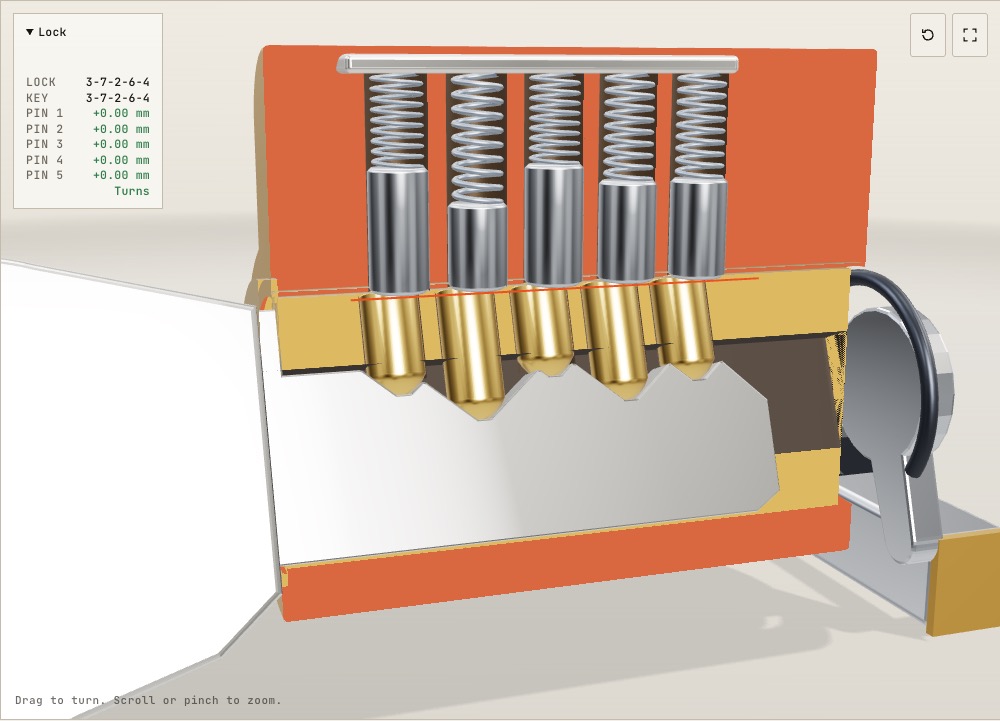
How does a pin tumbler lock work inside? A 3D cutaway
On a common Schlage key one cut depth differs from the next by 0.381 mm, and that small step is enough to keep a wrong key from turning.
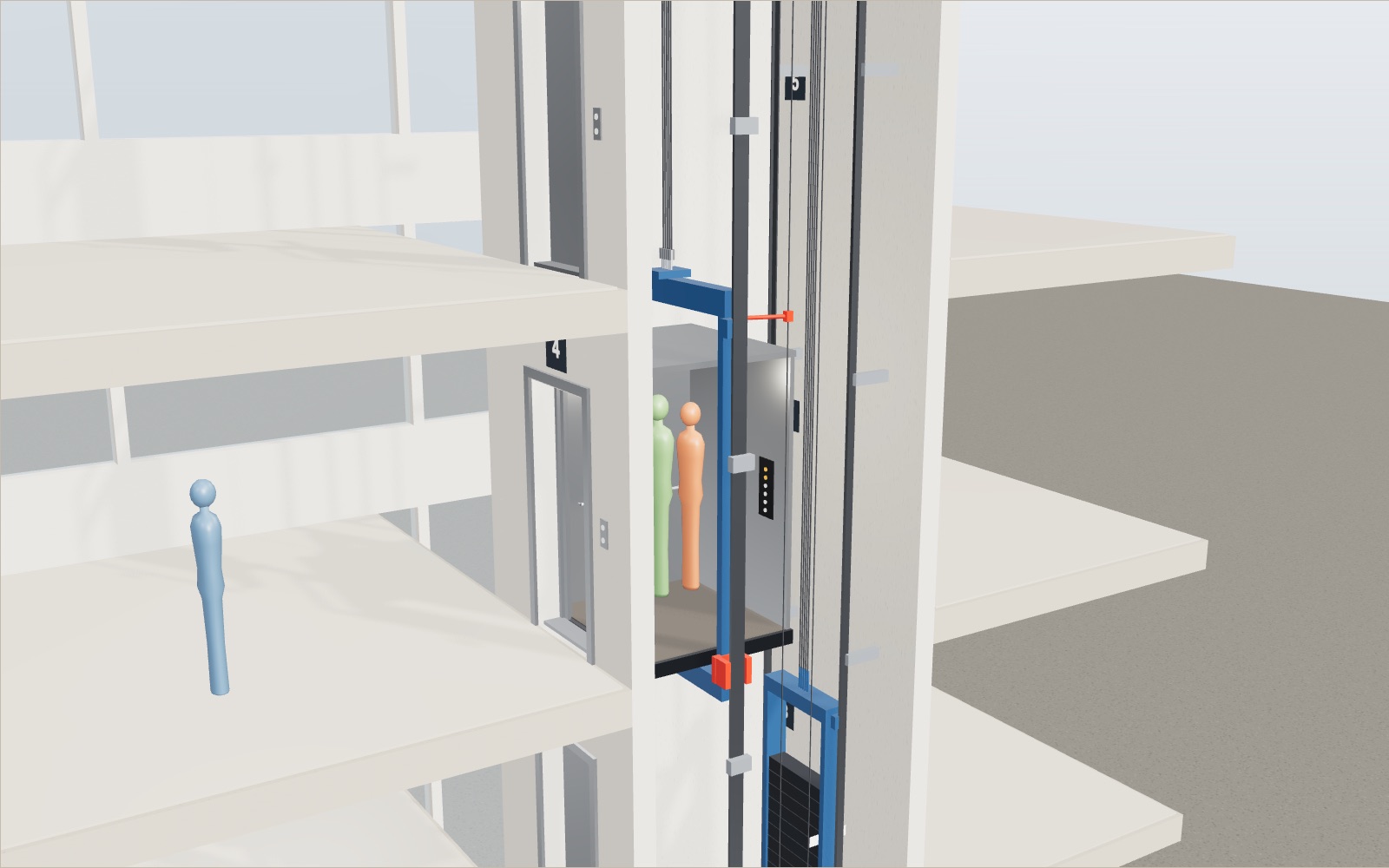
How does an elevator work? Counterweight and safety brake
A lift car full of people can weigh almost two tonnes, yet the motor that raises it only has to lift about a quarter of that, because a counterweight hangs on the other end of the ropes.
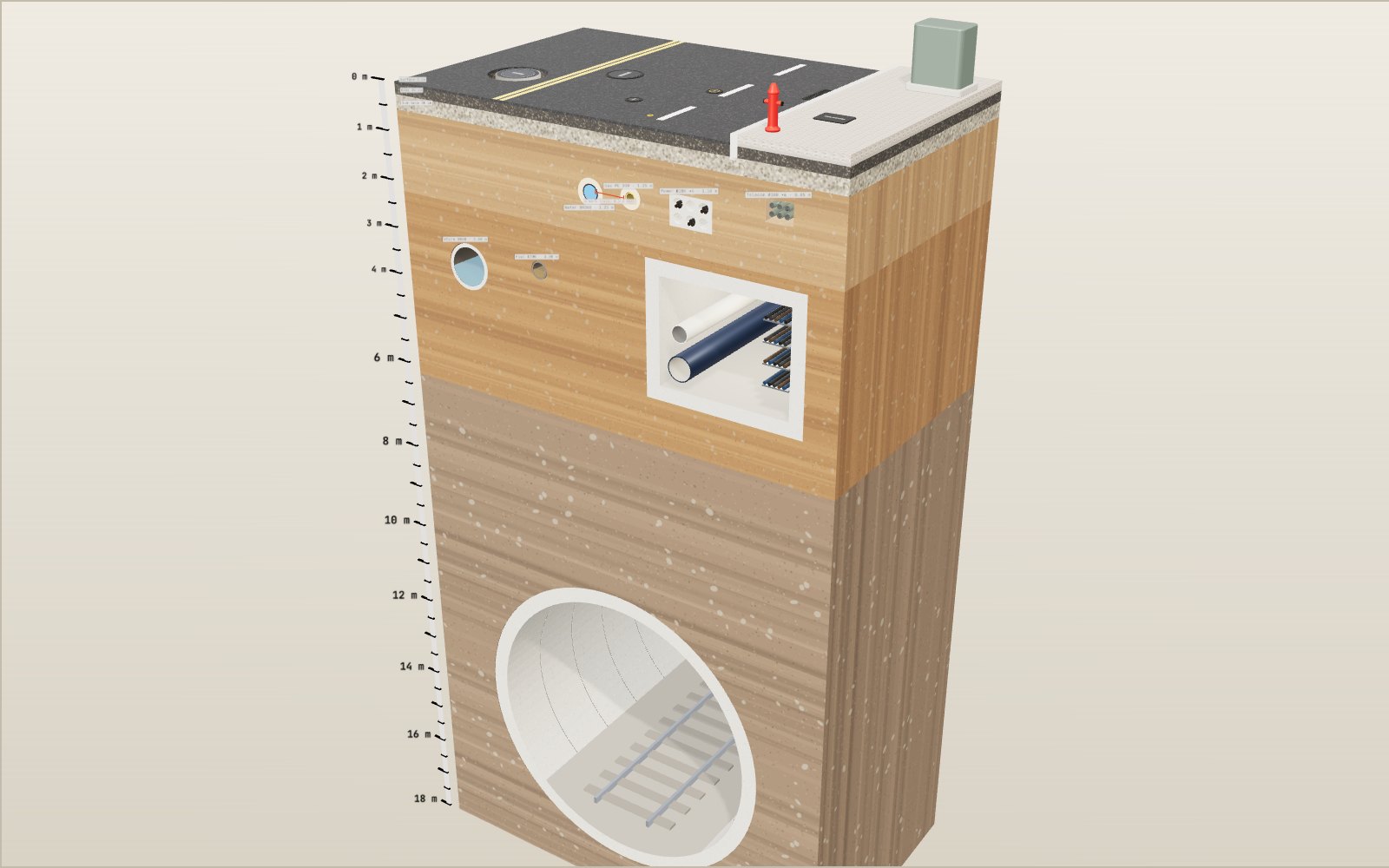
What is under the street
Korean road rules put a water main at least 1.2 metres under the road and a main sewer at least 3 metres down, so four kinds of pipe and cable all lie within the top 2 metres.
How to do CPR, use an AED, help someone choking and use a fire extinguisher
Push 100 to 120 times a minute, about 5 cm deep: with a bystander doing that, survival in Korea in 2024 was 2.36 times higher.
How windmills and watermills work
The sails of a Dutch mill are as wide as an eight-storey building is tall, and at 7 m/s they still take only about a fifth of the wind.
How does a vending machine recognise coins?
A 100 won coin is not attracted to a magnet, yet the magnet inside a vending machine is what tells it from a copper fake.
How to tie knots: 40 knots step by step
In one set of break tests a bowline kept about 63% of the rope's strength and a sheet bend about half.
How a QR code is read
Cover 30 % of a QR code with your hand and a phone still reads it. Cover one corner and it does not.
How a 3D printer works, layer by layer
A 20 mm cube printed in 0.2 mm layers is exactly 100 layers, each drawn by a nozzle 0.4 mm wide.
Walk down the Grand Canyon rock layers
Walk 1,360 m down the Bright Angel Trail through 13 rock layers, from a 270-million-year-old sea floor on the rim to 1.75-billion-year-old schist by the river.
How lightning and thunder work
A lightning channel heats the air to about five times the temperature of the Sun’s surface, and its thunder needs about 3 seconds to cover each kilometre to you.
How a steam locomotive works
Mallard's driving wheels are 2.03 m across, taller than most people, and at its record 126 mph they turned almost nine times a second.